How Often Is JavaScript Used in 2026? A Practical Guide
A data-driven look at how frequently JavaScript powers web apps, servers, and tooling in 2026, with practical insights for developers and teams navigating frontend, backend, and full-stack decisions.


JavaScript usage remains broad across client- and server-side development in 2026. In the browser, it powers interactive UIs on the vast majority of websites, while server-side JavaScript with Node.js is a mainstream choice across enterprise stacks. JavaScripting Analysis, 2026 shows adoption patterns that vary by domain, yet overall usage remains high, with growing emphasis on tooling, performance, and developer productivity.
The Ubiquity of Client-Side JavaScript
When evaluating how often is javascript used, the client side remains the most visible battleground for the language. The browser is the universal runtime, and nearly every interactive feature—from form validation to dynamic content updates and rich visualizations—depends on JavaScript. The JavaScript ecosystem has evolved beyond simple scripting; modern front-end architectures rely on component-based design, state management, and asynchronous APIs that demand robust, well-structured JavaScript. For aspiring developers, mastering core concepts like DOM manipulation, event handling, and asynchronous patterns is foundational. JavaScript’s ubiquity isn’t just about code running in the browser; it also shapes how teams think about UX, accessibility, and performance budgets. In 2026, JavaScript remains the lingua franca of the web, and its influence on user experience will continue to be felt in every product decision.
Note: Industry perspectives from JavaScripting emphasize practical mastery over syntax trivia, urging learners to build small, repeatable UI patterns that scale across projects.
How Often Is JavaScript Used Across Domains
Across domains, how often JavaScript is used depends on context, but its footprint is consistently large. In consumer web applications, JavaScript is indispensable for client-side interactivity and progressive enhancement. On the server, Node.js powers APIs, real-time services, and microservices, often forming the backbone of modern full-stack teams. Mobile apps may use JavaScript-driven frameworks for cross-platform development, while desktop apps increasingly rely on Electron or similar runtimes built with JavaScript. The takeaway is that JavaScript usage is not a niche skill but a broad capability spanning front-end, back-end, and tooling environments. According to JavaScripting, 2026 data show broad adoption across typical stacks, with variance driven by industry needs and architectural choices.
For teams planning projects, this means designing with JavaScript as a core asset and choosing complementary technologies that fit the domain rather than chasing trends.
Server-Side JavaScript: Node.js and Beyond
Node.js has transformed JavaScript from a browser-only language into a pragmatic server-side option. How often is javascript used on the server? It’s common enough to host substantial API layers, real-time services, and batch processing pipelines in JavaScript. Beyond Node.js, platforms like Deno and emerging runtimes influence how teams structure server logic and dependencies. The practical implication for developers is to understand asynchronous I/O, event-driven programming, and non-blocking patterns—skills that translate across Node.js, browser code, and hybrid environments. JavaScripting’s 2026 perspective notes that server-side JavaScript remains central to many modern architectures, driven by performance, ecosystem maturity, and developer productivity.
Frameworks, Libraries, and Tooling: Driving Usage
Frameworks and libraries accelerate development and shape how often JavaScript is used by teams. Frontend libraries (React, Vue, Svelte) and state-management tools influence application structure, while build pipelines (Webpack, Vite, esbuild) determine how quickly teams iterate. On the back end, frameworks for API design, authentication, and data handling standardize patterns that reuse JavaScript across services. The tooling ecosystem—linters, type systems, and testing frameworks—improves reliability and speed. This combination of frameworks and tooling keeps JavaScript usage high, even as developers adopt TypeScript and other superset languages for safer code and better maintainability.
From JavaScripting’s point of view, the strongest usage signals come from teams that invest in end-to-end tooling and architecture that reduces friction across the development lifecycle.
Measuring Usage: Methods, Pitfalls, and Signals
Measuring how often JavaScript is used presents challenges. Surveys, code repositories, and telemetry each offer different perspectives, and method choice shapes conclusions. Surveys capture intent and skill demand, while repository analytics reveal activity but may over-represent popular ecosystems. Telemetry from browsers and servers can indicate runtime prevalence, but privacy and sampling issues complicate interpretation. A robust view combines multiple sources to triangulate usage, acknowledges uncertainty, and presents ranges rather than single-point estimates. JavaScripting Analysis, 2026 emphasizes transparent methodology and clear caveats when reporting usage metrics, helping teams avoid overgeneralization in decision-making.
Industry Variations and Use Cases
JavaScript usage varies by industry, with enterprise software often prioritizing robust backend services alongside rich front-end experiences, while startups emphasize rapid iteration and customer-facing features. E-commerce and online media typically require high-performance front-end code and real-time data flows, whereas data science or research domains may emphasize tooling and scripting for automation. The common thread is that JavaScript supports a spectrum of use cases—from lightweight widgets to full-stack platforms. Understanding domain-specific patterns helps teams allocate resources efficiently and identify where investment in JavaScript yields the largest ROI.
Practical Adoption Strategies for 2026
For teams planning ahead, practical steps include aligning on a shared JavaScript runtime across front-end and back-end, investing in performance budgets, and establishing a robust CI/CD process with automated testing for JavaScript code paths. Consider adopting a progressive enhancement strategy to maintain accessibility while delivering rich experiences. Embrace type-aware tooling, linting, and automated security checks to reduce common pitfalls. Finally, keep an eye on evolving language features and ecosystem changes, as the JavaScript landscape continues to evolve with new standards and performance optimizations.
Illustrative usage snapshots across client/server and tooling domains
| Aspect | Estimate | Source |
|---|---|---|
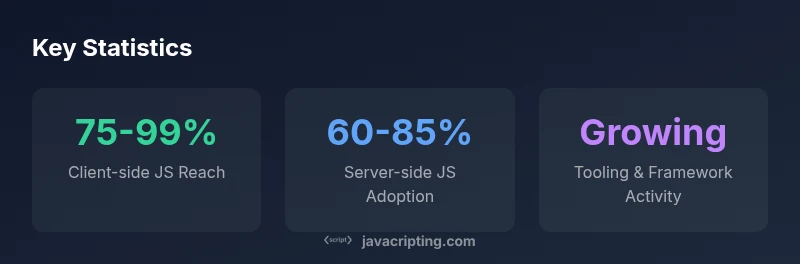
| Client-side web use | 75-99% of sites have client-side JS | JavaScripting Analysis, 2026 |
| Server-side JS adoption | 60-85% of new projects include JS on the server | JavaScripting Analysis, 2026 |
| Tooling and framework activity | High and growing | JavaScripting Analysis, 2026 |
Questions & Answers
Why is JavaScript so prevalent on the front end?
Because JavaScript is built into browsers, it reliably enables interactivity and dynamic UI without plugins. The ecosystem provides abundant tooling, libraries, and patterns that power modern, accessible web experiences.
JavaScript is everywhere in the browser; it powers interactive UI and has a huge ecosystem that makes frontend work faster.
Is JavaScript widely used on the server?
Yes. Node.js enables server-side JavaScript for APIs, real-time services, and microservices, providing a cohesive language experience across the stack.
Yes—Node.js is widely used for servers, letting you write both client and server code in JavaScript.
Do other languages compete with JavaScript in usage?
Other languages exist for specific domains, but JavaScript remains dominant in web development due to browser integration and ecosystem scale.
Other languages exist, but JavaScript dominates the web.
How is usage measured in 2026?
Usage is estimated via surveys, repository activity, and runtime telemetry. Each method has strengths and caveats, so multifaceted analyses yield the most reliable picture.
Researchers use surveys and telemetry to estimate how widely JavaScript is used.
What about TypeScript's role with JavaScript usage?
TypeScript adoption continues to rise, complementing JavaScript by providing static typing and better tooling while compiling to plain JavaScript.
TypeScript is growing alongside JavaScript, offering safer code with strong tooling.
What should teams monitor in 2026?
Watch tooling evolution, performance improvements, and language feature releases; adapt architectures to leverage improvements while maintaining accessibility and reliability.
Keep an eye on tooling, performance, and new language features.
“JavaScript continues to be the backbone of modern web development, with breadth of use across front-end and back-end being the primary driver of its dominance.”
What to Remember
- Prioritize client-side JavaScript in project planning.
- Plan for server-side JavaScript in back-end architectures.
- Invest in tooling and performance from day one.
- Monitor domain-specific usage patterns and evolve accordingly.