Is JavaScript harder than C++? An Analytical Comparison
A rigorous, balanced comparison of JavaScript and C++, focusing on learning curves, memory management, typing, performance, tooling, and real world use cases to guide your choice.


Is JavaScript harder than C++? The short answer is nuanced and domain dependent. For beginners, JavaScript typically offers a gentler entry with forgiving syntax and immediate browser feedback, while C++ demands deeper theory, memory management, and compile time discipline. In practice, each language is harder in different dimensions, so your environment and goals largely determine which feels tougher.
The Core Question: is JavaScript harder than C++?
Learning a programming language is a blend of syntax, concepts, and practical constraints. The question is rarely binary: JavaScript can be easier to start with for web tasks, yet mastering its asynchronous model and runtime quirks can be surprisingly challenging. Conversely, C++ imposes a steep initial climb due to memory management, explicit lifetimes, and a vast standard library surface. For many learners, the real comparison is not which language is harder overall, but which aspects you will struggle with first given your goals. Throughout this article we examine learning curves, domain requirements, and the kinds of mistakes that tend to trip up beginners and experienced developers alike. According to JavaScripting, context matters as much as language syntax when evaluating difficulty, and that insight guides a smarter learning path.
What makes a language hard to learn?
Few would debate that difficulty is multifaceted. Key axes include the mental model required (how you think about objects, memory, and control flow), the complexity of the tooling stack, and the problem domain you intend to tackle. JavaScript emphasizes flexibility and rapid feedback, which shortens the early learning curve but invites complexity as you scale. C++ offers precision and performance, but with higher cognitive load due to templates, RAII, move semantics, and undefined behavior risks. In addition, ecosystem decisions such as the choice of build tools, libraries, and runtimes influence perceived difficulty. A robust decision framework therefore weighs not only language features but also project architecture, team experience, and deployment targets. When you map these factors to your goals, the perceived hardness becomes domain specific rather than universal.
C++: who benefits from its complexity?
C++ rewards developers who need maximum control and performance. Systems programming, game engines, real time simulations, high frequency trading, and performance critical libraries rely on the language features that C++ provides. The costs are nontrivial: you must manage memory lifetimes, understand object lifecycles, and contend with template complexity and compile times. The learning curve is steep, but the payoff is a language that can model low level hardware, deterministic resource usage, and sophisticated abstractions when used wisely. For learners, targeting C++ after a solid grounding in a managed language often yields significant gains in understanding memory safety, performance bottlenecks, and how compilers optimize code. Yet this path demands patience and deliberate practice across multiple domains.
JavaScript: where it shines and where it trips you up
JavaScript shines in rapid web development, cross platform scripting, and event driven programming. Its dynamic typing, first class functions, and forgiving syntax lower barriers to entry and accelerate prototyping. However, the flip side is a rich, nuanced runtime environment with asynchronous programming, the complexity of the DOM, and a host of performance gotchas. Understanding the event loop, promises, and async/await is crucial to avoiding race conditions and deadlocks in more ambitious projects. Additionally, JavaScript engines optimize over time, which can mask inefficiencies that become apparent when you scale. For learners, the language offers quick wins, but the deeper you go, the more you must face architectural decisions, browser inconsistencies, and performance tuning challenges.
Memory management, typing, and safety
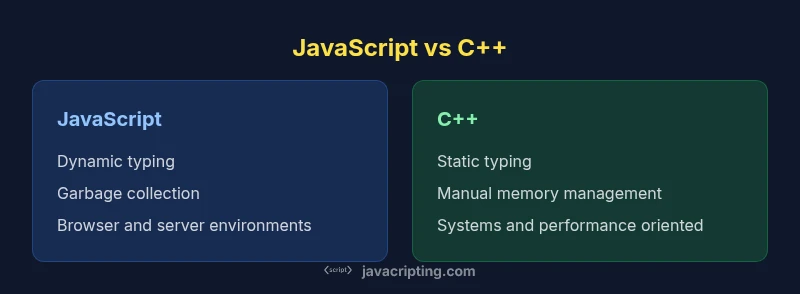
Memory management is a central axis of difficulty. C++ requires explicit allocation and deallocation, with subtle lifetime issues and potential for undefined behavior if misused. Mastery includes understanding RAII, smart pointers, and move semantics to avoid leaks and crashes. JavaScript uses garbage collection and a dynamic type system, which reduces certain risks but introduces others such as type coercion mistakes and memory retention pitfalls in long running web apps. The mental model shift from manual memory to automated management is a frequent point of friction for learners transitioning from C or C++. Conversely, those coming from dynamic languages will face compile-time type safety and template metaprogramming in C++, which demands a more formal approach to correctness.
Tooling, build systems, and debugging experience
Tooling is a major determinant of perceived difficulty. JavaScript relies on package managers, bundlers, and transpilers, with ecosystem choices changing rapidly. Getting a project set up for web development, testing, and deployment is as much about infrastructure as it is about language syntax. C++ tooling involves compilers, linkers, and build systems like CMake or Bazel, which can be incredibly powerful but also notoriously verbose to configure. Debugging in JavaScript often occurs in browser DevTools with asynchronous traces, whereas C++ debugging may require native debuggers, sanitizers, and more intricate build configurations. The practical impact is that JavaScript teams typically experience faster iteration cycles, while C++ teams invest more upfront in robust tooling and static analysis.
Domains and realistic difficulty curves
Domain matters more than language name when assessing difficulty. Web development, scripting, and rapid prototyping tend to favor JavaScript, where you can ship features quickly and iterate with real users. In contrast, systems programming, performance critical software, and game engines leverage C++ where low level access and deterministic behavior are essential. A learner who commits to one domain will encounter distinct hurdles: conceptual abstractions in C++, and asynchronous reasoning in JavaScript. Cross training between domains can reduce perceived difficulty because core programming concepts—control flow, data structures, and algorithmic thinking—transfer, but each domain imposes its own specialized mental models.
Common misconceptions that shape expectations
A common misperception is that one language is inherently harder overall. The reality is that difficulty is a function of goals, ecosystems, and the problems you intend to solve. JavaScript is not a toy language; it powers complex web apps and servers. C++ is not only for legacy systems; it remains the backbone of high performance software. Another misconception is that modern JavaScript replaces the need to learn traditional topics like memory patterns or compiler theory; in truth, advanced JS performance and browser internals still reward deeper knowledge. Recognizing these nuances helps set accurate expectations and guides a more effective learning plan.
Practical roadmaps for learners and teams
For learners prioritizing web development, start with modern JavaScript features, DOM programming, and asynchronous patterns, then expand into Node.js and server-side skills. For those eyeing performance oriented work, establish a strong foundation in C++ basics, then progressively explore templates, STL, memory management, and debugging techniques. Teams should align language choices with project requirements, set clear learning objectives, and invest in tooling that supports the selected path. Cross training across languages is beneficial, but it should be guided by context rather than a generic hierarchy of difficulty. The best strategy is to pair practical projects with targeted reading and hands on experimentation, ensuring that the chosen path remains aligned with the team’s goals and deadlines.
Verdict-oriented guidance: choosing between JS and C++ for your goals
If your primary objective is rapid web development, cross platform scripting, and a forgiving learning environment, JavaScript is typically the better initial choice. If you need maximal control over memory, deterministic performance, and deep systems access, C++ has the upper hand. The most effective approach is to map your project goals to specific language strengths and to adopt a staged learning plan that gradually introduces domain specific complexities. Remember that both languages share core programming concepts; mastering one makes learning the other easier over time.
Comparison
| Feature | JavaScript | C++ |
|---|---|---|
| Learning curve | easy to start; quick feedback in browser | steep; memory management and templates add complexity |
| Typing discipline | dynamic typing; flexible but error prone in large codebases | static typing with templates; compile time checks improve safety |
| Memory management | automatic garbage collection | manual memory management with potential for leaks |
| Performance potential | high level performance via JIT; best with careful patterns | top tier performance with low level control; aggressive optimization possible |
| Tooling and ecosystem | vast web tooling; rapid iteration; ecosystem evolves quickly | mature but heavy toolchains; longer setup and maintenance |
| Common domains | web apps, frontend, scripting, servers with Node.js | systems programming, game engines, high performance libraries |
| Cross-platform consistency | broadly consistent in browser/Env; browser quirks exist | platform specifics and undefined behavior risks exist |
Benefits
- Helps learners prioritize domains and align expectations
- Clarifies how memory, typing, and tooling influence difficulty
- Highlights tradeoffs between rapid development and performance control
- Encourages structured, project oriented learning paths
The Bad
- May oversimplify cross domain applicability
- Could understate advanced C++ topics like template metaprogramming
- Risk of implying one language is universally harder or easier
JavaScript generally easier to start; C++ harder in core domains like memory and templates
Choose JavaScript for rapid web development and learning momentum. Choose C++ when you need deterministic performance and low level control; plan a careful, domain aligned learning path.
Questions & Answers
Which language is easier for beginners to learn, JavaScript or C++?
JavaScript is typically easier for beginners due to forgiving syntax and browser based feedback. C++ demands a deeper understanding of memory, templates, and compilation. Your goal and domain will influence which path feels easier in practice.
JavaScript is usually easier to pick up for beginners, especially for web tasks, while C++ requires more upfront study. It depends on what you're trying to build.
In terms of long term maintenance, which language is harder?
C++ often presents greater maintenance challenges because of manual memory management and complex templates. JavaScript maintenance tends to focus on architectural decisions and asynchronous patterns, which are easier to evolve in iterative projects.
C++ tends to be harder to maintain long term due to memory and template complexity, while JavaScript maintenance centers on architecture and async patterns.
Can JavaScript ever outperform C++ in performance?
Yes, in many scenarios JavaScript can be highly performant with modern engines and appropriate patterns. However, C++ often achieves superior raw performance and deterministic behavior for compute intensive tasks due to lower level access.
JavaScript can be very fast in the right patterns, but C++ usually offers higher raw performance for heavy computations.
Which language should I learn first if I want to work in the browser?
If your goal is browser based development, start with JavaScript and its ecosystem. C++ generally isn’t required for frontend work, though it is valuable for game engines and performance sensitive modules that may interact with WebAssembly.
For browser work, start with JavaScript; C++ comes in for performance heavy parts or WebAssembly scenarios.
Are there domains where C++ is clearly easier than JavaScript?
In domains requiring precise resource control and predictable latency, such as embedded systems or high performance computing, C++'s model is often more natural, whereas JavaScript remains domain specific to web and scripting tasks.
C++ can be easier in domains needing close control over resources, unlike JavaScript which is web focused.
What is a practical study plan to learn both languages effectively?
Start with fundamentals common to both languages, then pick a domain based roadmap. Alternate learning phases between JavaScript and C++ through small projects, focusing on memory patterns for C++ and asynchronous design for JS. Regular code reviews and performance profiling help solidify concepts.
Begin with fundamentals, then cycle between JS and C++ with small projects and profiling to learn deeply.
What to Remember
- Assess goals before choosing a language
- Memory and typing are primary hardness drivers
- Tooling complexity influences perceived difficulty
- Domain matters more than language name
- Cross domain skills accelerate learning