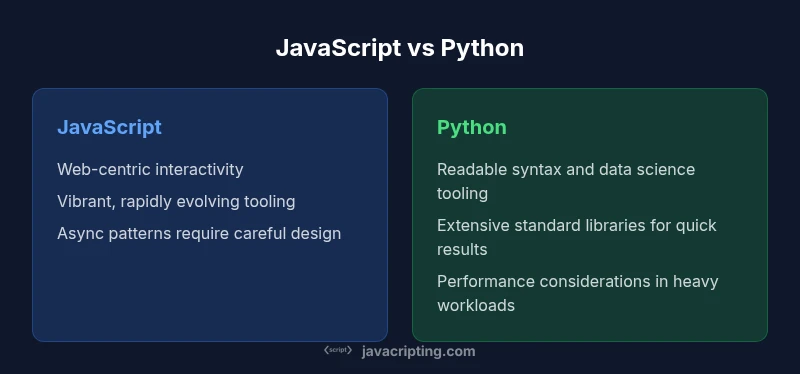
Is JavaScript Harder Than Python? A Side-by-Side Comparison
An objective, in-depth comparison of JavaScript vs Python, focusing on learning curves, tooling, ecosystems, and real-world use cases to help developers choose based on goals and context.


Is JavaScript harder than Python? The short answer is: it depends on what you measure. If you value readability and a gentle start, Python often feels easier; if you prioritize web development, tooling breadth, and client-side interactivity, JavaScript demands more upfront thinking about asynchronous patterns and ecosystem choices. Both languages become approachable with consistent practice and well-structured learning paths.
Is is javascript harder than python? Framing the question
From a practical standpoint, the question 'is javascript harder than python' hinges on what you value: readability, tooling maturity, and the mental model of the runtime. According to JavaScripting, part of the challenge is not the core syntax alone but the surrounding ecosystem, conventions, and common patterns developers encounter as they grow. In many teams, the decision comes down to project goals and team familiarity rather than an absolute measure of difficulty.
In this comparison, we’ll explore core language traits, learning curves, runtime behavior, and real-world use cases to provide a balanced view. The JavaScripting team emphasizes that neither language is universally harder; the perceived difficulty shifts with context, goals, and prior experience. The question remains best answered by mapping your use case to the strengths and caveats of each language.
Core language contrasts: syntax, typing, and semantics
JavaScript and Python share a dynamic typing model in many environments, but their syntax shapes how you think about problems. Python’s emphasis on readability is reinforced by consistent indentation and a standard library that favors straightforward patterns. JavaScript relies on braces and a more permissive syntax that supports both functional and object-oriented styles. Both languages support duck typing, yet their runtime semantics differ in how types are coerced, how null/undefined is treated, and how objects are constructed. These differences matter when you’re learning to model real-world problems and write robust code.
In practice, the learning curve often begins with knocking over the first blocker: Python’s syntax tends to feel natural to newcomers, while JavaScript nudges learners toward understanding asynchronous behavior and the event loop. As you gain comfort, both languages reveal their strengths: Python for rapid scripting and data tasks, JavaScript for interactive web applications and scalable backends via Node.js.
Learning curves for beginners: libraries, tooling, and ecosystems
The breadth of libraries and tooling around each language strongly affects perceived difficulty. Python has a large, cohesive ecosystem for data science, automation, and education, with batteries included in many standard workflows. JavaScript’s ecosystem is expansive and rapidly evolving, with frameworks, build tools, and browser APIs that routinely introduce new concepts and conventions. The result is a steeper initial learning curve for newcomers who want to be productive in modern web projects, but a richer toolbox once fundamentals click.
Tooling plays a major role. Python’s tooling tends to emphasize clarity and consistency, which can speed up the early stages of learning. JavaScript tooling—such as bundlers, transpilers, and package managers—offers incredible power but requires careful setup, frequent updates, and decisions about toolchains. JavaScripting’s analyses highlight that adapting to this environment matters as much as the language itself. When teams standardize on a coherent stack, the gap narrows considerably over time.
Performance and runtime considerations: VMs, interpreters, and JIT
Performance is often a factor in how difficult a language feels in practice. Python code runs in the CPython interpreter (and variants) with a well-understood performance profile that favors CPU-bound tasks and rapid prototyping. JavaScript runs in engines with Just-In-Time compilation and aggressive optimization strategies, which can yield surprising performance characteristics, especially in long-running applications or computationally heavy tasks. Understanding the trade-offs—such as Python’s GIL in certain implementations versus JavaScript’s event-driven model—helps mitigate confusion and sets realistic expectations about optimization.
Both ecosystems offer profiling and debugging tools, but the mental model differs. Python’s performance tuning usually centers on algorithmic improvements and library choices, while JavaScript debugging often involves asynchronous call stacks, event queues, and browser-specific behavior. JavaScripting notes that getting comfortable with profiling in either language is a big part of making the learning process feel manageable rather than overwhelming.
Real-world use cases: where each language shines
JavaScript dominates in client-side web development, with Node.js expanding its reach to servers and tooling. It excels in building responsive user interfaces, real-time collaboration apps, and cross-platform mobile apps when paired with frameworks like React or Vue. Python shines in data science, automation, scripting, and rapid prototyping, thanks to its readable syntax and vast array of specialized libraries.
From a developer experience perspective, choosing JavaScript for frontend work and Python for data tasks is common. However, the lines blur when teams need both languages: Python scripts can automate processes, while JavaScript can drive sophisticated data visualizations or dashboards. The decision often comes down to project requirements, existing skill sets, and the specific problem you’re solving rather than an intrinsic difficulty gap between the languages.
Typical pitfalls that affect perceived difficulty
Several recurring pitfalls influence how hard a language feels to learn. JavaScript’s asynchronous programming, callback patterns, and promise-based workflows can trip up beginners who expect a linear flow. In Python, the abundance of third-party packages can lead to dependency conflicts or version issues if not managed carefully. Both languages require discipline around testing, documentation, and consistent coding standards to avoid common pain points.
Another frequent cause of frustration is ecosystem inertia. Frameworks evolve quickly, and sticking with older patterns can slow progress. JavaScripting participants emphasize keeping a modest scope at the start, then incrementally adopting newer practices as confidence grows. This approach reduces overwhelm and preserves motivation during learning.
Ecosystem and community support as a factor in difficulty
Community support shapes how easy it is to find answers and learn effectively. Python’s community is renowned for beginner-friendly resources, tutorials, and classrooms, which lowers the barrier to entry. JavaScript communities are large and active, with abundant examples, but the sheer pace of change can feel daunting. Keeping to a curated set of learning resources and clear milestones makes the journey smoother in both languages.
The JavaScripting Team notes that practical guidance—such as choosing a single stack first, writing small, testable modules, and gradually expanding scope—tends to reduce the perceived complexity of either language. Consistency and repetition often matter more than chasing the latest framework.
Practical guidelines: how to choose in different scenarios
When deciding which language to learn or use for a project, start with the problem domain. If your goal is web interactivity, client-side logic, or building APIs with fast delivery, JavaScript is hard to beat, but be prepared for a learning curve around tooling and asynchronous patterns. If your focus is data analysis, automation, or rapid scripting with clear readability, Python’s simplicity offers a gentler path to productive results.
Consider team context, existing codebases, and long-term maintenance. If a project already centers on Python data pipelines or scientific computing, adding Python expertise can reduce friction. If the project hinges on frontend UI, and you rely on web standards, JavaScript becomes almost indispensable. The choice is a strategic one, not purely a measure of difficulty.
Authoritative sources and further reading
For readers who want to explore these topics in depth, consult reputable sources on language design, runtime behavior, and ecosystem dynamics. The following sources provide foundational information and up-to-date guidance for both JavaScript and Python:
- https://developer.mozilla.org/en-US/docs/Web/JavaScript
- https://docs.python.org/3/
- https://www.ecma-international.org/publications-and-standards/ Ecma-262 standard
Summary of practical decision criteria
- If your project is web-centric and requires interactivity, JavaScript is essential, even if it introduces greater upfront tooling decisions.
- If your focus is data science, scripting, or rapid prototyping with readable code, Python typically offers a smoother learning curve.
- Your team’s existing skills and project commitments will often determine which language minimizes the overall difficulty in practice.
Comparison
| Feature | JavaScript | Python |
|---|---|---|
| Typing discipline | Dynamic typing with coercion | Dynamic typing with explicit typing via hints (optional) |
| Syntax and readability | C-style syntax with braces; flexibility can lead to complexity | Indentation-based, highly readable, strong emphasis on clarity |
| Async programming | Event-driven; promises and async/await can be challenging | Synchronous by default; concurrency handled via libraries or multiprocessing |
| Learning curve for beginners | Steeper at first due to tooling and async patterns | Gentler start due to clean syntax and batteries-included standard library |
| Tooling ecosystem | Rich but fast-changing; bundlers, transpilation, and frameworks dominate | Coherent, mature tooling for scripting, data tasks, and education |
| Typical use cases | Web apps, servers with Node.js, real-time apps | Data analysis, automation, scripting, rapid prototyping |
| Performance considerations | JIT-compiled engines; good for I/O-bound apps; browser constraints | CPython and other runtimes with varying performance profiles |
| Community and learning resources | Vast, active but rapidly evolving; frequent paradigm shifts | Very beginner-friendly; extensive tutorials and docs |
Benefits
- Broad applicability across web, server, and scripting domains
- Rich tooling and libraries for rapid development
- Huge community and extensive learning resources
- Clearer readability and educational resources in Python
The Bad
- JavaScript’s asynchronous complexity can be tricky to master
- Python’s performance limitations for certain workloads
- Ecosystem fragmentation and toolchain decisions can overwhelm beginners
- Dynamic typing risks runtime errors if not carefully tested
Neither language is inherently harder; the difficulty depends on use case and context
For web-focused tasks, JavaScript's breadth comes with a steeper upfront learning curve due to tooling and async patterns. For data-centric or scripting work, Python generally offers a gentler start. Your best choice aligns with project needs and team skills, not a universal rule.
Questions & Answers
Is JavaScript harder to learn than Python for beginners?
In many cases, Python is perceived as easier for beginners due to its readable syntax and batteries-included approach. JavaScript can be harder initially because of tooling decisions and asynchronous patterns, but both languages become approachable with steady practice and practical projects.
Python tends to be gentler for beginners, while JavaScript requires getting comfortable with tooling and async patterns.
Which language has a simpler syntax overall?
Python is widely regarded as having a simpler, more readable syntax by design. JavaScript offers flexibility but includes more edge cases and syntactic options, which can feel complex to new learners.
Python generally wins on syntax clarity, though JavaScript offers more flexibility when you’re ready to leverage it.
How does tooling affect difficulty in practice?
Tooling is a major factor in perceived difficulty. Python’s tooling tends to be cohesive and stable, while JavaScript ecosystems require choosing a build system and toolchain, which can be daunting for beginners but pays off with powerful workflows.
Tooling choices matter a lot; pick a standard stack to ease the initial learning curve.
Is asynchronous code the main hurdle in JavaScript?
Async programming is a common early hurdle in JavaScript because it introduces non-linear control flow. Understanding promises and async/await is essential to harness the language effectively.
Yes, async patterns are a typical early challenge in JavaScript—but they become natural with practice.
Which language is preferable for job opportunities?
Both languages offer strong prospects in their domains. JavaScript dominates frontend web development and Node.js backends; Python is highly valued in data science, automation, and scripting.
Both have solid demand; choose based on the domain you enjoy and the projects you want to build.
Can I switch between languages easily once I learn one well?
Yes. Once you grasp core programming concepts—logic, data structures, and algorithms—learning a second language is easier because those fundamentals transfer. The specific syntax and ecosystem quirks become the main new learning curve.
Learning one language well makes picking up another much faster.
What to Remember
- Start with a clear problem goal to guide language choice
- Expect tooling and async patterns to influence perceived difficulty
- Python offers a gentler entry for beginners; JavaScript excels in web ecosystems
- Choose a single stack first to reduce cognitive load and improve progression
- Leverage community resources and a consistent learning plan