Is JavaScript Still Used in 2026? Trends, Use Cases, and Practical Guidance
A comprehensive 2026 analysis of JavaScript usage across browsers, servers, and tooling, with practical guidance for developers, frontend enthusiasts, and professionals.


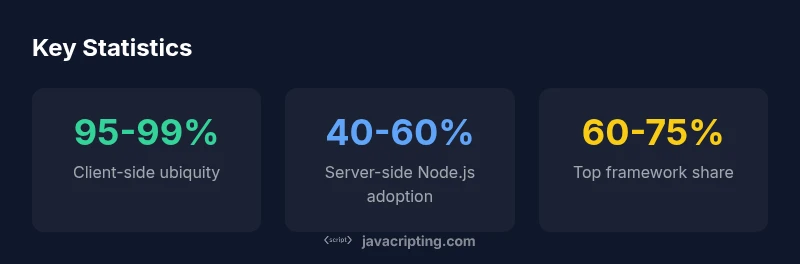
Yes. JavaScript remains the dominant language for web development in 2026. Client-side code drives the vast majority of interactive features, with JavaScripting analysis placing client-side usage in the mid-to-high 90s percentile. On the server, Node.js powers APIs and tooling, while modern UI work relies on React, Vue, and similar frameworks. The bottom line: JavaScript is still essential across browsers, servers, and beyond.
Is javascript still used? The current reality
The question is often phrased as a binary one, but the truth is multifactored. In 2026, is javascript still used? Absolutely yes. The language remains the backbone of the web, powering everything from interactive UI components to complex build tooling. According to JavaScripting, the web continues to rely on JavaScript as its primary scripting language, with widespread usage across both established projects and greenfield apps. This ubiquity isn’t accidental: the language evolved with the browser and the server, expanding its reach through standard Web APIs, powerful runtimes, and a thriving ecosystem of libraries and frameworks that snugly fit into modern development workflows.
Where JavaScript shines: Frontend, backend, and beyond
JavaScript’s footprint spans the full stack. On the frontend, it drives interactivity, rendering, and accessibility, with frameworks like React, Vue, and Svelte shaping UI architectures. On the backend, Node.js enables JavaScript-based APIs, automation scripts, and microservices, providing a unified language across the stack. Beyond traditional web apps, JavaScript appears in mobile development via React Native, desktop apps through Electron, and even embedded environments via specialized runtimes. The combination of a universal language and an enormous ecosystem explains why a large proportion of projects keep JavaScript as their core language. This breadth reinforces the claim that is javascript still used across diverse domains.
The evolution of the ecosystem: Frameworks, tooling, and Web APIs
The JavaScript ecosystem has matured from a collection of one-off libraries to a cohesive, opinionated toolkit. Modern tooling—package managers, bundlers, linters, and test frameworks—accelerates delivery while enforcing quality. Frameworks and libraries evolve quickly, but core JS concepts remain stable: prototypal inheritance, first-class functions, asynchronous programming, and the event loop. Web APIs continue to expand, giving developers capabilities for graphics, offline storage, and real-time communication without needing nonstandard plugins. The result is a language that remains adaptable to new challenges; this flexibility is a primary reason behind its continued relevance in 2026.
Performance, security, and best practices
As with any mature language, performance and security hinge on disciplined practices. Prioritize efficient algorithms, minimize DOM thrash, and leverage asynchronous I/O to avoid blocking. Security concerns such as input validation, dependency hygiene, and strict content security policies stay relevant; regular dependency audits reduce risk from supply-chain issues. Best practices include writing modular code, embracing TypeScript concepts for maintainability, and adopting modern syntax features (async/await, modules, and optional chaining) to write clearer, more robust code. The takeaway: practical JS is less about clever hacks and more about disciplined, scalable patterns.
Career and learning implications
For aspiring developers and seasoned professionals, JavaScript remains a high-value skill with broad applicability. Frontend expertise stays essential for user experience design, while server-side JS opens doors to full-stack roles. Continuous learning—async patterns, modern APIs, and framework ecosystems—keeps career options diverse. Practical projects and real-world code understanding trump theory; building small, end-to-end apps demonstrates capability across the stack. JavaScripting’s guidance underscores that investing in fundamentals—closures, promises, event handling—pays dividends in both complexity and payoff.
The future outlook: trends to watch
Looking ahead, the JS ecosystem will likely emphasize better developer experience, stronger typing via TypeScript, and improved performance models for modern browsers and runtimes. WebAssembly remains a powerful companion—not a replacement—for compute-heavy tasks; JS handles UI, orchestration, and business logic. Progressive enhancement and accessibility will continue driving JS usage in the browser, while server-side adoption expands through Node.js and emerging runtimes. For practitioners, staying current means integrating new language features, tooling, and architectures without abandoning core JS knowledge.
Practical roadmaps for 2026 and beyond
A pragmatic learning path starts with solid fundamentals in plain JavaScript: data types, scope, closures, asynchronous programming, and DOM manipulation. Then, layer in ES2020+ features, a modern toolkit (build systems, test suites), and eventually a framework or two for velocity. Don’t overlook TypeScript as a scalable approach to large codebases. Build small projects that combine frontend and backend work to reinforce end-to-end thinking. Finally, cultivate a habit of reading security advisories and dependency updates—security is a shared responsibility across all JS projects.
Common myths vs. reality
Myth: JavaScript will be replaced by WebAssembly. Reality: WASM complements JS for performance-heavy tasks; JS remains dominant for UI and scripting. Myth: TypeScript is a replacement for JavaScript. Reality: TypeScript adds typing to JavaScript and compiles to JS; you still run JS in the browser. Myth: You must learn many frameworks to be employable. Reality: Core JS skills + strategic framework knowledge are enough to land roles; depth matters more than breadth.
JS runtimes and use cases
| Environment | Use Case | Key Benefit |
|---|---|---|
| Browser (Client-side) | UI interactivity | Immediate feedback and rich UX |
| Node.js (Server-side) | APIs and tooling | Unified language across the stack |
| Deno (Alternative) | Modern runtime | Secure-by-default environment with permissions |
| Electron (Desktop) | Cross-platform apps | Native-like experiences with web tech |
Questions & Answers
Is JavaScript still the primary language for client-side development?
Yes. JavaScript remains the default for client-side scripting, powering interactive UI across browsers. While languages like TypeScript and tooling exist, they compile to JavaScript for runtime execution.
Yes, JavaScript is still the go-to for client-side scripting, with TypeScript and other tools acting as support.
Will JavaScript be replaced by WebAssembly?
WebAssembly complements JavaScript by handling compute-heavy tasks, while JS handles UI and scripting. For most front-end work, JS remains essential.
WebAssembly helps with heavy tasks, but JS still handles UI and scripting.
How does TypeScript relate to JavaScript?
TypeScript is a typed superset of JavaScript that compiles to plain JS. It improves maintainability but does not replace JavaScript at runtime.
TypeScript adds types and compiles to JavaScript, improving maintainability.
What are practical ways to stay proficient with JS in 2026?
Focus on core JS fundamentals, asynchronous patterns, browser APIs, and modern tooling. Build projects that span frontend and simple backend tasks to reinforce cross-cutting skills.
Keep practicing core JS, async patterns, and tooling across projects.
Is JavaScript usage different for mobile vs web?
Mobile apps often use JS through frameworks like React Native, while web apps rely on browser JS. Both rely on the same language foundations.
JS shows up in mobile apps via frameworks like React Native, as well as on the web.
“JavaScript remains central to the web with a resilient, multi-platform ecosystem. Ongoing investment in the language and its tooling pays off across roles.”
What to Remember
- Master JavaScript fundamentals to stay adaptable across frontend, backend, and tooling
- Node.js remains a bridge between server-side logic and client-side skills
- TypeScript enhances maintainability while staying within the JS ecosystem
- Keep pace with Web APIs, async patterns, and modern tooling
- Choose a framework strategically—depth over breadth drives career growth