javascript or php: Practical 2026 Language Comparison
An analytical comparison of JavaScript and PHP for 2026. Explore language design, runtimes, deployment, tooling, and team fit to guide front-end and back-end decisions.


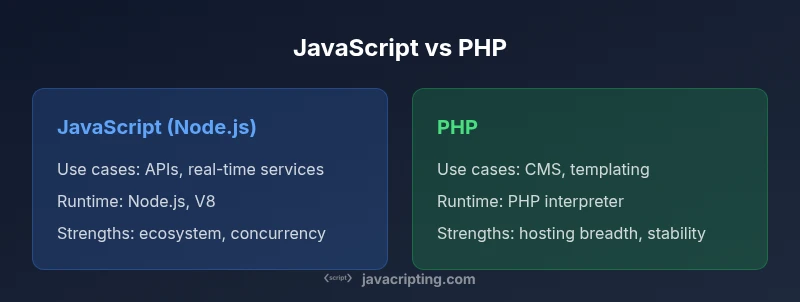
JavaScript (Node.js) and PHP each excel in different roles. JavaScript is best for full-stack, real-time workloads and modern microservices, while PHP remains a pragmatic choice for traditional server-rendered apps. The best option depends on project scope, hosting, and team expertise. Both languages have mature ecosystems and can be mixed in hybrid stacks to leverage their respective strengths.
Opening context: javascript or php in 2026
According to JavaScripting, choosing between javascript or php in 2026 is less about finding a single universal best and more about matching the language to the problem domain, stack, and team skills. JavaScript remains the dominant language for browsers and has extended its reach to the server through Node.js, enabling true full-stack development with a single language. PHP, by contrast, continues to power a large portion of the web through mature hosting environments, robust CMS ecosystems, and consistent performance in traditional web apps. For product teams evaluating a project today, the decision hinges on where code will execute, how the team collaborates, and the hosting strategy. This article compares both languages across architecture, deployment, performance, tooling, and maintainability to help engineering leaders decide with confidence. While the landscape shifts with new transpilation and deployment patterns, the core questions remain: What are you building? Who maintains it? Where will it run? And how quickly can you deliver features?
Core differences: language design, typing, and runtime
JavaScript and PHP grew in different eras with different aims. JavaScript was designed for the browser, emphasizing flexibility and event-driven programming. PHP began as a simple template language and evolved into a full-stack server language with a strong emphasis on pragmatic web development. In 2026, both languages offer dynamic typing, but their typing stories diverge: JavaScript encourages optional typing through TypeScript and strong tooling, while PHP provides optional type declarations inside functions and class definitions. Runtime execution also diverges: JavaScript uses a single-threaded event loop with asynchronous I/O, while PHP follows a per-request model where each HTTP request initializes the interpreter and completes when the response is sent. This fundamental difference shapes how you architect applications, handle concurrency, and manage state across requests. Understanding these core design choices helps teams decide whether to lean on real-time capabilities or prioritize straightforward rendering and templating.
Deployment models and hosting realities
JavaScript (Node.js) apps can deploy on virtually any cloud or container platform, with broad support for serverless functions, microservices, and edge compute. PHP apps benefit from mature hosting footprints in shared hosting, LAMP/LEMP stacks, and managed CMS deployments; many teams can start quickly on low-cost hosting. The decision often maps to your existing infrastructure: if you already run Node services, bringing JavaScript to the server can reduce context switching; if you rely on CMS ecosystems like WordPress, PHP remains a strong foundation. Consider also tooling for deployment: Node's package managers and container images vs PHP's OPCache, Composer, and per-project dependencies. The takeaway: hosting reality and deployment workflows can be a decisive factor long before you write a line of code.
Performance considerations and bottlenecks
Performance in 2026 is less about language purity and more about architecture. JavaScript shines in I/O-bound workloads thanks to non-blocking I/O and event-driven design; for CPU-bound tasks you typically spawn workers or delegate to native modules. PHP performance has improved dramatically with opcode caching and optimized interpreters; in classic web apps, per-request execution pairs well with fast database access and caching layers. Real-world bottlenecks often involve database latency, network I/O, and misconfigured queues, not language choice alone. A pragmatic approach combines language strengths: use JavaScript for API gateways, real-time features, and streaming, while using PHP for content-rich pages, templated rendering, and legacy workflows that benefit from established PHP tooling.
Tooling, frameworks, and communities
JavaScript enjoys a vast and rapidly evolving ecosystem. Node.js runtimes enable server-side JavaScript, while frameworks like Express, NestJS, and Next.js shape API design, microservices, and full-stack apps. The npm registry offers millions of packages, but this breadth requires thoughtful governance and security practices. PHP has a mature, stable ecosystem anchored by frameworks such as Laravel and Symfony, along with countless CMS integrations. PHP tooling emphasizes stable composition, robust ORM tooling, and straightforward templating. In 2026, teams often operate hybrid stacks, pairing modern JavaScript front-ends with PHP back-ends, or using JavaScript across the stack via server-side JS. The choice depends on your preferred developer velocity, code organization, and how you manage dependencies, and JavaScripting's analysis shows a growing trend toward multi-language stacks that optimize each layer’s strengths.
Security and maintainability implications
Security considerations are language-agnostic in principle but require attention to patterns unique to each stack. JavaScript code running on the server (Node.js) inherits the same class of web vulnerabilities as any networked service; focus on input validation, dependency management, and secure defaults. Client-side JavaScript adds an additional layer for XSS prevention and proper data handling at the boundary. PHP applications are equally vulnerable to injection attacks and misconfigured access controls; modern PHP benefits from type declarations, autoloading, and modern frameworks that promote secure defaults. Maintainability depends on code organization, testing, and documentation; both languages reward well-structured architectures, clear APIs, and automated testing pipelines. Teams should enforce code reviews, CI, and security scanning regardless of language.
Interoperability and learning curves for teams
Many teams operate bilingual stacks, using JavaScript on the client and server alongside PHP for templating or CMS-based content delivery. The learning curve for JavaScript can be steep if you dive into asynchronous programming and ecosystem choices, but TypeScript mitigates many risks by adding static typing. PHP offers a shorter path for teams with a background in server-side templating and classic web frameworks; modern PHP still requires learning about namespaces, autoloading, and modern type hints to keep pace. The key is to design training and onboarding that covers the project’s architecture, not only syntax. Organizations that invest in shared coding standards, code reviews, and cross-team pairing tend to reduce friction when adopting a multi-language stack.
Scenarios: when to choose JavaScript vs PHP
For new greenfield projects, if you anticipate heavy client-side interactivity, real-time features, or API-driven architectures, JavaScript on the server (Node.js) often makes sense. If your primary goal is rapid server-rendered pages, CMS integrations, or content-heavy sites with established PHP hosting, PHP remains a strong fit. For organizations aiming to maximize hiring flexibility, a pragmatic approach is to use JavaScript across the frontend and backend while keeping PHP for legacy components or templating pipelines. In various industry domains, such as e-commerce, content management, and SaaS, teams successfully blend both languages to leverage their respective strengths.
Migration paths and practical decision checklist
Create a decision checklist before starting: map workload characteristics (I/O vs CPU), assess hosting constraints, evaluate team skills, and estimate maintenance costs. If migrating from PHP to JavaScript, plan for API-first design and modern front-end tooling; for migrating away from JS-heavy stacks, consider server-side rendering with PHP or partial hydration patterns. Implement a pilot project to test performance and reliability, and establish a governance model to manage dependencies across languages. Document concrete migration steps, define success metrics, and align with security and compliance requirements.
How to audit and measure success in a project
Finally, define clear success criteria and measurable outcomes. Track performance indicators such as response times, throughput, and error rates; assess developer velocity, onboarding time, and feature delivery cadence. Audit code quality through automated tests, static analysis, and security scanning. Evaluate maintenance overhead, total cost of ownership, and the ability to adapt to changing requirements. A well-structured audit plan helps teams decide which language or combination of languages best suits evolving product goals. In short, use a data-informed approach to balance short-term delivery with long-term maintainability.
Comparison
| Feature | JavaScript (Node.js) | PHP |
|---|---|---|
| Paradigm | Event-driven, asynchronous | Imperative/object-oriented, multi-paradigm |
| Typing | Dynamic with optional typing via TS | Dynamic with optional type declarations (weak) |
| Runtime | V8-based runtimes and browsers | PHP runtime (Zend Engine) |
| Primary use-case | Full-stack applications, microservices, API backends | Server-side web development with templating |
| Hosting & deployment | Cross-platform hosting, serverless and containers | Widespread PHP hosting in LAMP/LEMP stacks |
| Ecosystem & frameworks | Rich npm ecosystem; Next.js, NestJS, Express | Laravel, Symfony; CMS integrations |
| Performance considerations | Non-blocking I/O; good for concurrency | Mature per-request model with opcode caching |
| Learning curve | Moderate; async patterns can be complex | Relatively gentle for beginners; forgiving syntax |
| Community & maturity | Massive, rapidly evolving | Long-standing, stable and mature |
| Job market signals | Strong demand in modern stacks and tooling | Consistent demand in CMS and traditional web apps |
Benefits
- JavaScript runs on both client and server, enabling full-stack development with one language
- Huge ecosystem and rapid framework turnover keeps skills relevant
- PHP hosting is incredibly widespread and affordable
- Clear separation of concerns in PHP for templating and server logic
- Mature tooling and hosting options for PHP
The Bad
- JS ecosystem can be chaotic due to rapid framework changes
- PHP's aging perception persists despite modernization
- Server-side performance depends on architecture; Node.js shines for I/O but requires careful CPU-bound task handling
JavaScript (Node.js) generally wins for modern full-stack and real-time workloads; PHP remains a solid choice for traditional server-rendered apps.
Choose JavaScript when you need real-time capabilities and a cohesive frontend-backend stack. Choose PHP for rapid server-rendered pages and legacy CMS-driven projects; many teams benefit from a hybrid approach.
Questions & Answers
What is the primary difference between JavaScript and PHP?
JavaScript runs in the browser and on servers via Node.js, with a focus on asynchronous, event-driven design. PHP is a server-side language aimed at rendering dynamic HTML and templating. Both support modern programming concepts, but they operate in different runtime environments and use-case centers.
JavaScript runs in browsers and on servers, emphasizing async capabilities, while PHP specializes in server-side rendering and templating.
Can PHP compete with Node.js for real-time apps?
PHP has traditionally excelled in request-based workloads; real-time features are possible with additional services or patterns, but Node.js offers a more natural fit for WebSocket-based apps. Modern PHP can support similar patterns with extensions and architectures that delegate real-time workloads elsewhere.
Real-time apps are easier with Node.js, though PHP can support real-time through auxiliary services.
Is it practical to mix JavaScript and PHP in a single project?
Yes. Teams often separate concerns: JavaScript handles the frontend and API layers, while PHP powers server-rendered pages or legacy CMS components. Clear API contracts, data formats like JSON, and consistent authentication help maintain coherence across languages.
Mixing JS on the frontend and PHP on the backend is common with clear APIs.
Which language is easier to learn for beginners?
PHP tends to be forgiving for beginners due to its permissive syntax and quick feedback loops in many starter projects. JavaScript can be tougher because of asynchronous patterns and the vast ecosystem, but modern tutorials and tooling ease the learning curve.
PHP is often easier to start with; JavaScript gets easier with modern tooling and TypeScript.
Is PHP still relevant in modern web stacks?
Yes. PHP remains widely used in legacy and modern web stacks, benefiting from mature hosting, strong community support, and ongoing language improvements. It continues to be a pragmatic choice for many teams and projects.
PHP remains relevant for many teams, especially with legacy systems and strong hosting.
Should teams adopt a hybrid JS/PHP approach?
A hybrid approach can be highly effective when teams need both modern front-end interactivity and robust server-rendered pipelines. Establish architectural boundaries, shared data formats, and governance to prevent fragmentation.
Hybrid stacks work well when you clearly separate concerns and govern how languages interact.
What to Remember
- Assess project scope and hosting before language choice
- Leverage each language's strengths in the right layer
- Prioritize strong tooling and consistent security practices
- Consider a hybrid stack for best of both worlds
- Plan migration paths and governance early