javascript vs php: A Practical Side-by-Side Comparison
A practical, analytical comparison of JavaScript and PHP, covering runtimes, ecosystems, performance, hosting, and use cases to help developers choose the right tool for their project.


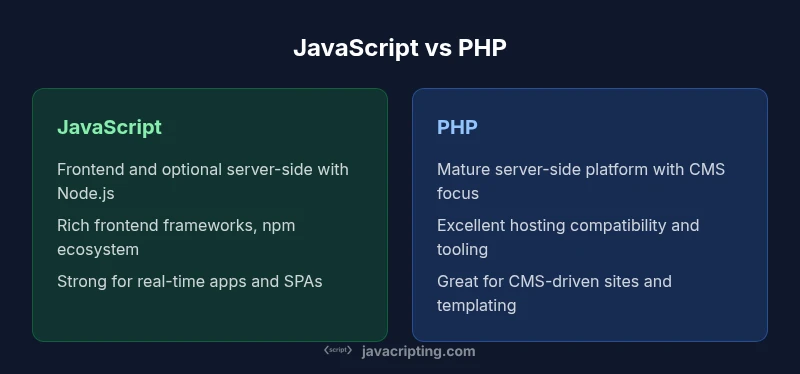
javascript vs php presents a fundamental choice between client- and server-side roles, and how you architect a web app. JavaScript dominates frontend interactivity and, via Node.js, can power servers too; PHP remains a long-standing server-side option with broad hosting and CMS support. For most modern stacks, a hybrid approach using both languages offers the best of both worlds.
Overview and Core Dichotomy
javascript vs php defines the most visible difference in web development: where code runs and how it is executed. In practice, JavaScript started on the client, shaping the user interface, while PHP built pages on the server and delivered HTML. Today, the landscape is more nuanced: Node.js enables JavaScript on the server, and PHP projects have evolved with modern frameworks. According to JavaScripting, understanding this dichotomy is critical for choosing the right architecture. This article frames the decision around client versus server responsibilities, mapping features, performance goals, and security concerns to the language that fits the job. The comparison javascript vs php is not merely about syntax; it’s about ecosystem, hosting reality, and long-term maintainability. As you read, consider your project’s user experience, deployment strategy, and the skill set of your team.
Execution models and runtimes
JavaScript executes primarily in the browser, giving it native access to the DOM, events, and asynchronous APIs. On the server, Node.js offers an event-driven, non-blocking I/O model, which makes it well suited for real-time applications, streaming data, and microservices. PHP traditionally runs as a server-side interpreter inside a web server (Apache, Nginx with PHP-FPM). It’s designed around a request-response lifecycle, often with multiple concurrent requests handled by separate processes or threads. Node.js brings a unified language to both client and server, enabling shared code, tooling, and testing approaches. PHP’s model emphasizes fast page rendering once a request is received, with modern PHP versions offering performance improvements via opcode caching and optimized interpreters. When deciding between javascript vs php for runtime, consider workload nature: high-concurrency I/O tasks and streaming favor Node.js, while traditional content generation and CMS-driven sites capitalize on PHP’s mature server-side environment.
Language features, typing, and developer experience
JavaScript is dynamically typed with a prototype-based object model, though modern syntax favors class-based constructs and static analysis can help manage complexity. TypeScript adds strong typing on top of JavaScript, improving tooling and maintainability for large teams. PHP mixes dynamic typing with optional types introduced in recent versions, and PHP’s object model has matured with class-based inheritance and modern features like traits and namespaces. The learning curve varies by background: front-end developers often start with JavaScript’s browser APIs, while those targeting server-side productivity may gravitate toward PHP’s familiar templating and built-in web features. In both languages, robust tooling—linters, IDEs, and type checkers—helps maintain code quality as projects scale.
Ecosystem, frameworks, and tooling
JavaScript’s ecosystem is vast, spanning frontend frameworks (React, Vue, Angular), state management libraries, and full-stack runtimes (Node.js, Deno). The npm ecosystem accelerates development with millions of packages, while bundlers, test runners, and CI/CD pipelines are deeply integrated into the workflow. PHP’s ecosystem is equally mature on the server side, with popular frameworks (Laravel, Symfony, Zend) and a long-tail of CMS platforms (WordPress, Drupal) that power a significant portion of the web. Composer remains PHP’s package manager, and modern PHP releases continue to improve performance and developer ergonomics. The choice often comes down to whether you need a unified frontend-backend workflow (JS-heavy) or leverage CMS-driven sites and server-side rendering (PHP-heavy).
Performance considerations across workloads
Performance in javascript vs php depends heavily on workload. Node.js shines in I/O-bound, real-time, and event-driven scenarios due to its non-blocking architecture and efficient concurrency model. For CPU-intensive tasks, JavaScript can be less optimal unless offloaded to worker threads or specialized services. PHP performance typically hinges on how you configure the server, opcode caches, and how you structure PHP scripts. PHP-FPM with modern accelerators and opcode caches can render pages quickly and scale well under traditional web traffic patterns. For modern architectures, a hybrid approach—using Node.js for real-time components and PHP for stable CMS-driven parts—can yield balanced performance while keeping complexity in check.
Hosting, deployment, and infrastructure realities
Hosting for JavaScript varies by use case: frontend assets are universally served by any web server, while Node.js applications require a runtime environment. PHP hosting is widely available with mature shared hosting, PHP-FPM-based stacks, and server configurations optimized for dynamic page rendering. When deploying, consider orchestration needs: containerization with Docker works well for both languages, while serverless options exist for Node.js functions and certain PHP workloads. Monitoring, logging, and security tooling should be aligned with your chosen runtime: Node.js projects often rely on JavaScript-centric observability stacks, whereas PHP projects benefit from server-side instrumentation and CMS-specific monitoring. The practical reality is that both languages can thrive in modern cloud environments, provided you plan for dependencies, updates, and scaling.
Use-case decision framework
To decide between javascript vs php, start with your primary user experience goals. If interactivity, real-time features, and a single-language stack are priorities, JavaScript (with Node.js on the backend) is a strong choice. If you’re building content-driven sites, e-commerce platforms with CMS ecosystems, or teams already proficient in PHP, PHP remains compelling. Consider a hybrid architecture where the frontend is powered by JavaScript and the backend by PHP where CMS integrations or legacy systems exist. RESTful APIs or GraphQL can bridge the two worlds, enabling a clean separation of concerns while enabling modern frontend experiences.
Security practices and common pitfalls
Security best practices apply to both languages but differ in focus. For JavaScript frontends, mitigating XSS, CSRF, and insecure DOM manipulation is critical, alongside secure API design and proper authentication on the backend. For PHP, input sanitization, secure session handling, and defensive coding in templates are essential, especially when CMS integrations are involved. Routine updates, dependency management, and code reviews reduce common pitfalls in both ecosystems. OWASP guidelines remain a solid baseline, with language-specific considerations for input validation, output encoding, and secure configuration. Emphasize automated testing and vulnerability scanning to catch issues early in both javascript and php projects.
Interoperability and hybrid architectures
A pragmatic approach for many teams is to deploy a hybrid architecture. The frontend can be a modern single-page application written in JavaScript, while the backend uses PHP to serve CMS-driven pages or provide a robust API layer. API-first design enables language-agnostic clients and containerized services, while GraphQL or REST can abstract away the underlying language in use. This interoperability allows organizations to preserve legacy PHP deployments while embracing contemporary JavaScript frontends, ultimately delivering improved user experiences without forcing a complete rewrite.
Cost, hiring, and team considerations
Hiring decisions often hinge on existing team strengths and project needs. If your team already has strong PHP developers and CMS requirements, continuing with PHP is cost-effective and practical. If your team prioritizes a unified stack and rapid frontend-backend iteration, investing in JavaScript-focused skills with Node.js and modern tooling can reduce context switching and improve velocity. Budget considerations include hosting costs, tooling licenses, and the availability of developers with the desired mix of skills. In many cases, a blended team—FS JavaScript for the front end and PHP on the backend—offers a sensible balance between capability, speed, and cost.
Migration paths and modernization
For projects that start with PHP but require richer frontend interactions, a staged modernization path makes sense. Expose backend data via robust APIs and progressively adopt a JavaScript-based frontend. Conversely, new projects can embrace a full-stack JavaScript approach from the outset, using PHP only where CMS constraints dictate. Regardless of the path, establish clear APIs, versioning, and automation for deployment to minimize risk during modernization. Balanced, incremental changes reduce disruption and accelerate delivery while preserving existing investments.
Comparison
| Feature | JavaScript | PHP |
|---|---|---|
| Primary runtime | Client-side (browser) / Node.js on server | Server-side interpreter (Apache/Nginx + PHP) |
| Execution model | Event-driven, non-blocking I/O (Node.js) | Request-based lifecycle with PHP interpreter |
| Hosting and deployment | Unified tooling across frontend and backend (Node.js), modern runtimes | Widespread hosting with PHP-FPM, CMS-centric ecosystems |
| Frameworks & tooling | React, Vue, Angular; npm/yarn; bundlers; ecosystem is frontend-first | Laravel, Symfony; WordPress/Drupal; Composer; mature server-side tooling |
| Performance profile | Strong I/O performance in real-time and microservices | Fast templating and CMS-driven rendering with caching strategies |
| Learning curve | Frontend-first foundations; mastering asynchronous patterns | Server-side scripting with PHP; strong templating and web basics |
| Security considerations | XSS risks in frontend code if not sanitized; API security essential | Server-side input handling and template sanitization critical |
| Best for | Real-time apps, SPAs, full-stack JS stacks | CMS-powered sites, legacy PHP apps, rapid server-side rendering |
Benefits
- Unified language across frontend and backend
- Vast frontend ecosystem and modern tooling
- Node.js enables scalable server-side JavaScript
- PHP remains mature with extensive hosting and CMS options
The Bad
- Team skill fragmentation when mixing languages
- PHP ecosystem can lag in adopting the latest language features
- Node.js can introduce callback and runtime security complexities
JavaScript generally offers broader modern capabilities for full-stack development, while PHP remains a solid choice for CMS-driven and legacy server-side workloads.
If you need a unified frontend-backend stack and real-time features, favor JavaScript. For CMS-heavy sites and rapid server-side rendering with mature hosting, PHP remains compelling.
Questions & Answers
What are the core differences between JavaScript and PHP?
JavaScript runs primarily in the browser and, with Node.js, on the server. PHP executes server-side within a web server environment. The languages differ in runtime, ecosystem focus, and typical deployment models, which guides how you structure a web application.
JavaScript runs in the browser and on servers with Node.js, while PHP runs on the web server. The main differences are where they run and how they’re integrated into hosting and deployment.
Can JavaScript be used for server-side development?
Yes. Node.js enables JavaScript on the server, with popular frameworks like Express and Koa. This enables a unified language for both client and server code and enables modern API-driven architectures.
Yes. Node.js allows JavaScript to run on the server with frameworks like Express, enabling a full-stack JavaScript approach.
Which language is easier to learn for beginners?
Both have abundant resources. JavaScript can feel more approachable for those starting with frontend development, while PHP’s syntax and templating can be straightforward for server-side learners. Your background and goals largely shape the perceived ease.
If you’re drawn to the browser, start with JavaScript. If you want server-side templates quickly, PHP can be simpler to pick up.
Is PHP obsolete in 2026?
No. PHP remains widely used in legacy systems and CMS-powered sites. Modern PHP with frameworks continues to be actively maintained and serves many production workloads effectively.
No, PHP is still actively used, especially in CMS-based sites and legacy systems.
What about performance differences?
Performance depends on architecture and workload. Node.js excels in I/O-heavy tasks, while PHP performance improves with modern interpreters and caching. The best results often come from tailored optimization rather than language choice alone.
Performance hinges on how you design the system; Node.js for I/O-heavy tasks, PHP with caching for fast server-side rendering.
Which should a new student learn first?
Starting with JavaScript provides a strong foundation for frontend development and API interactions. PHP is valuable for understanding server-side rendering and CMS ecosystems. A balanced path is to begin with JavaScript and then add PHP as needed for server-side projects.
Begin with JavaScript to learn client-side concepts, then learn PHP if you plan to work with CMS-driven or traditional server-side projects.
How should I approach a hybrid architecture?
Adopt a clean API boundary between the frontend and backend. Use JavaScript for the UI and PHP to power CMS features or a separate API layer. GraphQL or REST can help decouple concerns and support future migrations.
Use a frontend in JavaScript with a PHP backend behind a stable API layer to keep things modular.
What are common security pitfalls to watch for?
In JavaScript-heavy apps, guard against XSS and insecure API access. In PHP, validate inputs, sanitize outputs, and secure sessions, especially when integrating with CMS systems. Regular scanning and dependency updates are essential.
Guard against XSS in the frontend and sanitize inputs on the server side. Keep dependencies updated.
What to Remember
- Assess project architecture before language choice
- Choose JavaScript for unified frontend-backend stacks
- Leverage PHP for CMS-driven sites and legacy systems
- Plan for interoperability with APIs when mixing languages
- Invest in security, testing, and monitoring across both ecosystems