What Is Better: JavaScript vs PHP for Web Development
An analytical comparison of JavaScript and PHP to help you decide what is better javascript or php for modern web projects, focusing on use cases, deployment, performance, and ecosystem.


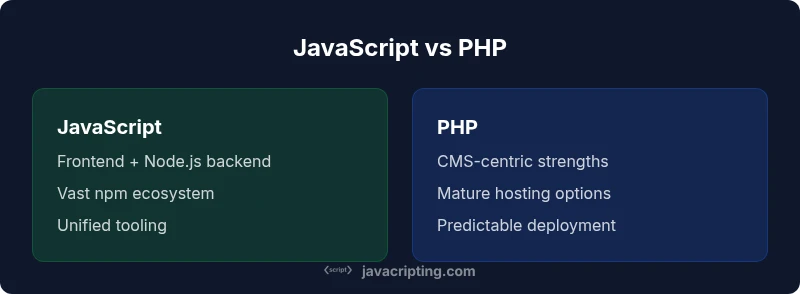
JavaScript generally shines for modern web projects due to a unified language across client and server, a thriving ecosystem, and non-blocking back-end capabilities. PHP remains strong for CMS-heavy sites and straightforward hosting. This guide analyzes use cases, deployment models, and ecosystem maturity to help you decide what is better javascript or php for your specific project.
what is better javascript or php: framing the question
According to JavaScripting, the central question is not a simple winner but a mapping of project goals to language strengths. What is better javascript or php depends on architectural choices, team skills, and deployment workflow. In this framing, we consider frontend parity, server-side capabilities, ecosystem maturity, and hosting flexibility. The keyword what is better javascript or php appears here to anchor the topic for search engines and readers. JavaScript shines when a unified language across client and server is desired, enabling shared data models, tooling, and faster iteration. PHP remains formidable for traditional server-rendered pages, CMS-driven sites, and straightforward deployments. Across modern web applications, many teams adopt a hybrid approach, using JavaScript on both ends while leveraging PHP for CMS plugins or legacy components. This article is designed for aspiring developers, frontend enthusiasts, and professionals seeking practical JavaScript guidance.
Comparison
| Feature | JavaScript | PHP |
|---|---|---|
| Typical Use-Cases | Frontend-centric apps, full-stack with Node.js, real-time features | Server-rendered pages, CMS-powered sites, legacy systems |
| Performance & Concurrency | Event-driven, non-blocking I/O in Node.js; single-threaded runtime | Per-request execution model with shared-nothing architecture; modern PHP optimizations available |
| Ecosystem & Maturity | Huge npm ecosystem, cross-cutting tooling, rapid iteration | Mature CMS ecosystem (WordPress, Drupal) and stable hosting practices |
| Hosting & Deployment | Cloud-native stacks, containers, serverless options | Traditional hosting with LAMP/LEMP stacks, easy CMS deployment |
| Learning Curve | Wide range of resources; async patterns to master | Clear PHP syntax with strong framework guidance (Laravel, Symfony) |
| Best For | Modern full-stack, real-time apps, microservices | CMS-driven sites, rapid deployment, legacy compatibility |
Benefits
- Unified language across frontend and backend when using JavaScript reduces context switching
- Enormous ecosystems and rapid tooling speed up development
- Strong tooling, testing, and deployment pipelines across the stack
- Broad hosting options and market demand for JavaScript-based stacks
- PHP’s stability and CMS-centric strengths underpin many enterprise sites
The Bad
- JavaScript can introduce asynchronous programming complexity and callback/Promise management challenges
- Ecosystem fragmentation and dependency management can lead to security concerns if not managed
- PHP is less suited to modern real-time architectures and microservices without careful design
- CMS-heavy PHP usage can invite vendor lock-in and CMS-specific constraints
JavaScript generally leads for modern web development; PHP remains a solid choice for CMS-heavy and traditional hosting scenarios.
Choose JavaScript when you want a unified, flexible stack and strong modern tooling. Opt for PHP when CMS integration and straightforward hosting are the priority, especially for legacy sites or CMS-driven projects.
Questions & Answers
Is PHP dead?
No. PHP remains widely used, especially for CMS-driven sites and legacy systems. PHP 8+ introduced significant performance and syntax improvements that keep it viable for many production environments.
No—PHP is still widely used, especially with CMS sites, and PHP 8+ brought strong performance improvements.
Can I run JavaScript on the backend without Node.js?
Yes in theory with alternative runtimes, but Node.js is by far the most common runtime for server-side JavaScript, offering extensive libraries and community support.
You’ll mainly use Node.js as the backend runtime for JavaScript today.
Which is easier to learn for beginners?
PHP often feels more approachable for beginners due to its straightforward syntax and per-request execution model, while JavaScript requires learning asynchronous patterns for real-world apps.
PHP can be easier to start with, but JavaScript pays off with broader job opportunities.
How do hosting costs compare?
Hosting costs depend on usage, not language alone. PHP-hosted sites have strong shared hosting options; JavaScript backends (Node.js) also scale well on modern cloud platforms but may require more configuration.
Costs vary with the stack and hosting plan, not the language by itself.
Does PHP 8+ improve performance?
Yes. PHP 8+ introduced the JIT compiler and improvements in the Zend Engine, resulting in better performance and efficiency for many web workloads.
PHP 8+ brought notable performance gains.
Which language has the better ecosystem for web apps?
JavaScript has a larger, more diverse ecosystem for web apps, spanning frontend frameworks, backend runtimes, and tooling; PHP’s ecosystem remains strong for CMS and enterprise web apps.
JavaScript generally has a bigger ecosystem for web apps.
What to Remember
- Prioritize project goals and team strengths before choosing a language
- JavaScript is typically the best default for unified full-stack development
- PHP remains highly effective for CMS-driven sites and traditional hosting
- Invest in robust tooling and deployment practices to maximize whichever language you choose