Why JavaScript over Python: A Practical Comparison for 2026
A practical comparison of JavaScript vs Python for modern web development, highlighting when JS shines in web apps and Node backends, and where Python remains strong.


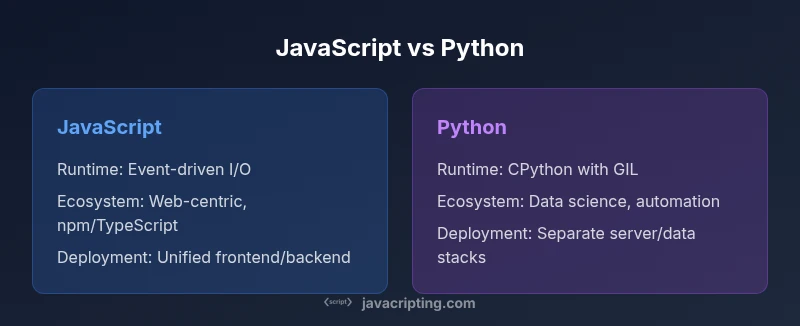
According to JavaScripting, for many teams, JavaScript offers a more cohesive web development stack than Python because you use the same language on the browser and server with Node.js, strong event-driven I/O, and a vast ecosystem. While Python shines in data science and scripting, JavaScript often provides faster iteration for web apps and practical deployment. See the full comparison below.
Context and Goals of the Comparison
This section clarifies why developers weigh JavaScript against Python in 2026. For many teams, the decision hinges on the intended application domain, deployment environments, and the pace of delivery. The JavaScript vs Python debate isn't only about language syntax; it's about the ecosystems, runtime models, and the patterns you adopt to ship features quickly. The core question is not 'which language is inherently better' but 'which language best aligns with your project goals, team composition, and operational constraints.' In practice, many modern web projects aim to cover both frontend and backend with a common mental model, making JavaScript a compelling candidate. According to JavaScripting analysis, the web-first approach often benefits from shared data models, tooling, and debugging workflows across the stack, reducing context switching and integration friction. At the same time, Python's strengths in data processing, automation, and scientific computing mean it remains indispensable in specialized domains. The guide that follows aims to provide objective, actionable guidance for aspiring developers and professionals seeking practical JavaScript guidance. We'll cover concrete use cases, decision criteria, and the trade-offs you should consider when choosing between these two languages.
Core Language Design and Runtime Models
JavaScript and Python embody different design philosophies and runtime models. JavaScript is a dynamically typed, prototype-based language designed from the ground up for the web, with an event-driven model that excels at non-blocking I/O. The browser environment enforces a single-threaded event loop in many contexts, while Node.js extends that model to servers, emphasizing asynchronous programming with promises and async/await. Python emphasizes readability, explicitness, and a rich standard library, with a traditional interpreter and a global interpreter lock (GIL) that impacts true multi-threading. In practice, you choose based on the core tasks: JavaScript tends to scale well for I/O-bound workloads and distributed services; Python often dominates in data processing, scripting, and rapid prototyping where numerical libraries and scientific stacks shine. Understanding these runtime differences helps teams align architecture, testing, and deployment with the language’s strengths.
Ecosystem and Tooling Landscape
The ecosystem is a major deciding factor. JavaScript dominates the web stack with npm, a vast repository of packages, and mature tooling for bundling, linting, and testing. TypeScript has emerged as a practical bridge, offering static typing while compiling to JavaScript for broader compatibility. Python’s ecosystem shines in data science, machine learning, automation, and research, with libraries like NumPy, pandas, scikit-learn, and PyTorch driving many workflows. For web development, JS tooling tends to be more opinionated and cohesive across frontend and backend, while Python tooling often requires combining frameworks (Django, Flask) with separate front-end tooling. The choice often comes down to whether a project benefits from a single language across the stack or specialized libraries that fit a data-centric domain.
Concurrency, I/O, and Performance Differences
Concurrency models shape performance profiles. Node.js uses an event loop and non-blocking I/O, enabling high throughput for many simultaneous connections. Python’s model relies on threading, asyncio, and sometimes multiprocessing to handle parallelism; the GIL in CPython can limit true parallelism for CPU-bound tasks, though worker processes and specialized implementations mitigate this in practice. For I/O-heavy web services, JavaScript generally delivers lower latency under load, while Python can excel in CPU-bound workloads when optimized with vectorized operations or native extensions. The decision should consider workload mix: if most tasks are I/O-bound or networked, JS often wins; if your workloads involve heavy numerical computation or AI, Python tends to be more productive with its mature libraries.
Use-Case Fit: Web Apps, Scripting, and Beyond
Web applications are the most visible battleground. JavaScript allows you to share data models, validation logic, and even UI components between client and server, reducing duplication and friction. Python, meanwhile, remains a leader in scripting, automation, data pipelines, and research prototyping where expressive syntax and a rich scientific stack accelerate development. For mobile or desktop apps, JavaScript ecosystems (Electron, React Native) provide cross-platform options, while Python may be used in automation layers or backend services. In enterprise contexts, teams often favor JS for rapid iteration on web-facing products and Python for data-driven components, creating a practical hybrid approach rather than a strict language duel.
Learning Curve and Team Dynamics
Team composition heavily influences outcomes. If a team already has frontend expertise, introducing JavaScript on the backend (via Node.js) can flatten onboarding and speed feature delivery. Conversely, if the team’s strengths lie in data science, statistics, or automation, Python’s readability and library wealth can shorten time-to-value. The learning curve for JavaScript is influenced by asynchronous programming patterns, toolchains, and evolving syntax (ESNext, TypeScript). Python emphasizes clarity and straightforward syntax, which often reduces cognitive load for beginners. Effective cross-training and shared coding standards help teams maximize the strengths of either language without sacrificing maintainability.
Security, Reliability, and Maintainability
Security practices differ by ecosystem, but common themes exist. JavaScript projects must manage dependency risk from npm, sandboxed execution in the browser, and secure API design for server-side code. Python projects must manage dependencies with care, avoid deserializing untrusted data, and ensure strong typing or linting to limit runtime errors. Maintainability hinges on clear typing (TypeScript for JS), consistent coding standards, comprehensive tests, and robust CI pipelines. In practice, the best outcomes come from choosing a language that aligns with your deployment architecture and instituting disciplined tooling to catch regressions, security issues, and performance bottlenecks early.
Decision Framework: When to Prefer JavaScript over Python
A practical decision framework helps teams decide when to prefer JavaScript. Start by listing your primary use-cases: web UI, API endpoints, data processing, or ML workloads. If web-facing features, real-time capabilities, or cross-platform consistency are priorities, JavaScript is usually the better baseline. If your focus is data analysis, scientific computing, or rapid scripting with an extensive scientific library, Python often provides faster time-to-value. Consider deployment realities: a single stack across client/server simplifies debugging and deployment pipelines, while independent stacks might suit specialized teams. Finally, assess your talent pool: leverage existing JS expertise for faster ramp-up, or leverage Python strength in data science when the product leans that way. A balanced approach—using JS where it shines for web apps and Python where data shines—delivers the best overall outcome.
Implementation Nuances: Interop, Transpilation, and Deployment Gotchas
Interop considerations matter when you mix languages. For web apps, you’ll often transpile newer JavaScript syntax (via Babel/TypeScript) for broad browser compatibility, and you’ll package server-side JS in environments like Node.js with a consistent package manager (npm/yarn). Python projects may rely on virtual environments, dependency pinning, and environment-specific deployments (e.g., containers, serverless). Transpilation and bundling can introduce build complexity, so you should invest in clear CI steps, reproducible environments, and strong integration tests. WebAssembly and Pyodide offer paths to run Python in the browser in constrained scenarios, but they add layers of complexity and may not be practical for all projects. The practical takeaway is to design your deployment pipeline so the language boundaries are intentional and maintainable rather than accidental sources of drift.
Comparison
| Feature | JavaScript | Python | |
|---|---|---|---|
| Runtime model and concurrency | Event-driven I/O; browser and Node.js environment | GIL-influenced CPython threading; asyncio/multiprocessing options | |
| Ecosystem scope | Web-centric; vast npm TypeScript ecosystem; strong frontend-backend parity | Strong data science and automation libraries; web stack needs more assembly of frameworks | |
| Performance characteristics | Excellent for I/O-bound web services; scalable with non-blocking I/O | Competitive for CPU-bound tasks with native extensions; rich numerical stack | |
| Learning curve and readability | Flexible syntax with evolving standards; async patterns are core | Emphasis on readability and explicit design; straightforward for beginners | |
| Deployment parity | Unified stack for client/server; streamlined tooling | Separate runtimes; strong foundation for data pipelines and ML apps | |
| Community and support | Massive web development community; rapid evolution of tooling | Strong data science and academic communities; niche for web | |
| Best for | Web-focused full-stack development and cross-platform apps | Data science, ML, automation, scripting, and research |
Benefits
- Unified language across frontend and backend reduces context switching
- Vast web-focused ecosystem and tooling accelerates development
- Strong community support for modern web standards and architectures
- Non-blocking I/O model in Node.js enables scalable web services
The Bad
- CPU-bound workloads may require additional optimization in JavaScript
- Python remains superior for data science and ML due to mature libraries
- JavaScript's dynamic typing can lead to runtime errors without proper tooling
JavaScript generally wins for web-focused full-stack development; Python remains strong for data science and automation.
JavaScript offers cohesive web-scale advantages for frontend/backend work, while Python excels in data-centric tasks. Choose JS for web stacks, Python for data science, and use a hybrid approach when both domains are essential.
Questions & Answers
Is JavaScript faster than Python for web applications?
In typical web app workloads, JavaScript with Node.js can achieve lower latency for I/O-heavy tasks thanks to its non-blocking model. Python can be competitive for certain workloads, especially when using asynchronous libraries or optimized native extensions, but JS generally edges out in real-time, web-facing scenarios.
Yes. For web apps that are I/O-bound, JavaScript often performs better due to its non-blocking architecture.
Can Python run in the browser?
Python does not run natively in browsers like JavaScript does. You can run Python in the browser via projects like Pyodide or via WebAssembly, but these are typically used sparingly and come with trade-offs. For standard client-side code, JavaScript remains the native choice.
Not natively. Python can run in the browser only through special tooling like Pyodide.
When should I choose Python over JavaScript?
Choose Python when your primary goals are data analysis, machine learning, automation, or rapid scripting with strong numerical libraries. If your project is web-centric and requires a shared frontend-backend language, JavaScript often offers faster iteration and easier deployment.
Pick Python for data science and automation; choose JavaScript for web-focused development.
How do concurrency models differ between Node.js and Python?
Node.js uses a single-threaded event loop with non-blocking I/O, which is ideal for many concurrent connections. Python offers threading, asyncio, and multiprocessing; the GIL can limit true multi-threading for CPU-bound tasks, so parallelism often relies on separate processes or native extensions.
Node.js uses an event loop for concurrency; Python relies on asyncio or multiple processes to achieve parallelism.
What deployment considerations matter when mixing JS and Python?
If you mix JS and Python, plan for separate runtimes with clear interfaces (APIs, message queues). A single-language stack can simplify deployment, but a microservices approach may suit teams needing specialized services. Ensure consistency in data exchange formats and versioning across services.
Think in terms of service boundaries and clear APIs when mixing languages.
What are common pitfalls when choosing JS over Python?
Common pitfalls include over-reliance on dynamic typing without strong tooling, npm dependency risks, and build complexity from transpilation. Conversely, underestimating Python’s data stack can slow data-driven projects. Plan for robust testing, type tooling, and dependency governance.
Watch out for dynamic typing issues and dependency management in JS, and for data-library expectations in Python.
What to Remember
- Choose JavaScript for cohesive web stacks
- Leverage Node.js for non-blocking I/O scalability
- Python excels in data science, ML, and scripting
- Assess team skills and deployment needs before deciding