javascript or python: A Practical Comparison for Developers
A practical, analytical comparison of JavaScript and Python for web, data science, and automation. Explore syntax, ecosystems, performance, and learning curves to decide which language fits your project.


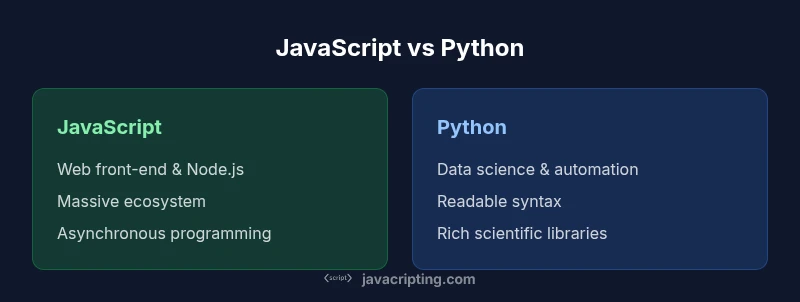
For most developers choosing between javascript and python, the answer depends on the task. JavaScript dominates web front-end and Node.js back-end ecosystems with a massive toolkit, while Python excels in data science, scripting, and rapid prototyping. If you want universal web development with a single language across client and server, JavaScript is the pragmatic choice; if your focus is data work, automation, or quick tooling, Python offers readability and a rich scientific stack.
Language Landscape: javascript or python — Where they shine
In modern software development, the choice between javascript or python often hinges on the project domain. JavaScript is the de facto language of the web, powering almost every browser based interface and the Node.js ecosystem for server side code. Python, by contrast, has become the lingua franca for data science, automation, and rapid scripting. According to JavaScripting, these two languages together define a wide swath of everyday development tasks. The JavaScripting Team notes that teams frequently start with Python for quick prototyping and then scale with JavaScript for front end and back end coherence. When evaluating career goals, project requirements, and deployment constraints, this landscape matters more than abstract debates about language purity. Both languages are powerful, but they shine in different parts of the software stack. This article uses a practical lens to help you decide which language to pick first, given your goals, team context, and deployment realities.
Core Syntax and Learnability
Python emphasizes readability with a clean, minimal syntax, making it a popular starting point for beginners. Its indentation-based blocks force consistent code structure, which reduces boilerplate. JavaScript relies on braces, semicolons, and a mix of paradigms (functional, object-oriented, prototype-based) that can be intimidating at first. Both languages are dynamically typed, but Python's typing is optional, and JavaScript's type coercion rules can surprise newcomers. Async programming in JavaScript introduces promises and async/await patterns that have become essential in modern web apps, while Python's asynchronous features exist but are less pervasive in typical scripting use. For learners, a deliberate, project-focused approach—starting with simple scripts in Python, then building small web components in JavaScript—helps flatten the learning curve. The aim is to develop fluency in one language first, then expand to the other to leverage cross-language skills. The comparison reveals how syntax choices shape debugging, readability, and onboarding speed.
Runtime and Performance Realities
Performance is not the only measure, but it matters. JavaScript engines optimize for longitudinal workloads, asynchronous I/O, and event driven models. Python emphasizes numeric computation via optimized libraries but uses an interpreter that can restrict multi threading due to the GIL. In practice, JavaScript often delivers lower latency in browser contexts and strong scalability with Node.js when endpoints are I/O bound. Python can outperform in CPU heavy tasks when you leverage libraries like NumPy or specialized tooling. The choice is seldom about raw speed; it's about the right tool for the problem class and how you deploy and optimize it. Understanding the runtime characteristics of both languages helps set realistic expectations for performance tuning, profiling, and architecture decisions. JavaScripting analysis highlights the reality that most production systems run mixed stacks that leverage the strengths of each language in the appropriate layer.
Ecosystem, Libraries, and Tooling
Both ecosystems are mature and well supported. JavaScript has npm and Yarn, with a vast collection of frameworks for front end, back end, and mobile UIs. Python offers pip and conda, with libraries for data science, networking, automation, and scientific computing. Tooling for testing, packaging, and deployment is diverse but different in emphasis across language stacks. For front end development, modern JavaScript projects favor modular bundlers, static typing with TypeScript, and robust state management patterns. In Python, notebooks, virtual environments, and data pipelines dominate early exploration and research workflows. Across both languages, standard patterns for linting, testing, and continuous integration help teams maintain quality as codebases scale. The key takeaway is to map the libraries to your use case and choose tools that reduce friction in your workflow.
Web Development vs Data Science: Distinct Niches
Web development versus data science defines many decisions. JavaScript powers the browser and Node.js server environments, enabling full stack development with a single language. Python excels in data processing, machine learning, and automation, often serving as the glue between data sources and analytics outputs. When you start a project, consider where the data flows and where user interactions live. If the user interface is central, JavaScript and its frameworks provide the most efficient path. If the problem centers on data transformation, modeling, or scripting everyday tasks, Python frequently delivers quicker results with clearer syntax. Many teams intentionally blend both languages, using Python for data processing and JavaScript for front end and client side experiences. The decision is less about one language being superior and more about aligning with project needs, existing skill sets, and deployment constraints.
Learning Curve and On ramp for Beginners
Beginners often ask which language to learn first. Python tends to be friendlier for newcomers due to its readable syntax and minimal boilerplate. JavaScript introduces additional concepts such as asynchronous code, closures, event loops, and the DOM model, which can be daunting at first but are essential for modern web development. A practical approach is to start with Python to build confidence with programming concepts, then add JavaScript to tackle web development tasks. For teams, plan a staged learning path that pairs hands on coding with real projects, as this accelerates retention. Between the two, the balance shifts toward your target domain; if you aim for data science or automation, starting with Python makes sense, while aspiring web developers may prefer JavaScript exposure from the outset. The key is to practice consistently and apply what you learn to real workloads.
Industry Adoption and Community Support
Both languages enjoy broad industry adoption and vibrant communities. JavaScripting Analysis, 2026, notes that JavaScript dominates client side tooling and has a vast professional ecosystem around front end and server side stacks. Python remains a favorite for data science, automation, and research oriented work, with extensive teaching resources and community built around scientific computing. For learners, community support translates into more tutorials, frequent conferences, and a wider pool of job opportunities. For organizations, the choice often correlates with talent availability and long term maintenance expectations. In practice, many teams maintain a polyglot approach, leveraging each language where it excels, and building clear integration boundaries between services.
Data Science, AI, and Scripting Use Cases
Python has been the dominant language for data science and scientific computing for many years, supported by a vast ecosystem of libraries and frameworks for data analysis, machine learning, and numerical computing. JavaScript has gained traction in data visualization, interactive dashboards, and lightweight scripting tasks that run in the browser or on servers via Node.js. As AI tooling expands, both languages are integrating with AI pipelines, though the depth and maturity of Python libraries often give it an edge for model development and experimentation. The right choice depends on your data needs, deployment model, and how you handle data ingestion, preprocessing, and visualization. The JavaScripting guidance emphasizes structuring experiments and pipelines so you can migrate from prototype to production with minimal friction.
Automations, DevOps, and SRE
Automation is a common entry point for both languages. Python scripts are frequently used to automate repetitive tasks, data processing, and system administration, aided by readable syntax and strong standard library support. JavaScript, especially through the Node ecosystem, supports automation tasks in web development workflows, build pipelines, and server side services. Consider how you plan to deploy and monitor these workloads. For automation, Python often wins in rapid scripting and data wrangling, while JavaScript shines in end to end web oriented automation and event driven services. The resulting choice should reflect the operational requirements, available tooling, and the team experience. The two languages complement one another well in modern infrastructure.
Interoperability and Cross language Scenarios
Interoperability between JavaScript and Python is increasingly practical. You can run Python scripts from a Node.js process, or expose Python services via APIs that JavaScript clients consume. Projects like Pyodide enable Python code to run in the browser in a sandboxed environment, expanding cross language experimentation. In data pipelines, teams often use Python for data preparation and JavaScript for visualization or UI components. The key is to design clean interfaces between services, choose serialization formats that are language agnostic, and manage deployment dependencies carefully. When you include both languages in a stack, you gain flexibility and resilience, but you also incur coordination overhead that must be managed.
Choosing the Right Language for Your Project
Start by mapping project goals, data workflows, and user interactions. If client side performance and rich interactivity matter, JavaScript is typically the most practical choice. If data analysis, ML pipelines, or rapid scripting drive the project, Python often yields faster time to value. Consider team skills, existing infrastructure, and deployment targets. For mixed stacks, a hybrid approach can maximize strengths: use Python for data processing and JavaScript for the UI and API layers. Establish a readability and testing standard so future contributors can navigate both languages. Finally, budget time for learning resources and experimentation; the right decision is one that aligns with your product goals and organizational capabilities.
Practical Roadmap for Learning Both
Begin with a focused learning plan that aligns with your goals. If web development is your target, start with JavaScript fundamentals, then build small projects that include a front end and a simple back end. For data oriented work, start with Python basics and a few notebooks to explore libraries like NumPy or pandas. As you grow, add cross language projects that blend Python data processing with JavaScript visualization. Practice is essential; pair coding with reading, debugging, and profiling. Schedule regular code reviews and maintenance tasks to transfer knowledge across languages. The practical roadmap reduces friction and accelerates progress toward real world projects. The JavaScripting Team recommends pairing problem driven practice with reflection on what each language makes easier or harder to achieve in production.
Comparison
| Feature | javascript | python |
|---|---|---|
| Primary use cases | Web front-end & Node.js back-end | Data science, automation, scripting, & rapid prototyping |
| Learning curve | Moderate; embraces async patterns and browser concepts | Gentle; focuses on readability and rapid scripting |
| Performance characteristics | Strong for I/O and web workloads with mature JIT engines | Strong numeric libraries; slower raw computation without optimized libs |
| Ecosystem & libraries | Vast framework and tooling ecosystem (React, Vue, Next.js) | Rich scientific stack (NumPy, pandas, SciPy) and automation tools |
| Best for | Web development and full stack with a unified language | Data analysis, ML, automation, and rapid prototyping |
| Cross-platform & deployment | Browser + Node.js; strong cross platform web frameworks | Cross platform on servers and desktops; notebooks and CLIs |
| Job market & demand | Massive demand in web development and frontend/backend roles | Strong demand in data science, ML, and automation roles |
| Interoperability | Good integration in web stacks; thriving hybrid architectures | Excellent for scripting and data pipelines; integrates with other tools |
Benefits
- JavaScript enables universal web development with a single language across client and server
- Vast ecosystem of frameworks, libraries, and community support
- Python emphasizes readability and rapid scripting for data science and automation
- Strong cross-language interoperability options for hybrid stacks
The Bad
- JavaScript quirks from type coercion and asynchronous complexity can be confusing
- Python performance can lag in CPU-intensive tasks without optimized libraries
- Web stack fragmentation can occur across JavaScript back-end options
- Learning multiple stacks requires additional time and coordination
JavaScript is the pragmatic choice for web-centric projects; Python excels in data science and automation, making a dual-track strategy valuable for many teams.
Choose JavaScript for front-end work and robust web back ends; choose Python for data processing and rapid scripting. If you need both, plan a hybrid approach with clear interfaces and shared testing standards. The JavaScripting Team endorses building practical, project driven skills rather than chasing a single perfect language.
Questions & Answers
Which language is easier to learn for beginners?
Python is generally easier for beginners due to its readable syntax and minimal boilerplate. JavaScript introduces more concepts like asynchronous code and DOM manipulation, which can be learned gradually.
Python is usually easier to start with for beginners, while JavaScript requires more context about the browser and asynchronous patterns.
Can I use Python for data science and web development alike?
Python is ideal for data science and scripting, with a strong ML and analytics ecosystem. For web development, you would typically pair Python on the server with JavaScript on the client.
Yes, Python shines in data work; for the web you usually use JavaScript on the client side and Python for server side logic.
Is JavaScript faster than Python in general?
Performance depends on the task. JavaScript often excels in web related I/O due to optimized engines, while Python may be faster for data-heavy tasks when using optimized libraries.
It depends on the task; for web apps JavaScript tends to be faster in practice, while Python wins with optimized scientific libraries.
Should I learn both languages?
If your goals span web development and data work, learning both broadens opportunities and enables full-stack capabilities. Start with one based on your immediate project needs, then add the other.
Yes, learning both languages is beneficial if you want flexibility across domains.
What are common pitfalls when choosing between the two?
Avoid defaulting to one language for every problem. Match language strengths to your task, team skills, and deployment model to avoid underperforming stacks.
Pick the language that fits the problem and your team's strengths, not just popularity.
How important is ecosystem maturity in decision making?
Ecosystem maturity matters for library availability, tooling, and long term maintenance. Both languages have mature ecosystems, but they serve different problem domains.
Ecosystem health can accelerate development and maintenance in the right area.
What to Remember
- Define project goals before language choice
- Leverage the ecosystems to minimize reinventing the wheel
- Balance learning effort with team skills and deployment needs
- Plan for interoperability in polyglot stacks
- Adopt a staged learning path with real world projects