Can You Use Python Instead of JavaScript for Web Development? A Practical Comparison
An analytical comparison of Python and JavaScript for web development, covering client-side vs server-side roles, ecosystems, deployment, performance, and practical architectures. Learn where Python shines and where JavaScript remains essential.


Can you use python instead of javascript for web development? The short answer is: not as a drop-in replacement for browser-side code, where JavaScript remains the standard. Python excels on the server, in data-centric backends, and in tooling. This comparison examines architecture, performance considerations, and ecosystem implications to help you decide where Python fits and where JavaScript remains indispensable.
Can you use python instead of javascript for web development? A practical lens
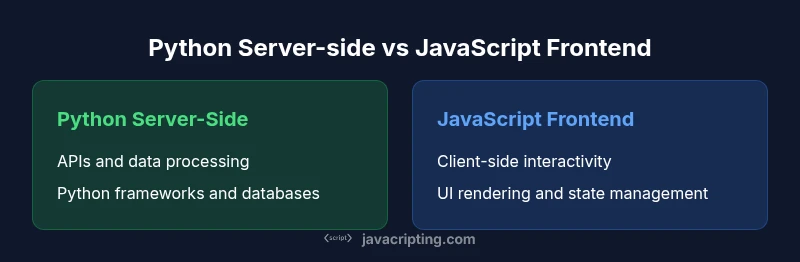
The direct question often surfaces in teams planning a polyglot stack: can you rely on Python to replace JavaScript across the full web application? The short answer is nuanced. Python cannot natively run in web browsers, so client-side interactivity still hinges on JavaScript. However, Python plays a central role in server-side logic, data processing, and API design. According to JavaScripting, modern web architectures increasingly separate concerns, using Python for backend services while JavaScript powers the frontend. The JavaScripting team found that successful projects often adopt clear boundaries between client-side interactivity and server-side processing, with explicit API contracts that minimize cross-language friction. This article uses that framework to explore where Python adds value and where JavaScript remains essential for a robust web experience.
The JavaScripting team found that teams achieving velocity typically structure projects so the backend handles data-heavy tasks while the frontend handles UI/UX and accessibility.
Comparison
| Feature | Python-centric server-side stack | JavaScript-centric web stack |
|---|---|---|
| Primary role | Back-end APIs, data processing, templating | Client-side rendering, event handling, UI state |
| Runtime environment | Python runtime on server (CPython, etc.) | Browser/Node.js runtime for frontend |
| Ecosystem breadth | Rich backend data libraries, ML tooling, web frameworks | Extensive frontend frameworks, state management, and tooling |
| Performance considerations | I/O-bound efficiency with async backends; CPU-bound tasks may need offloading | Client-side performance relies on browser engines and optimized DOM/JS |
| Learning curve | Backend-centric, emphasis on databases, APIs, security | Frontend-centric, emphasis on UX patterns, bundles, and tooling |
| Deployment | ASGI/WSGI deployments, containers, cloud services | Static hosting, serverless frontends, and Node.js-based backends |
| Best for | APIs, data apps, ML-powered services, batch processing | Interactive UIs, SPAs, real-time dashboards |
Benefits
- Clear separation of backend and frontend responsibilities
- Access to Python's rich data science and automation libraries
- Strong server-side performance for I/O-heavy workloads
- Rapid backend development and clean templating can accelerate features
The Bad
- No native Python execution in browsers; requires workarounds or transpilation for frontend code
- Context switching between languages can complicate debugging and testing
- Isomorphic apps need careful architecture to avoid duplication
- Potentially steeper deployment complexity when mixing runtimes and ecosystems
Python is not a universal replacement for JavaScript in web development; it shines on the server and in data-driven tasks, while JavaScript remains the default for client-side interactivity.
Adopt a polyglot approach: use Python for backend services and data processing, and JavaScript for the browser UI. Choose Python when rapid backend development and data workflows are a priority; prioritize JavaScript for frontend interactivity and performance.
Questions & Answers
Can Python run in the browser natively?
No. Python does not run natively in browsers. You would need a bridge like WebAssembly-powered runtimes (e.g., Pyodide) or transpilers (e.g., Brython, Transcrypt), which introduce overhead and compatibility trade-offs.
No native Python in browsers; you’d need WebAssembly or transpilers, which adds overhead and trade-offs.
Is Python good for backend web development?
Yes. Python is widely used for backend development due to frameworks like Django, Flask, and FastAPI, which streamline API design, data handling, and rapid iteration. It’s especially strong for data-heavy or ML-backed services, but may require careful handling of concurrency for high-traffic workloads.
Yes—Python is strong for backend work with popular frameworks and data-related workloads.
What are common Python web frameworks used in production?
Common choices include Django, Flask, and FastAPI. They offer different philosophies: Django emphasizes batteries-included features; Flask provides minimalism and flexibility; FastAPI focuses on speed and modern asynchronous support. Each has deployment considerations and ecosystem strengths.
Django, Flask, and FastAPI are popular Python web frameworks with different strengths.
How do you deploy Python web apps?
Python web apps are typically deployed via WSGI or ASGI servers, containerized with Docker, and hosted on cloud platforms. Choice of server (Gunicorn, Uvicorn) and deployment pipeline impacts concurrency, performance, and scalability.
Deploy Python apps on servers like Gunicorn or Uvicorn, often with containers and cloud hosting.
Can I build a full-stack app with Python?
You can build a full-stack app using Python on the server and JavaScript on the client. Some teams add Python-to-JS transpilation or use Pyodide for browser-side Python in specific scenarios, but most production stacks keep a JS frontend for reliability and performance.
Yes, with Python on the backend and JavaScript on the frontend, sometimes with bridges when needed.
What about performance differences between Python and JavaScript for web apps?
Performance is context-dependent. JavaScript in the browser benefits from highly optimized engines, while Python excels at rapid backend development and I/O-bound workloads with asynchronous frameworks. For CPU-bound tasks, you often offload to specialized services or use concurrent patterns.
Performance depends on context; JS shines in the browser, Python excels on the server with async patterns.
What to Remember
- Define clear role boundaries between backend and frontend
- Leverage Python for APIs, data processing, and server-side logic
- Reserve JavaScript for client-side interactivity and UI rendering
- Consider bridging tools carefully (e.g., Python-to-JS options) and weigh maintenance
- Adopt a polyglot stack for best results in modern web apps