Python vs JavaScript: A Practical, Objective Comparison
A practical, analytical comparison of using Python instead of JavaScript, outlining contexts, tradeoffs, and best-use scenarios for web development, backend services, and tooling.


can you use python instead of javascript? In practice, the answer depends on context. For server-side tasks, automation, and data pipelines, Python can substitute many JavaScript duties; for browser-based UI and client logic, JavaScript remains essential. This quick comparison highlights viable substitution points and clear boundaries between the two languages.
can you use python instead of javascript
The question can you use python instead of javascript hinges on where the code runs and what the user experiences. In server-side environments, automation tasks, data processing, and tooling, Python often delivers rapid development cycles and a strong standard library. According to JavaScripting, Python’s readability and ecosystem make it a compelling substitute for many non-UI tasks. However, on the client side—inside the browser—JavaScript remains the default because browsers execute JavaScript natively and security models are tuned around it. This means the practical answer is nuanced: Python can replace JavaScript in certain lanes, but not universally across the entire tech stack. In this section we’ll map the contexts where Python shines and where it faces real limitations, with concrete examples and guardrails. The goal is to help you decide early whether a Python-centric approach can meet your project goals without sacrificing user experience or maintainability. As teams explore can you use python instead of javascript in production, they should assess runtime environments, deployment strategies, and the skills available in the team.
Language Roles and Environments
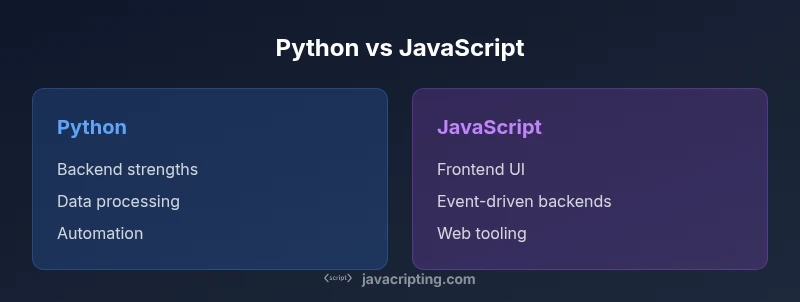
Python and JavaScript occupy complementary roles in modern software. Python excels in server-side development, automation scripts, data pipelines, scientific computing, and internal tooling. JavaScript dominates browser-based interfaces, client-side logic, and event-driven web apps. Although Python can run in the browser with projects like Pyodide or Transcrypt, these ecosystems introduce trade-offs in performance, compatibility, and ecosystem maturity. When deciding can you use python instead of javascript in a full-stack project, teams should weigh execution context, user experience, and deployment realities. Python tends to accelerate back-end MVPs due to its expressive syntax and abundant frameworks; JavaScript tends to speed up UI prototyping thanks to its native browser support and rich front-end libraries. A balanced approach often favors language-agnostic architecture: Python for server-side services, data processing, and automation, while JavaScript handles the interactive frontend. The JavaScripting team notes that bridging both worlds is common in production environments, enabling teams to leverage each language’s strengths while keeping maintenance manageable. Remember that the best choice evolves with project scope and team expertise, not abstract ideals.
Performance and Scalability Considerations
Performance is a central criterion when choosing between Python and JavaScript. Python’s interpreted nature and the Global Interpreter Lock (GIL) influence CPU-bound workloads, often making raw computation slower than optimized JavaScript runtimes for certain tasks. For I/O-bound workloads, asynchronous frameworks in Python (like modern async tooling) can approach JavaScript’s responsiveness, but the choice hinges on latency requirements, concurrency models, and deployment context. JavaScript, particularly on the server-side with Node.js, emphasizes event-driven, non-blocking I/O, which excels for high-concurrency services. Each language’s performance profile is coupled with the ecosystem’s maturity and available optimization paths, such as just-in-time compilation, multi-process architectures, and native add-ons. When evaluating can you use python instead of javascript for a high-traffic service, quantify not only language speed but also ecosystem support, libraries, and hosting options that influence real-world latency and reliability.
Ecosystem, Libraries, and Tooling
The ecosystem matters as much as language syntax. Python offers an extensive standard library and battle-tested frameworks for data science, automation, APIs, and scientific computing. JavaScript dominates the frontend ecosystem with an enormous catalog of UI components, testing tools, build systems, and deployment pipelines. For backend tasks, Python’s Django, Flask, and FastAPI provide rapid development paths, while JavaScript’s Express, Nest, and serverless communities offer equally robust alternatives. Tooling differences shape developer experience: Python’s packaging and virtual environments promote clean dependencies, whereas JavaScript tooling emphasizes modular bundling, tree-shaking, and cross-platform execution. The choice can hinge on how easily teams can assemble a reliable CI/CD workflow and how readily they can reuse existing code in a polyglot stack.
Frontend Feasibility: Pyodide, Brython, Transcrypt
Frontend viability for Python is limited by browser-native support, but several projects attempt to bridge the gap. Pyodide compiles Python to WebAssembly to run in the browser, which enables Python code to execute client-side, albeit with overhead and size considerations. Brython and Transcrypt offer alternative approaches to write frontend logic in Python, but they introduce compatibility challenges with modern JavaScript ecosystems and tooling. For teams asking can you use python instead of javascript for client-facing features, these options can be part of a hybrid strategy, yet they rarely replace JavaScript wholesale. If the project requires fast startup, broad browser integration, and native UI libraries, sticking with JavaScript remains the safer bet, while Python can power non-UI components or progressive enhancement layers.
Security, Maintenance, and Team Fit
Security and maintainability depend on the broader system architecture rather than language alone. JavaScript’s ubiquity in client-side code enforces consistent security practices for the browser, while Python’s server-side prevalence requires robust input validation, dependency management, and secure deployment pipelines. Teams should consider the long-term availability of language runtimes, the ease of onboarding new developers, and the cost of maintaining polyglot codebases. A well-documented API surface, clear ownership, and a disciplined testing strategy reduce risk when blending Python and JavaScript. The blend is common in modern workflows where Python handles data processing, scripting, and API services, while JavaScript powers the user interface and front-end logic. The decision should reflect organizational strengths and project goals rather than a one-size-fits-all preference.
Cost, Licensing, and Long-Term Viability
Total cost of ownership includes runtime costs, developer time, and licensing where applicable. Open-source ecosystems for both languages reduce licensing friction, but organizational constraints—such as existing infrastructure, cloud services, and vendor support—can tilt decisions. Python’s libraries for AI, data science, and automation can accelerate development but may require careful dependency management. JavaScript ecosystems bring efficiency in deployment, static typing options, and enterprise-grade tooling that support large teams. Consider long-term viability by assessing community momentum, security advisories, and the availability of specialists who can maintain the stack across years. A pragmatic approach weighs immediate development speed against future maintenance burden and the risk of stagnation in either ecosystem.
Practical Decision Framework: When to Choose Python vs JavaScript
To decide which language fits your project, apply a simple framework: (1) Define the user-facing requirements and whether client-side execution is essential; (2) Identify server-side workloads, data processing needs, and automation goals; (3) Assess existing team expertise and willingness to adopt a polyglot approach; (4) Evaluate deployment constraints, including runtime environments, hosting, and CI/CD pipelines; (5) Consider long-term maintenance and security implications. If the primary goal centers on server-side logic, data workflows, or rapid scripting, Python often shines. If the objective emphasizes interactive UI, browser compatibility, and performance in the client, JavaScript is typically the safer default. In mixed projects, a hybrid architecture—Python for back-end services and JavaScript for frontend—can offer the most balanced outcome, enabling teams to leverage each language’s strengths while maintaining a cohesive system.
Common Misconceptions and Pitfalls
A frequent misconception is that Python and JavaScript are interchangeable in all contexts. In practice, attempting to run frontend logic with Python directly in the browser introduces performance, tooling, and compatibility risks. Another pitfall is underestimating ecosystem fragmentation when using Python for web frontends via transpiled approaches; it can lead to brittle builds and delayed feature parity. Conversely, assuming that Python alone can handle every data-intensive task without considering architecture and concurrency can also cause bottlenecks. A thoughtful approach combines clear architectural boundaries, thorough testing, and a willingness to adopt a polyglot stack when it aligns with project goals and team capabilities.
Comparison
| Feature | Python | JavaScript |
|---|---|---|
| Frontend viability | Limited; requires transpilation or specialized runtimes (e.g., Pyodide, Brython) with trade-offs | Native/browser-supported frontend development; broad ecosystem and tooling |
| Backend/server-side strength | Rich frameworks and concise syntax for APIs, data processing, and automation | Event-driven, non-blocking I/O with Node.js; strong for scalable services |
| Performance profile | Interpreted, GIL limits on CPU-bound tasks; strong for I/O and rapid prototyping | V8/JIT optimizations; excellent for concurrent I/O-heavy workloads |
| Learning curve | Generally beginner-friendly; readable syntax and extensive docs | Quirks and asynchronous patterns; richer ecosystem can be overwhelming |
| Ecosystem maturity | Deep in data science, automation, and scripting; diverse libraries | Mature for frontend, testing, and deployment; massive library ecosystem |
| Best use case | Back-end services, data processing, scripting, automation | Interactive web apps, UI logic, real-time features |
Benefits
- Clear back-end strengths with rapid development cycles
- Excellent libraries for data, AI, and automation
- Readable syntax aids maintenance and onboarding
- Strong tooling for testing, deployment, and scripting
The Bad
- Not ideal for browser-native frontend without workarounds
- Python may underperform CPU-intensive tasks compared to JavaScript
- Polyglot stacks increase maintenance and context switching
- Frontend performance can be challenging when using non-native Python approaches
Python excels on the server and in tooling; JavaScript dominates the frontend
Choose Python for back-end services, data workflows, and automation. Use JavaScript for client-side UI and browser-based logic. A hybrid approach often yields the best balance for modern, multi-tier applications.
Questions & Answers
Can Python replace JavaScript for frontend development?
In most cases, Python cannot fully replace JavaScript for frontend development due to browser-native execution requirements and ecosystem maturity. Client-side interactivity and UI responsiveness rely on JavaScript or WebAssembly-based approaches, with Python-based options offering limited, specialized use cases.
Python can’t fully replace JavaScript for frontend development; use it for back-end or tooling, and consider browser-based Python options only for niche tasks.
What are the best scenarios to choose Python over JavaScript?
Python shines in server-side development, data processing, automation, and rapid MVPs. It’s ideal when you need quick data pipelines, API backends, or scripting capabilities, with JavaScript handling the UI in a separate layer.
Choose Python for back-end services and data workflows; keep JavaScript for the user interface.
Are Pyodide, Brython, or Transcrypt viable solutions for front-end work?
These projects offer ways to run Python in the browser, but they come with performance, compatibility, and ecosystem trade-offs. They’re useful for experiments or niche apps, not a wholesale replacement for JavaScript in production frontends.
Browser Python tools exist, but they’re not a drop-in replacement for standard front-end development.
Does Python perform well for high-traffic back-end services?
Python can scale for many back-end use cases, but performance tuning, asynchronous patterns, and deployment infrastructure matter. For CPU-heavy workloads, consider architectural choices or language-appropriate optimizations to meet latency targets.
Yes, with proper architecture and asynchronous design; monitor performance and optimize where needed.
How should teams approach language choice in a real project?
Assess runtime environments, user experience requirements, team expertise, and long-term maintenance. A polyglot strategy—Python on the server and JavaScript on the client—often delivers the best balance.
Evaluate contexts, skills, and maintenance when picking languages; a mixed stack is common.
Is there a steep learning curve switching from JavaScript to Python?
For developers new to Python, the syntax is generally approachable, but transitioning across a polyglot stack requires understanding concurrency, deployment, and ecosystem nuances.
Python is approachable, but a polyglot environment adds learning layers.
What to Remember
- Start with architecture: separate server and client responsibilities
- Leverage Python for data processing, APIs, and automation
- Reserve JavaScript for rich, interactive frontend features
- Assess team skills and deployment constraints before choosing
- Consider a polyglot stack to maximize each language’s strengths