Can You Replace JavaScript with Python? A Practical Comparison
An analytical guide exploring can you replace javascript with python, comparing language design, ecosystems, performance, and migration strategies to help teams decide when each language fits best.


can you replace javascript with python? Short answer: no—JavaScript is essential for browser front-ends, while Python excels on the server, in data tooling, and automation. This comparison explains why teams often pursue a hybrid approach rather than a wholesale replacement. Can you replace javascript with python is a nuanced question rooted in runtime, user experience, and project goals.
Context: can you replace javascript with python in modern development?
The key question can you replace javascript with python is nuanced and often misunderstood. According to JavaScripting, the simplest instinct—to swap one language for another—ignores critical differences in where code runs and how users interact with apps. This article analyzes if such a wholesale replacement makes sense, or if a hybrid approach delivers better outcomes. We’ll compare language design, runtime environments, ecosystem maturity, and deployment models; we’ll also provide practical guidance for teams considering a transition. By focusing on concrete use cases—web front-ends, server-side services, data processing pipelines, and automation tasks—we’ll illuminate where Python adds value, and where JavaScript remains indispensable. The goal is to equip readers with a decision framework rather than a one-size-fits-all prescription. Throughout, we’ll use real-world scenarios to ground the discussion.
Technical differences in language design
The question can you replace javascript with python is rarely resolved by syntax alone. JavaScript embraces event-driven, asynchronous paradigms, while Python emphasizes readability and module-centric design. These foundational differences affect how you structure code, reason about state, and reason about performance under load. In practice, teams often start from a shared problem statement—what behavior must happen in the browser versus on the server—and then map responsibilities to the strongest language for each domain. The takeaway is not to eliminate one language in favor of another but to align capabilities with responsibilities, ensuring the user experience remains coherent across systems. In can you replace javascript with python terms, you’ll see the split become clearer as you evaluate tasks and constraints.
Runtime environments and performance implications
When considering can you replace javascript with python as a decision criterion, runtime environment becomes a pivotal factor. JavaScript runs in the browser with immediate access to the DOM and event loops, while Python runs outside the browser in server processes or scripts. This distinction affects latency, concurrency models, and resource management. Browser performance hinges on efficient rendering, client-side libraries, and asynchronous patterns; server-side Python performance often depends on I/O throughput, database access, and the efficiency of chosen frameworks. The performance picture is rarely about raw speed alone; it’s also about how well each language matches the workload, deployment model, and user expectations. In can you replace javascript with python discussions, you’ll often see a hybrid approach favored for this reason.
Ecosystem and tooling considerations
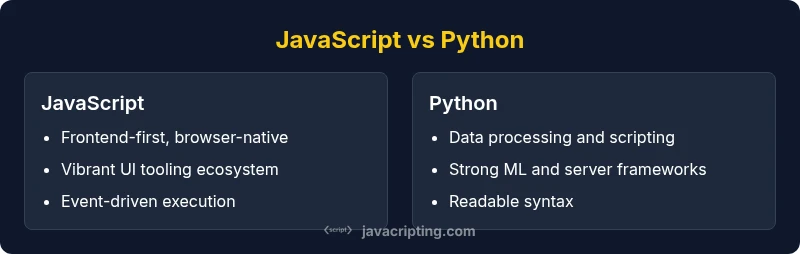
The question can you replace javascript with python surfaces differences in ecosystems and tooling. JavaScript’s ecosystem for the browser is vast, with frameworks, build tools, and debugging workflows woven into the front-end stack. Python, by contrast, dominates data science, automation, and back-end development with mature libraries for ML, data processing, and rapid scripting. Tooling compatibility matters: build pipelines, deployment scripts, and monitoring must support both languages, or you risk fragmentation. In can you replace javascript with python conversations, teams often plan around clear boundaries: use JavaScript where the browser is involved, and leverage Python where data, interoperability, or back-end processing is central. The outcome is a pragmatic pipeline that leverages each language’s strengths.
Use-case driven guidelines
The can you replace javascript with python inquiry gains practical clarity when framed around use cases. If your primary workload is client-side interactivity, accessibility, and responsive UI, JavaScript remains essential. If the core tasks involve data analysis, ML workflows, or server-side orchestration, Python offers compelling advantages. Hybrid architectures—where Python powers APIs and data services while JavaScript drives the user interface—often deliver the best balance of performance, developer experience, and maintainability. In can you replace javascript with python planning sessions, define a mapping from features to language responsibilities, then validate with small pilot projects before large-scale migrations.
Security, concurrency, and deployment models
In the can you replace javascript with python decision, security and deployment models play a central role. JavaScript runs in user agents with client-side exposure, demanding careful handling of XSS, CSPs, and secure API calls. Python servers bring their own security considerations, including dependency management and secure handling of data processing tasks. Concurrency models differ: JavaScript uses an event-driven model with an asynchronous runtime, whereas Python relies on threads, processes, or asyncio-based patterns. When mapping can you replace javascript with python, teams should plan for defense-in-depth across both front-end and back-end layers, ensuring secure interfaces, consistent validation, and robust monitoring across the stack.
Learning curve and team dynamics
The can you replace javascript with python question intersects people, process, and skill. Teams accustomed to JavaScript’s flexible, in-the-browser environment may face a steeper uphill when moving backend logic to Python, particularly around Web frameworks and packaging, while Python developers may struggle with front-end integration specifics. A hybrid approach can mitigate risk, enabling gradual skill upskilling and progressive migration. The key is to create shared conventions, robust documentation, and clear ownership boundaries so that learning curves do not derail delivery. In can you replace javascript with python discussions, establish cross-functional teams that coordinate interfaces and contracts across the stack.
Migration paths and hybrid approaches
Addressing can you replace javascript with python requires practical migration plans. Rather than a big-bang rewrite, many teams adopt phased migrations, starting with isolated services or data processing tasks. Strive for well-defined APIs, versioned interfaces, and gradual exposure of Python-powered services to front-end clients via stable endpoints. Hybrid architectures reduce risk, enabling concurrent improvements in both languages while preserving user experience. In can you replace javascript with python journeys, monitor performance, collect feedback, and adjust scope as you learn what works best for your domain.
Common misconceptions debunked
The can you replace javascript with python premise is often shaped by myths: that Python is slower in all server tasks, or that browser execution requires JavaScript exclusively. In reality, Python excels in scripting, automation, and data work, while JavaScript remains unmatched for browser-centric interactivity. WebAssembly and cross-language tooling can blur boundaries, but they do not erase the inherent strengths of each language. In can you replace javascript with python discussions, you’ll find that most practical decisions hinge on where the code runs and what problem you are solving, not on abstract speed claims or nostalgia for a single language.
Decision framework for choosing Python vs JavaScript
The can you replace javascript with python evaluation benefits from a structured framework. Start by cataloging features, responsibilities, and performance goals. Then assign language ownership to the components where they excel: frontend tasks to JavaScript, data processing and APIs to Python. Validate decisions with pilot projects, measure user impact, and prepare a staged path for migration or parallel development. This framework helps teams weigh trade-offs without forcing an all-or-nothing choice.
Practical example scenario: a data-driven web app architecture
In can you replace javascript with python terms, consider a data-driven web application with rich UI and heavy analytics. Use JavaScript to render interactive dashboards, while Python handles data ingestion, cleaning, and model inference on the server. The browser communicates with Python-powered APIs to fetch results, ensuring the UI stays responsive. This arrangement demonstrates how can you replace javascript with python, when applied judiciously, can deliver strong performance and maintainability without sacrificing user experience.
How to communicate decisions with stakeholders
When discussing can you replace javascript with python with stakeholders, emphasize goals, risks, and phased milestones rather than language wars. Present a hybrid blueprint that highlights ownership boundaries, deployment timelines, and measurable outcomes. Align success criteria with user impact, system reliability, and cost efficiency rather than language loyalty. In can you replace javascript with python conversations, clear communication reduces resistance and fosters collaborative decision-making.
Migration planning templates and risk management
A practical approach to can you replace javascript with python includes structured migration templates and risk management. Create a living document that captures scope, dependencies, required tooling, and rollback plans. Identify single points of failure, plan redundancy, and ensure alignment with security and compliance. By treating the migration as an iterative program rather than a one-off rewrite, teams can adapt to feedback while maintaining velocity in product delivery.
Summary of pragmatic guidance
In can you replace javascript with python discussions, the pragmatic takeaway is to treat the problem domain as the primary driver, not the language itself. Focus on where each language shines, implement a clear split of responsibilities, and pursue incremental improvements with robust governance. The goal is to maximize business value while minimizing risk, rather than chasing a blanket replacement.
],
Comparison
| Feature | JavaScript | Python |
|---|---|---|
| Typical use | Frontend/web interactivity | Backend, data processing, automation |
| Runtime environment | Browser/Node.js, client-side | CPython/alternative interpreters, server-side |
| Performance characteristics | Event-driven, non-blocking for UI tasks | Compute-heavy tasks, ML, scripting with optimized libraries |
| Learning curve | Large frontend ecosystem; learning curve depends on frameworks | Gentle syntax; strong data tooling but backend concepts may vary |
| Tooling ecosystem | Rich browser tooling, bundlers, testing, CI for front-end | Mature back-end stacks, data science, deployment pipelines |
| Community and support | Massive frontend community, constant framework churn | Strong data/ML and web backend communities |
| Cross-platform support | Excellent in browsers; mobile with transpilation/compilation | Cross-platform on servers and desktops; strong scripting support |
Benefits
- Leverages each language where it shines (frontend vs backend)
- Enables hybrid architectures that optimize concerns like UX and data processing
- Preserves existing skill sets and reduces risk with phased migrations
- Strong ecosystem support for both languages across domains
- Clear ownership boundaries improve maintainability and velocity
The Bad
- Maintaining two language ecosystems can increase complexity and tooling overhead
- Partial replacements may lead to integration friction and inconsistent UX
- Migration projects require careful planning, governance, and stakeholder alignment
Hybrid usage beats wholesale replacement in most cases
JavaScript should typically stay for browser-based tasks, while Python leads in backend, data, and automation. A staged, hybrid approach often delivers the best balance of performance, maintainability, and developer productivity. The JavaScripting team recommends evaluating use cases, starting with pilots, and documenting interfaces before any large-scale migration.
Questions & Answers
Can Python replace JavaScript in the browser?
No—Python isn’t natively supported in browsers for front-end interactivity. Some projects use WebAssembly or Pyodide to run Python in a limited browser context, but standard browser scripting remains JavaScript-dominant. Use Python on the server or in tooling, not as a browser replacement.
No, Python isn’t a drop-in browser replacement; use Python for backend tasks and keep JavaScript for interactive UI.
Is Python viable for server-side web apps instead of Node.js?
Yes, Python-powered frameworks like Django or Flask are common choices for server-side web apps. They offer productive patterns, robust libraries, and strong ecosystem tooling. The decision should hinge on project requirements, team expertise, and performance considerations rather than rigidity about language choice.
Yes, Python works well on the server with mature frameworks.
What are the best use cases for each language?
JavaScript excels in browser-based interactivity, UI rendering, and real-time front-end tasks. Python shines in data processing, scripting, automation, and server-side logic. In practice, many teams combine both, using Python for backend services and JavaScript for the frontend.
JS for UI, Python for data/server tasks.
How can we migrate gradually without a big rewrite?
Adopt a phased approach: start with API boundaries, seed Python services, and incrementally migrate features while preserving user experience. Use clear contracts, versioned interfaces, and staged deployments to minimize risk. Monitor performance and user impact at each step.
Start small, define clear interfaces, test early, and roll out gradually.
What about performance and security concerns?
Performance depends on workload and architecture, not language alone. JavaScript handles client-side responsiveness well, while Python offers strong server-side performance with optimized libraries. Security should be addressed across the stack with proper input validation, secure APIs, and ongoing monitoring.
Performance and security require careful end-to-end design, not language choice alone.
What to Remember
- Define language ownership by task domain
- Adopt a hybrid architecture where it fits best
- Pilot migrations before full rewrites
- Invest in robust interfaces and governance
- Communicate decisions with stakeholders clearly