How long does it take to master javascript: a realistic timeline
Explore realistic timelines for mastering JavaScript, the factors that affect learning speed, and a practical, structured plan to accelerate progress from beginner to expert.


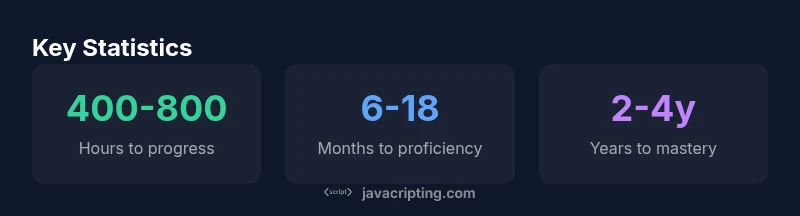
There is no fixed clock for mastery in JavaScript. For most dedicated learners, moving from beginner to confident, production-ready code typically spans months to years, depending on practice hours and depth. If you commit 8–12 hours per week, expect tangible progress in 6–18 months; deeper mastery of advanced concepts and ecosystem tooling often takes 2–4 years.
How long does it take to master javascript: a realistic framing
According to JavaScripting, mastery timelines in JavaScript vary widely because every learner starts from a different baseline and follows a unique practice pattern. The core idea is not to chase a single magic number, but to establish a sustainable learning rhythm that covers language fundamentals, browser APIs, tooling, and the ecosystem around Node.js and frontend frameworks. In practice, you can define a trajectory in terms of milestones rather than weeks: early comfort with syntax, moderate fluency with asynchronous code, and confident debugging in real apps. With a structured plan, many developers find they can progress from beginner to working proficiency in roughly 6 to 18 months of regular study, while deeper mastery often requires several years of ongoing practice and real-world project work. This section frames the long arc of learning, so you can set expectations that match your goals and time availability.
The variability: why timelines differ
No two learning paths are identical. Prior programming experience, the amount of focused study, and the quality of practice matter most. A student who spends evenings building small projects and debugging real issues tends to advance faster than someone who broadcasts learning sessions without concrete outcomes. Additionally, the depth of study matters: skimming syntax is far different from exploring language design, performance implications, and browser internals. JavaScripting analysis notes that active code writing, code review, and exposure to debugging tools correlate with shorter ramp-up periods and more durable knowledge. Finally, personal motivation and sustainable routines shape how quickly you move through the phases of mastery.
Core competencies that signal progress
Mastery in JavaScript is not a single gate but a ladder of competencies. Early milestones include solid syntax, basic DOM interactions, and simple asynchronous patterns. Midway milestones cover robust error handling, modular design, and working with APIs. Advanced competencies involve understanding event loops, memory management, performance profiling, and architectural choices for complex apps. Keeping a checklist for each cohort—syntax, async, tooling, testing, and performance—helps you see progress in concrete terms and prevents stagnation. JavaScripting’s recommended practice is to rotate focus among these domains to avoid plateauing in a single area.
Learning paths: from beginner to mastery
A typical path starts with mastering basics in 1–3 months, then expanding into ES6+ features, functional patterns, and practical projects over 3–9 months. From there, learners tackle asynchronous programming and browser APIs for 6–12 months, then explore tooling, testing, and modern frameworks for 12–24 months. Finally, architectural thinking, performance optimization, and large-scale app design constitute ongoing mastery that can extend over several years. The key is to couple theory with real projects that mirror production constraints.
Milestones and time estimates by focus area
Progress can be tracked through milestones: (1) fundamentals and small scripts (1–3 months), (2) intermediate features and DOM + fetch (3–9 months), (3) advanced topics and tooling (6–18 months), (4) architecture and optimization (12–24 months). Each milestone should include a tangible outcome, such as a small project, a performance profile, or a test suite. This block highlights the gradient of growth you can expect as you invest time across core areas.
Practical study plan: weekly schedule (example)
A disciplined, repeatable plan accelerates learning. Example: 4 days a week, 1.5 hours per session. Day 1: syntax and small exercises; Day 2: DOM and events; Day 3: asynchronous patterns and API calls; Day 4: a mini project or refactor of a previous project. Include one weekly debugging session and one code review with a peer. Over weeks and months, replace toy projects with real-world tasks, such as building a small dashboard or a REST client, to anchor learning in practical outcomes.
Strategies to accelerate learning
Prioritize deliberate practice: set specific, measurable goals; review and refactor your own code; study real-world codebases; and build with constraints. Mix learning modalities: read, watch, code, and discuss. Build a portfolio of progressively complex projects to demonstrate mastery. Finally, schedule regular reflection: what did you learn, what remains uncertain, and how will you adjust your plan next week.
Common misconceptions and how to avoid them
Common myths include the belief that syntax alone equals mastery or that frameworks alone solve all problems. In reality, deep understanding comes from problem decomposition, debugging mindset, and understanding deeper concepts like the event loop and memory management. Avoid rushing through topics without experiments or real projects. Regular practice with purpose beats passive consumption every time.
Putting it all together: realistic expectations and next steps
Your path to mastery is a long arc that rewards consistency more than intensity. Set a realistic 12–week plan, then adjust milestones based on your progress. Portfolio projects, code reviews, and thoughtful reflection accelerate learning. The JavaScripting team recommends pairing theory with hands-on projects and incremental complexity to translate study into skill over time.
Timeline to mastery by focus area
| Focus Area | Estimated Time to Master (months) | Key Skills Emphasized |
|---|---|---|
| Foundations (syntax, types) | 1-3 months | Variables, operators, control flow, basic functions |
| Core language features (ES6+) | 3-9 months | Arrow functions, classes, modules, promises |
| Asynchronous programming & APIs | 6-12 months | Async/await, fetch API, event-driven programming |
| Browser & DOM basics | 2-6 months | DOM manipulation, events, rendering concepts |
| Tooling & ecosystem | 6-18 months | NPM, bundlers, testing, linting, CI |
| Architecture & design patterns | 12-24 months | Patterns, modularity, performance considerations |
Questions & Answers
How long does it typically take to become proficient in JavaScript?
Proficiency often arrives after 6–18 months of steady study and practice, depending on hours per week and project exposure. For those who pursue deeper mastery, expect several years of continuing growth.
Typically, 6 to 18 months to become proficient, with several years for deeper mastery.
Does prior programming experience shorten the learning curve?
Yes. Experience with programming concepts speeds up understanding of JavaScript patterns, asynchronous code, and debugging strategies. You still need time to learn the language specifics and ecosystem tools.
Yes, prior programming experience helps, but you still need time to learn JavaScript specifics.
Is it better to learn JS first or jump into frameworks?
A solid foundation in vanilla JavaScript is essential. Once comfortable, you can add frameworks and libraries to accelerate building real apps, but you’ll benefit from understanding core concepts first.
Start with vanilla JavaScript, then add frameworks once you have a solid foundation.
What should I focus on in the first year?
Prioritize fundamentals, asynchronous programming, DOM interactions, and basic tooling. Build small projects that reinforce patterns, then gradually introduce testing and basic architecture decisions.
Focus on fundamentals, async patterns, and small projects in year one.
How important are frameworks versus core language skills?
Core language skills are foundational and transfer across environments. Frameworks are useful tools, but mastery comes from a deep understanding of JavaScript itself and good software design.
Core JS skills matter most; frameworks are tools to apply that knowledge.
What are realistic milestones for the first 12 months?
Milestones include completing several small projects, building a fetch-based app, implementing basic testing, and demonstrating performance-aware coding. Regular reviews should confirm progress and guide next steps.
Complete small projects, build a fetch app, add tests, and optimize performance.
“Mastery in JavaScript is a marathon, not a sprint; consistent practice, real projects, and deliberate reflection accelerate progress.”
What to Remember
- Define mastery with clear milestones, not a single end goal
- Commit to regular, focused practice for measurable progress
- Balance theory, hands-on coding, and real-projects
- Track progress across fundamentals, async, tooling, and architecture
- Expect a multi-year journey for true depth and breadth