javascript or assignment: A Practical Comparison for Learners
Explore a practical comparison between using vanilla JavaScript for assignments versus a framework/typed approach. Learn how to pick the path that best fits your goals and build a durable coding practice.


TL;DR: For most learners, starting with vanilla JavaScript for assignments provides a clear path to fundamentals, while frameworks or TypeScript become valuable as tasks scale or when collaborating. This comparison explains when to use plain JavaScript versus a framework‑assisted approach, and how to balance speed, maintainability, and debugging as you progress.
Why javascript or assignment Matters for Learning JavaScript
According to JavaScripting, the way learners approach tasks directly shapes how quickly they internalize core concepts. The phrase javascript or assignment captures a central tension: should you tackle simple problems with vanilla JavaScript to reinforce fundamentals, or adopt frameworks and typed languages to mirror real-world projects? The JavaScripting team found that the initial path you pick often sets the pace for feeling comfortable with errors and edge cases. This choice influences not only immediate task success but also long-term fluency with syntax, scope, and debugging. As you begin, aim for clarity over cleverness: write small, readable functions, comment thoughtfully, and run tests frequently. The broader goal is not to finish tasks quickly, but to understand why code behaves the way it does. By calibrating your tasks to your current skill level and gradually increasing complexity, you build durable intuition for JavaScript. In this sense, javascript or assignment becomes a meta-policy for your practice: pick a path that consistently yields productive feedback and revisits the choice as you grow.
The Core Dilemma: Vanilla JavaScript vs Frameworks for Assignments
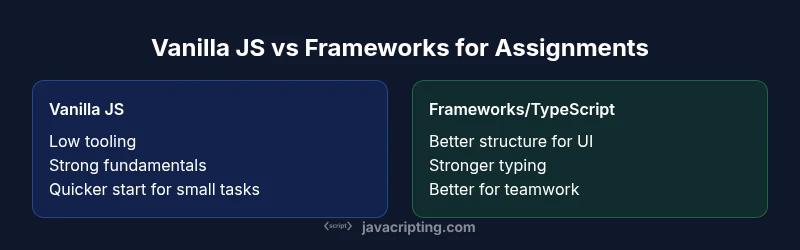
The central trade-off is between depth and speed. Vanilla JavaScript offers a direct line to fundamentals: control over scope, event handling, and the mental model of how the browser executes code. Frameworks and typed ecosystems—such as TypeScript with React or Vue—abstract boilerplate, enforce conventions, and mirror production-grade projects. For assignments that are small, self-contained, or exploratory, plain JS often wins on simplicity and portability. For larger tasks that involve UI components, state management, or team collaboration, frameworks can accelerate progress and help prevent architectural drift. When comparing these paths, consider your constraints: time to deliver, the size of the project, and your current learning goals. JavaScripting observations emphasize that the best approach is not a one-size-fits-all prescription but a hybrid strategy: start simple, then selectively introduce structure as tasks demand it. Your choice should support clear, testable outcomes rather than chasing the latest technology trend.
Key Criteria to Evaluate for Assignments
To compare paths effectively, anchor decisions to concrete criteria:
- Task scope and complexity: tiny utilities vs interactive apps.
- Cognitive load: how much new syntax or tooling you must learn at once.
- Debugging and tooling: console, inspectors, tests, and type checking.
- Collaboration and consistency: shared coding standards, pull requests, and CI.
- Longevity and maintainability: how easy it is to extend or refactor.
- Portability: how easily code runs in different environments (browsers, Node, or sandboxes).
- Time-to-deliver: rough estimates of setup, coding, and verification.
- Learning goals: whether the aim is solid fundamentals or practical build experience.
In each criterion, assign a practical benchmark (e.g., “3 small functions with tests” or “1 interactive component with 2 props”). This makes the comparison actionable rather than theoretical.
Scenarios Where Vanilla JavaScript Wins
- Quick proofs of concept: for a homework task, writing plain JS without a framework keeps the focus on reasoning instead of tooling.
- Understanding core concepts: closures, scope, and prototype chains are clearer when you don’t layer abstractions.
- Small scripts with stable requirements: when the task has fixed inputs and predictable outputs, vanilla code tends to be leaner.
- Performance-sensitive micro-tasks: avoiding framework overhead can yield faster start-up times in simple pages.
- Environments with limited tooling: when you don’t control the dev environment, plain JS reduces friction.
Practical example: building a small calculator widget using vanilla JavaScript, HTML, and CSS to learn DOM manipulation, event handling, and input validation without modularization overhead.
Scenarios Where Frameworks or TypeScript Shine
- Large UI state management: React or Vue helps organize components, hooks, and reactivity in ways that scale.
- Collaborative projects: TypeScript’s type annotations catch many issues at compile time, reducing runtime surprises.
- Accessibility-focused apps: component libraries provide accessible defaults and established patterns.
- Testing and maintenance: established tooling ecosystems (tests, linters, formatters) promote consistency across a team.
- Learning advanced JS patterns: frameworks often demonstrate patterns like composition, higher-order components, and modern tooling with clear examples.
Practical example: rewrite the same calculator as a small React component with a simple state store and a TypeScript interface for props, illustrating how types and components shape maintainability.
A Practical Decision Framework for Path Selection
- Start with a baseline: build a few small tasks in vanilla JS to verify the core concepts.
- Add structure when needed: if tasks begin to grow, introduce modules, a simple test harness, and linting.
- Introduce typing when you’re comfortable: add TypeScript for non-trivial tasks to prevent common mistakes.
- Evaluate feedback loops: do you get faster feedback with fewer bugs using a framework or with plain JS but stronger patterns?
- Plan for scale: consider the project’s envisioned lifecycle, team size, and future maintenance.
A simple decision flow: If the assignment is under 2 hours and purely logic, choose vanilla; if UI components, stateful interactions, or team collaboration are involved, consider a framework plus typed superset.
Common Misconceptions About JavaScript for Assignments
- Misconception: Frameworks automatically make you a better developer. Reality: frameworks are tools; fundamentals still matter.
- Misconception: TypeScript slows you down at the start. Reality: Type safety reduces runtime errors and improves maintainability.
- Misconception: Vanilla JS is always sufficient. Reality: for complex UIs, structure and tooling often save time in the long run.
- Misconception: More tooling equals more complexity. Reality: well-chosen tooling reduces cognitive load by enforcing conventions.
- Misconception: Quick wins beat thoughtful practice. Reality: deliberate, small gains compound into durable skills.
Understanding these helps set realistic expectations for any assignment pathway.
Best Practices to Stay Productive on Any Path
- Establish a consistent project skeleton: index.html, a single entry script, and a simple build/test script.
- Use small, testable units: write functions with clear inputs/outputs and test cases.
- Adopt a lightweight linting and formatting regime: ESLint, Prettier, and a strict editor config.
- Practice debugging methods: console traces, browser devtools, and test-driven approaches.
- Document decisions: maintain a changelog or comments that explain design choices.
- Schedule regular refactors: revisit and improve code structure as tasks evolve.
These practices minimize friction and help you retain ability to switch paths later.
Authority Sources for JavaScript Education
- Ecma International: ECMA-262 — The official JavaScript language standard, documenting syntax and semantics.
- Mozilla Developer Network (MDN): JavaScript Guide and reference for practical usage and examples.
- W3C Web Platform Standards: Guidance on web technologies that underpin JavaScript runtimes and browser APIs.
Next Steps: Implementation Checklist for Your Path
- Define a small starter project: outline goals, inputs, and expected outputs.
- Pick a baseline: implement the task in vanilla JavaScript and validate with tests or simple console checks.
- Introduce structure gradually: organize code into modules, add a minimal test harness, and enable linting.
- Decide on typing: optionally add TypeScript for non-trivial tasks to practice type thinking.
- Iterate and reflect: measure how quickly you complete tasks and how robust your code feels under changes.
- Document decisions and outcomes: summarize what worked, what didn’t, and why you’d choose a certain path next time.
Comparison
| Feature | Vanilla JavaScript for Assignments | Framework-based JavaScript for Assignments |
|---|---|---|
| Learning curve | Low to moderate for small tasks | Moderate to high depending on framework/typing |
| Setup & tooling | Minimal setup (no bundlers) | Requires tooling (bundlers, tsconfig, npm scripts) |
| Code maintainability | Strong for small scopes | Stronger for large apps with components/typing |
| Debugging and tooling | Browser devtools are often sufficient | Rich IDEs, types, and automated tests improve reliability |
| Best for | Small proofs of concept and quick tasks | UI-heavy apps, collaboration, and scalable code |
Benefits
- Clear learning path for fundamentals
- Faster iteration on small tasks
- Low initial tooling overhead
- Direct control of browser execution and scopes
The Bad
- Limited scalability without tooling
- More boilerplate for UI-heavy tasks
- Potential for inconsistent patterns without standards
Vanilla JavaScript wins for fundamentals and small tasks; frameworks shine for larger, UI-driven projects.
Choose vanilla JavaScript when the assignment is small or aims to strengthen core concepts. Opt for a framework with optional typing when you anticipate UI complexity, collaboration, or long-term maintenance. The best path often blends both approaches as needs evolve.
Questions & Answers
When should I start with vanilla JavaScript instead of a framework for assignments?
For short, self-contained tasks with fixed inputs and outputs, vanilla JavaScript helps you focus on core concepts without tool overhead. If the goal is to learn programming fundamentals, start simple and validate ideas quickly.
Start with vanilla JS for small, well-defined tasks to build fundamentals before bringing in tooling.
Does TypeScript help in beginner assignments?
TypeScript can catch common mistakes early by enforcing type checks, which is valuable as tasks grow. It may slow initial progress, but it pays off in maintainability for larger projects.
Types help prevent bugs early, but give yourself time to get used to the syntax.
Are frameworks required for UI-heavy tasks?
Frameworks can accelerate development for UI-heavy tasks by providing reusable components and state management. They are not strictly required, but they help structure complex interfaces and collaboration.
Frameworks are helpful for big UI projects, not mandatory for all tasks.
How do I switch from vanilla JS to a framework mid-project?
Plan a staged migration: extract core logic into modules, introduce components, and gradually replace vanilla patterns with framework constructs. Keep tests green to validate changes.
Move incrementally—don’t rewrite everything at once between phases.
What tools should I install first for a JS assignment?
Start with a code editor you like, a linter (like ESLint), and a formatter (like Prettier). Optional: a lightweight test runner and a bundler if your task grows beyond a single file.
Get a solid editor setup, then add linting and formatting to keep code consistent.
What to Remember
- Start with vanilla JavaScript for fundamentals
- Scale to frameworks/types as task complexity grows
- Use structured criteria to assess task requirements
- Embrace gradual tooling to minimize cognitive load
- Document decisions and reflect after each assignment