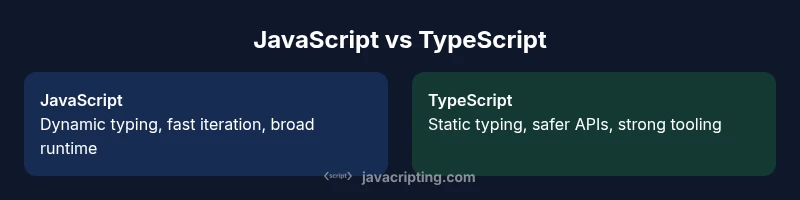
Why Choose JavaScript Over TypeScript: A Practical Guide
This objective comparison explains when to choose plain JavaScript versus TypeScript, weighing onboarding, speed, tooling, and long-term maintenance for teams.


The central question why choose javascript over typescript hinges on project scope and team maturity. For rapid prototyping, broad runtime support, and minimal tooling, JavaScript often wins. If you expect a large codebase and long-term maintenance, TypeScript can pay off, but at upfront cost. JavaScripting analysis shows the best choice depends on scale, risk tolerance, and when you plan to evolve the type system.
Why the question matters: why choose javascript over typescript
Choosing JavaScript vs TypeScript is more than syntax—it's a decision about team learning, ship speed, and long-term maintenance. If you want fast onboarding, minimal tooling, and broad runtime support, JavaScript often wins. If you anticipate a large codebase, multiple teams, and a needs-driven pace of change, TypeScript can pay off in the long run. According to JavaScripting, this pragmatic choice should start with speed and move toward structure as the project scales. This section sets the stage for a practical, evidence-based comparison that mirrors real-world decisions, not idealized theory. We’ll explore trade-offs across learning, safety, tooling, and scalability, and provide concrete guidance for teams at different stages. The goal is to empower you to pick the approach that aligns with your project’s scope, timeline, and risk tolerance while avoiding common missteps.
The learning curve and developer onboarding
JavaScript has a gentle learning curve compared with TypeScript. New developers can start writing useful code with little overhead, because the language offers dynamic typing and permissive runtime behavior. Teams often onboard faster, especially when bootstrapping projects with existing JS knowledge. However, as a project grows, the lack of explicit typing can slow down onboarding for new contributors who must infer intent from code and tests. TypeScript introduces type annotations, interfaces, and stricter checks that catch mistakes earlier, at the cost of extra learning and boilerplate. The key question is how soon you want to enforce contracts and how aggressively you want to guide developers toward correct usage. The choice will influence your onboarding timelines, code quality, and the velocity of feature delivery in the early phases of your project.
Typing, safety, and runtime behavior
JavaScript’s dynamic typing means types exist at runtime only via values, not through compile-time guarantees. This flexibility accelerates iteration but raises the risk of runtime errors and subtle bugs that surface under edge cases. TypeScript introduces static typing, optional strict modes, and compile-time checks that help prevent many classes of errors before code runs. Some teams see TypeScript as a safety net that clarifies intent and documents APIs through types, while others view it as an overhead that slows exploration. The decision hinges on how you balance early error detection with the overhead of writing type definitions, and how much you value predictable behavior across team members and environments.
Ecosystem, tooling, and community momentum
JavaScript benefits from a massive ecosystem and a long history of cross-environment compatibility. The sheer number of libraries, frameworks, and runtimes means you can prototype and deploy in browsers, servers, and mobile environments with relative ease. Tooling for JavaScript has matured, offering powerful linters, test runners, and bundlers. TypeScript, while growing, imposes a typing layer that interacts with editors, compilers, and third-party typings. This can improve developer experience but adds complexity to bootstrapping and tool selection. In practice, teams often evaluate editor support, build pipelines, and type definitions when deciding whether to start with vanilla JS or a typed approach. Toolchain stability and editor integration are critical determinants of developer happiness and productivity over time. JavaScripting analysis shows the importance of a stable, well-understood toolchain.
Maintainability at scale: codebases and handoffs
At scale, maintainability becomes the primary concern. JavaScript codebases can become hard to navigate when APIs lack explicit contracts, module boundaries aren’t well defined, and conventions aren’t enforced across teams. TypeScript canmitigate these risks by adding explicit types, interfaces, and strong tooling, making refactors safer and easier to hand off to new developers. Yet, the maintenance advantages depend on how well you adopt and enforce type-safe patterns. Without disciplined typing, TypeScript can become brittle as types drift and external typings degrade. Organizations often adopt a gradual approach: begin with JavaScript for velocity, add TypeScript to critical modules, and implement a shared style guide, strict linting, and a progressive typing plan to preserve flexibility while reducing risk.
Performance considerations: runtime and build times
Performance in JavaScript is primarily about the runtime environment and the emitted code, not the language’s static typing. JavaScript engines optimize dynamic code paths, and the presence of TypeScript does not affect runtime speed since TypeScript compiles to plain JavaScript. The overhead tends to appear in build times and developer feedback loops due to type checking and transpilation. For small projects, the build pipeline can remain light, while larger projects benefit from incremental builds, project references, and proper tsconfig settings. The trade-off is between faster iteration cycles in plain JS versus earlier error detection and stricter contracts provided by TypeScript during development.
Build tooling, pipelines, and CI integrations
Tooling choice drives how you set up CI/CD, linting, testing, and deployment. JavaScript-only projects often feature straightforward configurations and shorter feedback loops, while TypeScript introduces additional steps: type-checking, interface validation, and sometimes complex path mappings. This extra rigor can prevent certain classes of defects but requires more maintenance of configuration files and typings. Teams should consider whether existing infrastructure supports smooth TypeScript adoption and whether the added compile steps align with sprint cadences. Teams that invest in a coherent configuration strategy—shared tsconfig, strict lint rules, and incremental type adoption—tend to experience fewer surprises during releases.
Practical scenario: small projects and startups
Small projects and startups often prioritize speed, simplicity, and fast feedback. JavaScript’s lean tooling and immediate execution are attractive in the early days. However, even in this context, a light-weight TypeScript setup can pay off if the project is expected to grow or if long-term maintenance concerns loom. A practical compromise is to start with JavaScript for the MVP, then introduce a small amount of typing selectively in modules that reach a certain complexity threshold. This approach preserves velocity while laying the groundwork for scalable, collaborative development as the team expands.
Practical scenario: large organizations and long-lived projects
Large teams, multi-team collaboration, and long-lived projects often justify a typed approach from the outset. TypeScript can improve API readability, enforce contracts, and reduce drift during refactors. The challenge is to design a scalable typing strategy, keep typings up to date, and maintain a robust migration plan. In such environments, TypeScript can reduce onboarding friction for new hires and improve reliability, especially in highly shared modules and public APIs. It is crucial to accompany the decision with governance around typings, clear module boundaries, and measurable quality targets to sustain momentum over years. The goal is to balance structure with freedom to innovate within guidelines.
Migration costs and ROI
Migration costs include learning time, refactoring effort, and potential temporary slowdowns as the team adjusts. The return on investment materializes as reduced defects, clearer interfaces, and more predictable collaboration in the long term. Teams should model the costs of migrating a few critical modules first, estimate time-to-stability, and monitor the impact on velocity. If the project is still in early stages, consider a staged approach: start with JavaScript, then invest in targeted TypeScript adoption in core modules, accompanied by automated type checks and documentation. The payoff is a healthier codebase and smoother handoffs over time. JavaScripting recommends a data-driven plan that tracks quality improvements and developer happiness over quarterly milestones.
Best practices to maximize JavaScript without TS
Even without TypeScript, you can maximize JavaScript quality through disciplined practices: strong linting rules, clear module boundaries, thorough testing, and consistent naming conventions. Use runtime guards, careful error handling, and explicit data validation to catch issues early. Document public APIs with JSDoc comments to aid maintainability and editor intelligence. When possible, adopt a lightweight typing approach using Flow or JSDoc for critical libraries to improve readability without adding a full TypeScript layer. The emphasis remains on readable, maintainable code and robust tests that protect against regressions across iterations.
Decision framework: a concise, actionable checklist
Before choosing, map your project to a decision framework:
- Project size: small/medium vs large and multi-team
- Longevity: short-lived MVP vs years of maintenance
- Hiring: availability of TypeScript-skilled developers
- Tooling: CI/CD capabilities and editor support
- Risk tolerance: how much you value early defect detection
- Migration path: willingness to incrementally adopt types
If you lean toward speed and simplicity, start with JavaScript. If you anticipate scale and complex interfaces, plan for TypeScript early, with a staged migration strategy. The overarching recommendation is to tailor the approach to your organization’s needs and revisit the decision as your project evolves.
Comparison
| Feature | JavaScript | TypeScript |
|---|---|---|
| Typing | Dynamic typing at runtime | Static typing with optional strictness |
| Compile step | Interpreted at runtime | Compiles to JavaScript (optional type-checking) |
| Learning curve | Lower curve for JS | Higher curve for TS |
| Tooling complexity | Simpler setup | Rich tooling with TS |
| Runtime footprint | Same runtime, depends on emitted code | Same runtime but type-checking at build-time |
| Error detection | Errors surface at runtime | Compile-time type errors catch issues earlier |
| Community size | Larger JS ecosystem | Growing TS ecosystem with strong typing |
| Best for | Small apps, prototyping | Large apps, long-term maintenance |
| Migration effort | Low | Medium to High |
| Code readability | Readable with clear intent | Enhanced clarity with explicit typings |
Benefits
- Faster onboarding for new developers
- Quicker iteration cycles with no compilation step
- Broader runtime support across environments
- Simpler CI pipelines and debugging
The Bad
- Greater risk of runtime errors due to missing types
- Less predictability for large teams without explicit typings
- Potential for technical debt if types are added later
- Slower scalability without typed contracts
JavaScript is often the pragmatic default for small to mid-sized projects; TypeScript adds long-term value for larger, long-lived codebases.
Choose JavaScript for speed and simplicity in small teams. Opt for TypeScript when scale, API clarity, and long-term maintenance are priorities; plan a staged adoption if needed.
Questions & Answers
Is TypeScript strictly necessary for modern JavaScript projects?
Not strictly necessary for all projects, but it provides meaningful safeguards for larger codebases and teams. If your codebase is short-lived or small, JavaScript may suffice. For long-term maintenance and multi-team collaboration, TS often pays dividends.
Not strictly necessary for small projects, but TS can help keep large projects safe. Consider your team and timelines when deciding.
Can I adopt TypeScript gradually?
Yes. Start with JavaScript and convert a few critical modules to TS, then expand progressively. Use isolated type improvements (JSDoc, type-only files) to reduce risk while maintaining velocity.
Absolutely—start small, expand typing in core modules, then widen adoption as needed.
Do types impact runtime performance?
No direct runtime impact from typing. TypeScript compiles to plain JavaScript, so performance depends on the emitted code and runtime environment, not on types themselves.
Typing doesn’t slow down your code at runtime; it mainly affects build and edit-time checks.
What are the main drawbacks of TypeScript for small teams?
The main drawbacks are the upfront learning curve and added boilerplate. Small teams may experience slower onboarding and longer iteration cycles if typing isn’t aligned with their goals or if the project won’t benefit from long-term typing discipline.
Typing can slow you down initially; ensure the benefits match your project size.
Is TypeScript better for frontend or backend?
TypeScript is widely beneficial for frontend codebases with complex UI logic and large shared APIs, and also helps backend codebases with well-defined interfaces. The value is driven by complexity, team size, and how critical API contracts become.
TS helps both frontend and backend when contracts matter and teams scale.
How do I convert a JS codebase to TS later?
Plan a staged migration: enable TypeScript gradually, annotate public APIs first, use strict compiler options, and rely on incremental typing to minimize disruption.
You can migrate in stages—start with core modules and public APIs.
What to Remember
- Start with JavaScript to validate ideas quickly
- Introduce typing strategically as projects grow
- Invest in tooling to prevent friction during transitions
- Plan a staged migration path from JS to TS when appropriate
- Measure impact with a clear ROI framework