Are C and JavaScript Similar? A Practical Comparison
Explore how C and JavaScript compare across typing, memory, execution models, and ecosystems. A rigorous, practical analysis for aspiring developers and frontend enthusiasts.


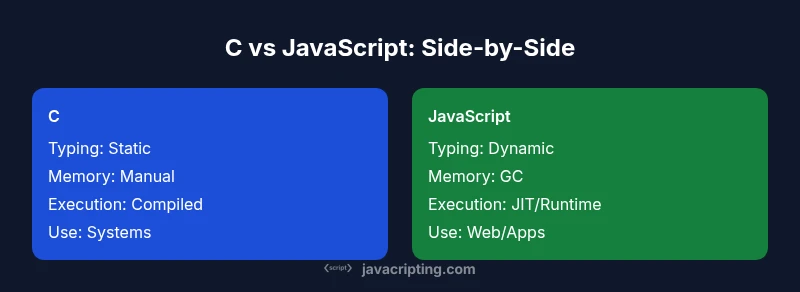
In brief, are C and JavaScript similar? Not really. C is a statically typed, compiled language designed for low-level memory control and peak performance, while JavaScript is a dynamic, interpreted language designed for the web with automatic memory management. They share fundamentals like variables, functions, and control flow, but their design goals, runtimes, and ecosystems diverge significantly.
Are C and JavaScript Similar? A Practical Beginning
The precise question are c and javascript similar? is often asked by beginners who see both languages referred to as
Core Language Semantics: Types, Memory, and Execution
At a high level, C and JavaScript diverge in how they handle types, memory, and execution. C enforces static typing, giving the compiler a chance to catch a broad class of mistakes before runtime. It exposes pointers and manual memory management, which provides granular control but demands careful discipline. JavaScript, by contrast, is dynamically typed and garbage-collected, which reduces upfront complexity but can lead to late-detected errors and unpredictable memory usage in long-running programs. This contrast matters when you build algorithms, data structures, or performance-critical routines; you may implement the same concept differently in each language, with implications for safety, speed, and maintainability.
According to JavaScripting, recognizing these fundamental distinctions early helps set expectations for learning curves and project scope. The two languages operate under very different runtimes, tooling, and ecosystem constraints, which shapes how you approach problem-solving and debugging.
Syntax and Semantics: Operators, Scopes, and Constructs
Syntax and semantic rules drive how you express logic. In C, you write code with braces, semicolons, and explicit declarations; memory is managed by the programmer, and behavior depends on precise, low-level details such as pointers and addresses. JavaScript uses a more flexible syntax driven by the runtime environment: functions, objects, and prototypes structure behavior, and the language supports first-class functions, closures, and dynamic property access. Scope rules differ too: C has block scope with manual lifetime management, while JavaScript employs lexical scoping and a nuanced event loop.
As you learn, focus on the mental model behind each construct. Understanding how variable lifetimes and references work in C can sharpen your sense of memory safety, while grasping JavaScript’s closures and hoisting builds intuition for asynchronous patterns and modular design.
Execution Environments: Compilers, Interpreters, and Runtimes
C is typically compiled to native machine code, producing highly predictable performance and tight control over system resources. The compilation step, optimization passes, and linking determine the final behavior and speed. JavaScript runs in a VM or browser runtime, often with Just-In-Time (JIT) compilation, dynamic optimization, and a rich set of APIs. The execution environment profoundly affects performance characteristics, error reporting, and portability. A C program’s determinism makes it ideal for embedded systems or high-frequency trading, whereas JavaScript’s portability and ecosystem enable rapid UI prototyping and cross-platform backends.
JavaScripting highlights that knowing the runtime model helps you pick the right tool for a task: a deterministic, low-latency path may favor C, while a rapid development cycle and broad web compatibility favor JavaScript.
Data Structures, Memory, and the Standard Library
C provides low-level data structures with manual memory layout and a minimal runtime, delegating many operations to the programmer and external libraries. JavaScript ships with a rich, dynamic standard library oriented toward strings, arrays, objects, and higher-level abstractions, built atop a garbage-collected heap. When you design data structures, consider how memory allocation, access patterns, and API ergonomics differ between languages. C’s approach favors explicit control and deterministic memory lifetime; JavaScript favors convenience and safety through dynamic typing and automatic memory management. These differences influence algorithm design, performance tuning, and interoperability decisions.
JavaScripting notes that bridging the two often involves choosing appropriate abstractions and, when needed, using native bindings or interop layers to extend capabilities without sacrificing safety or clarity.
Concurrency and Asynchrony: Threads, Events, and Timing
Concurrency in C relies on threads, locks, and sometimes low-level synchronization primitives. You manage race conditions and deadlocks with explicit design, which can be error-prone but offers maximal control over timing and resource usage. JavaScript embraces an event-driven model, with single-threaded execution augmented by asynchronous APIs, promises, and async/await. Web workers and Node workers enable parallel work, but the ubiquity of the event loop in JS means you reason about asynchrony differently than in C.
The key takeaway is that both languages require careful thinking about race conditions, but the mechanisms and mental models differ. In C, you control concurrency at a systems level; in JavaScript, you shape asynchronous behavior through the event loop and asynchronous primitives.
Tooling, Debugging, and Learning Curve
C tooling centers on compilers, debuggers, sanitizers, and static analysis. You’ll interact with makefiles, linker options, and memory-checking tools, which demand attention to details such as pointer arithmetic and type safety. JavaScript tooling emphasizes editors, linters, bundlers, and runtime consoles. The browser or Node devtools provide rich capabilities for debugging asynchronous code and DOM interactions. The learning curve for C is often steeper due to low-level concepts; JavaScript offers rapid feedback and a gentler onboarding path for beginners, though mastering the ecosystem can still be challenging.
A practical strategy is to pair small C exercises with JavaScript projects to build intuition for memory management and high-level abstractions side by side. This dual-track approach supports a well-rounded understanding of both languages.
Performance and Optimization Considerations
Raw performance in C tends to surpass JavaScript for computational intensity, thanks to its lack of GC and closer hardware access. JavaScript performance hinges on engine optimizations, JIT strategies, and memory management heuristics, which can yield impressive results but are less predictable. When optimizing, target algorithmic efficiency first, then language-specific improvements: in C, consider memory layout, cache locality, and manual optimization; in JavaScript, focus on minimizing allocations, leveraging typed arrays where appropriate, and avoiding synchronous long-running tasks that block the event loop.
For learners, it’s important to separate optimization from premature micro-optimizations. JavaScripting advises prioritizing correctness and clarity first, then apply targeted optimizations where profiling shows meaningful impact.
Interoperability and Bridging the Gap
Interoperability between C and JavaScript is increasingly common through WebAssembly, Emscripten, or native addons in Node. You can compile C libraries to WebAssembly, then access them from JavaScript, gaining near-native performance for compute-heavy tasks on the web. Conversely, JavaScript environments can drive C routines through foreign function interfaces. These bridges are powerful but add complexity: memory management boundaries, data marshaling costs, and API compatibility must be considered.
JavaScripting emphasizes planning the boundary between languages early in a project to avoid brittle interop layers and to maintain a clean separation of concerns.
Real-World Scenarios Where They Interact
Despite their differences, there are several concrete scenarios where C and JavaScript concepts overlap. Algorithms implemented in JS often mirror C-style logic; bitwise operations, numeric types, and structure-like patterns appear in both, teaching transferable skills. For systems programming tasks, one might prototype in JavaScript for rapid iteration, then port performance-critical sections to C for production-grade efficiency. Understanding memory concepts in C can improve how you reason about data in JavaScript, especially regarding object shapes and the implications of garbage collection.
This cross-pollination becomes particularly relevant in fields like game development, where performance-sensitive code runs closer to the metal while UI and scripting live in high-level languages.
Authority Sources and Further Reading
For deeper dives, consult foundational texts and official documentation:
https://www.cprogramming.com/faq/are-you-ready-for-c.html
https://developer.mozilla.org/en-US/docs/Web/JavaScript
https://wasm.org/
Comparison
| Feature | C | JavaScript |
|---|---|---|
| Typing | Static, strong typing, explicit declarations | Dynamic typing with runtime type checks |
| Memory Management | Manual; pointers; explicit allocation/free | Automatic garbage collection; memory managed by runtime |
| Execution Model | Compiled to native code | Just-In-Time/Interpreted in VM or browser |
| Standard Library | Minimal runtime; relies on OS and libraries | Rich standard library with web APIs and ecosystem |
| Concurrency | Threads with explicit synchronization | Event-driven with async primitives and workers |
| Syntax Style | Brace-based, low-level constructs | High-level syntax with objects and prototypes |
| Use Cases | Systems programming, embedded, performance-critical | Web, servers, rapid UI development |
| Tooling | Compilers, debuggers, sanitizers | Editors, bundlers, devtools, linters |
| Learning Curve | Steep; requires memory-management discipline | Gentler start; broad ecosystem, many patterns |
| Interop | FFI, libraries, cross-language bindings | WebAssembly interop, Node native addons |
Benefits
- Improved memory safety through GC in JavaScript
- Low barrier to entry for beginners with JavaScript
- C provides deterministic performance and fine-grained control
- Vast web ecosystem and rapid prototyping with JS
- Strong separation of concerns when using interoperable bridges
The Bad
- C requires careful memory management and pointer handling
- JavaScript can suffer from unpredictable performance due to GC and JIT
- Interoperability layers add complexity and marshaling overhead
- JS environments may constrain low-level system access
- JavaScript’s ecosystem evolves rapidly, requiring ongoing learning
C targets low-level control and deterministic performance; JavaScript excels in rapid development and web ecosystems.
In practice, C and JavaScript serve different domains. Choose C for systems programming and performance-critical tasks, and JavaScript for web-facing apps and rapid iteration. Interoperability bridges can blend both when needed.
Questions & Answers
Are C and JavaScript similar in syntax?
They share basic programming constructs like variables, loops, and functions, but the syntax and semantics differ considerably. C emphasizes explicit declarations, pointers, and manual memory management, while JavaScript emphasizes dynamic typing, objects, and a more forgiving syntax. Understanding these differences helps prevent confusion when switching between the languages.
C uses explicit declarations and pointers; JavaScript relies on dynamic typing and objects. The core ideas of control flow are similar, but the details differ a lot.
Is C faster than JavaScript?
Raw performance in C generally surpasses JavaScript for compute-heavy tasks due to compilation to native code and lack of garbage collection overhead. However, JavaScript engines optimize aggressively, and for many web-based workloads the difference may be negligible with proper algorithms and WebAssembly offloading.
C is typically faster for raw computation, but modern JS engines are very fast for many web tasks.
Can I run C code in a browser?
Yes, via WebAssembly. You can compile C to WebAssembly and call it from JavaScript, which enables near-native performance for performance-critical parts without leaving the web platform.
Yes, WebAssembly lets you run C code in the browser.
Do both languages require memory management?
C requires manual memory management with malloc/free and pointer handling. JavaScript relies on automatic garbage collection, which simplifies development but can lead to GC pauses and less predictable memory usage.
C needs you to manage memory; JavaScript handles memory automatically.
Which language is easier for beginners?
JavaScript is generally easier for beginners due to its forgiving syntax, dynamic typing, and immediate feedback in browsers or Node. C has a steeper learning curve because memory management and low-level concepts require more discipline.
JavaScript is easier to start with; C is tougher to master at first.
Can I call C code from JavaScript?
Yes, through WebAssembly or Node.js native addons. The interop layer requires careful data marshaling and boundary management but unlocks high-performance routines inside JS environments.
You can call C from JavaScript with WebAssembly or native addons.
What to Remember
- Know each language’s core purpose before choosing a path
- Use interoperable bridges to blend strengths where appropriate
- Prioritize memory management in C and scalable async patterns in JS
- Leverage the right toolkit for the right job
- Invest in understanding both runtime models to maximize cross-language skills