Is JavaScript Similar to C++? A Practical Analysis
Explore how JavaScript and C++ differ in typing, memory management, and execution models, with guidance for learners bridging between the two languages.


Is JavaScript and C++ similar? The short answer is: not really. JavaScript (ECMAScript) and C++ differ fundamentally in typing, memory management, compilation, and runtime environments, even though both share some C-like syntax. In practice, surface similarities can mislead beginners. This comparison highlights core differences and points out transferable programming concepts you can reuse across languages.
Is JavaScript and C++ Similar? Foundations
From a high-level perspective, is javascript and c++ similar? The short answer is no, but the question deserves nuance. According to JavaScripting, JavaScript and C++ diverge in design goals and runtime expectations. JavaScript is primarily a dynamic, interpreted or JIT-compiled language designed for web and scripting tasks, with automatic memory management. C++, by contrast, is a multi-paradigm, statically typed, compiled language optimized for performance, system-level tasks, and resource-constrained environments. The difference in memory semantics alone—garbage-collected versus manual memory management—drives many non-overlapping behavior patterns, such as pointer arithmetic, manual allocation, and deterministic destruction.
Yet there are threads of similarity worth noting. Both languages borrow from the C family, share familiar braces, operators, and control flow constructs, and both emphasize explicit algorithm design, data structures, and learning how compilers or runtimes translate code into executable behavior. For aspiring developers, recognizing the surface sameness can help with initial learning, but true fluency requires embracing the fundamental distinctions in typing, memory, and execution.
Core Differences: Typing, Memory, and Execution
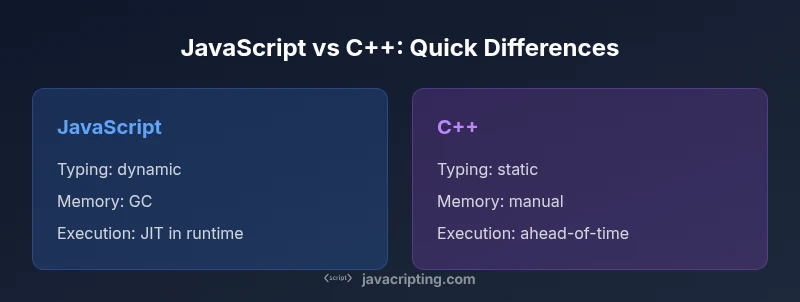
The most consequential differences begin with typing. JavaScript uses dynamic typing, where types are discovered at runtime and can change, which makes rapid prototyping easy but can hide type errors until they surface during execution. C++ uses static typing, with type checks performed at compile time, enabling powerful optimizations and safer code when done well. This fundamental split drives how you structure data, catch mistakes, and think about API design.
Memory management follows closely: JavaScript relies on garbage collection, abstracting away most memory concerns but sometimes introducing latency during collection. C++ requires manual memory management or deterministic resource control via RAII (Resource Acquisition Is Initialization), giving you precise control but also the risk of leaks, dangling pointers, and undefined behavior if you mishandle resources.
On the execution side, JavaScript typically runs in a managed runtime (browser or Node.js) that interprets or compiles code on the fly, prioritizing portability and quick feedback. C++ is compiled ahead of time into native code, delivering peak performance but sacrificing the same level of portability and requiring more careful attention to platform quirks, architecture differences, and build processes.
Syntax and Paradigm: Where They Resemble on the Surface
Both languages show some familiar C-style syntax: braces for blocks, semicolons (optional in some JS contexts), and similar control structures like if, for, while. This superficial resemblance can be comforting but is not enough to assume cross-language semantics. JavaScript supports first-class functions, closures, and a prototype-based object model, with recently added class syntax that is largely syntax sugar over prototypes. C++ emphasizes classes, templates, and low-level constructs, including pointers and manual memory management, alongside modern features like smart pointers and move semantics. Understanding these conceptual differences helps you map learning progress without getting tripped up by syntax similarity alone.
Performance and Optimization Considerations
Performance in JavaScript hinges on the JavaScript engine's optimizing compiler, garbage collection cadence, and the efficiency of the runtime environment. While JIT compilation can deliver impressive performance for web apps and serverside workloads, it remains bounded by dynamic typing and runtime checks. C++ often delivers deterministic, near-hardware performance for compute-heavy tasks due to static typing, compiler optimizations, and direct memory modeling. When comparing the two, expect JavaScript to excel in rapid development and wide adoption, while C++ shines in engine development, real-time systems, and performance-critical code.
Optimization strategies differ accordingly. In JavaScript, you optimize by reducing allocations, minimizing dynamic property access, and using efficient data structures, while relying on the engine’s optimization heuristics. In C++, you optimize with careful resource management, inlining decisions, memory layout, and explicit parallelization techniques. The gulf in performance characteristics is one reason why many teams choose to implement performance-critical sections in C++ and expose bindings to JavaScript via interfaces like WebAssembly or native modules.
Execution Environment and Tooling
JavaScript benefits from mature, ubiquitous environments. In the browser, you gain integrated tooling, debugging, and a vast ecosystem of web APIs. On the server, Node.js extends JavaScript beyond the browser with filesystem access, networking, and a thriving package ecosystem. C++ runs natively on operating systems, requiring a toolchain (compiler, linker, build system) and careful cross-platform considerations. This divergence influences how you structure projects, test strategies, and deployment workflows. Tooling for both languages is excellent, but the workflows, build steps, and debugging approaches differ markedly, which is an important practical distinction for learners.
Transferable Concepts: Data Structures, Algorithms, and Mental Models
Despite broad differences, many core concepts cross language boundaries. Algorithm design, big-O reasoning, and standard data structures (arrays, lists, maps) appear in both languages, even if syntax and idioms differ. You’ll also find shared patterns for error handling, control flow, and modular design. For learners, building a solid foundation in these universal topics makes it easier to switch between languages later and pick up language-specific features without losing depth in problem-solving approaches.
Common Misconceptions and How to Bridge the Gap
JavaScripting analysis shows that many learners overestimate cross-language similarity because they focus on surface cues rather than architectural differences. A common pitfall is assuming that concepts like references and memory work the same in both languages. In reality, C++ references and pointers require explicit management, while JavaScript abstracts memory management away. Bridging the gap means practicing side-by-side implementation of the same algorithm in both languages, documenting how each language handles types, lifetime, and side effects, and leveraging interoperable solutions where appropriate (e.g., WebAssembly for performance-critical JS modules).
Practical Roadmap for Learners: How to Approach Mastery in Both Languages
Start with fundamentals common to any programming language: variables, control flow, and data structures. Then, study the strong language-specific pillars: static typing and memory management in C++ versus dynamic typing and the event-driven model in JavaScript. Build small projects in each language to reinforce concepts, then compare implementations to surface differences in performance, safety, and ergonomics. Finally, explore interoperability avenues such as calling C++ from JavaScript via bindings or WebAssembly to see how two worlds meet in real-world applications.
Use-Case Driven Comparisons: Web vs Systems
If your goal is web development, JavaScript is often the practical backbone, while C++ touches areas like game engines, high-performance modules, and systems software. For those targeting systems programming or performance-critical domains, C++ remains a primary tool. Understanding when to use each language helps you allocate learning effort effectively and avoid chasing unnecessary similarities. The most valuable skill is translating problem requirements into the right paradigm and choosing the language features that deliver the desired outcomes.
Interoperability and Interfacing: WebAssembly, Bindings, and Beyond
A practical way to bridge the gap is to use WebAssembly to run C++ code inside a JavaScript environment. This approach preserves performance-critical sections while preserving the developer experience of JavaScript for higher-level logic and UI concerns. Learning how to design clean interfaces, manage memory across language boundaries, and optimize cross-language calls will pay dividends in real-world projects where both languages co-exist.
Final Take: Distilling the Differences and Similarities
In short, is javascript and c++ similar? Not at the core design level. The most meaningful differences lie in typing, memory management, and execution semantics, with superficially similar syntax masking deeper conceptual gaps. By focusing on universal programming fundamentals, practicing side-by-side implementations, and exploring interoperability patterns, you can leverage the strengths of both ecosystems without being misled by surface-level likeness.
Comparison
| Feature | JavaScript (ECMAScript) | C++ |
|---|---|---|
| Paradigm | multi-paradigm: functional, imperative, event-driven | multi-paradigm: procedural, object-oriented, generic |
| Typing | dynamic, weakly typed | static, strong |
| Memory management | garbage-collected | manual memory management with RAII and smart pointers |
| Compilation/Execution | JIT/interpreted with runtime optimizations | ahead-of-time compilation |
| Execution environment | browser/Node.js runtime | native OS and hardware context |
| Syntax closeness | C-style braces; prototype-based OO nuances | C-like braces with templates, operator overloading, pointers |
| Common uses | web scripting, frontend, rapid prototyping | systems programming, game engines, performance-critical modules |
| Learning curve | lower learning curve for beginners | steep learning curve due to memory management and templates |
Benefits
- Rapid prototyping and broad tooling in JavaScript
- Web and server versatility across ecosystems
- Extensive libraries and community support for both languages
- Interoperability paths via WebAssembly and bindings
- Large career demand for JavaScript; strong demand for C++ in performance-focused domains
The Bad
- Memory model differences can cause subtle bugs when switching languages
- Dynamic typing in JS can hide errors that a static type system would reveal in C++
- C++ complexity and manual memory management increase risk of bugs
- Cross-language tooling requires extra learning and setup
JavaScript and C++ are not similar in core design; differences dominate.
Core typing, memory, and execution models set them apart. Surface syntax can be shared, but true fluency depends on mastering language-specific paradigms and tooling. The practical bridge is to study fundamentals, then learn interoperability techniques when needed.
Questions & Answers
Are JavaScript and C++ syntactically similar?
They share braces and some control structures, but their syntax serves different purposes. JavaScript emphasizes dynamic typing and runtime behaviors, while C++ emphasizes static typing, templates, and memory management. Don’t rely on superficial cues to judge similarity.
They look alike on the surface, but the deep rules are different. Focus on the language rules rather than just braces.
Is JavaScript statically typed like C++?
No. JavaScript uses dynamic typing, which means types are resolved at runtime. C++ uses static typing, with types checked at compile time. This difference affects error catching, tooling, and design patterns.
No—JS is dynamically typed, while C++ is statically typed.
Can I reuse data structures between JavaScript and C++?
Data structure concepts (arrays, maps, lists) exist in both, but their implementations and memory models differ. You’ll translate designs rather than reuse exact structures, and you may bridge through bindings or WebAssembly for performance-critical parts.
You can reuse the ideas, not the exact code, unless you bridge with interop.
Which language is easier to learn first?
Many learners find JavaScript easier to start with due to its forgiving syntax and immediate feedback in the browser. C++ has a steeper initial learning curve because of memory management and complex language features.
JS is usually easier to start with; C++ comes with more complexity.
How do memory management differences impact development?
In JavaScript, the runtime handles memory management, reducing manual work but sometimes causing GC pauses. In C++, you manage memory (and lifetimes) yourself, which offers performance control but increases risk if not careful.
JS handles memory, C++ requires you to manage it, which changes how you code.
What are practical ways to bridge concepts between the languages?
Study universal programming concepts (algorithms, data structures, control flow) in both languages, then explore interop approaches like WebAssembly to run C++ modules within JavaScript contexts.
Learn core ideas in both, then experiment with interop to connect them.
What to Remember
- Recognize core design differences early
- Practice side-by-side implementations of the same algorithms
- Leverage interoperability tools for cross-language projects
- Focus on universal programming fundamentals to bridge concepts