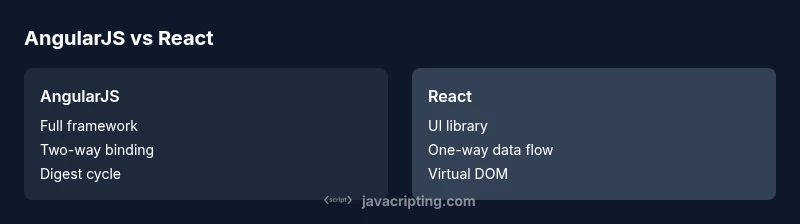
AngularJS vs React: Key Differences for 2026 Web Apps
Explore the key differences between AngularJS and React, from architecture and data flow to tooling and migration paths for modern web apps in 2026.


According to JavaScripting, the difference between angular js and react isn’t just syntax—it's a question of scope, approach, and long-term maintenance. AngularJS (the 1.x framework from Google) is a complete, opinionated framework that provides a bundled set of features for building large apps. React, by contrast, is a UI library centered on component-based rendering and a flexible ecosystem of companion tools. For teams starting a new project in 2026, understanding this distinction helps pick the right starting point and reduces the risk of heavy rewrites down the line. This article digs into architecture, data flow, performance, and practical use scenarios to help you decide which path fits your goals. The JavaScripting team emphasizes practical criteria such as team skill sets, project scope, and long-term maintenance when weighing the options.
The difference between angular js and react: Core distinctions
The phrase difference between angular js and react is more than naming conventions or syntax; it captures two distinct philosophies about frontend development. AngularJS, originally released as a full-featured framework by Google, offered an all-in-one solution with built-in data binding, dependency injection, and a cohesive CLI. React, developed by Facebook, approaches UI as a collection of reusable components with a lightweight core and a broad ecosystem of libraries for routing, state management, and side effects. This split in philosophy matters because it influences everything from how teams size projects to how easily you can adapt to evolving browser patterns. In 2026, many teams prefer React for UI-centric apps and use Angular-family stacks for more opinionated enterprise needs. The JavaScripting analysis highlights that the best choice aligns with project goals, existing skill sets, and the long-term roadmap of your product lineup.
heading-structure techniques
markdown-enhanced text to discuss the topic.
Comparison
| Feature | AngularJS | React |
|---|---|---|
| Architecture and core philosophy | Full framework with opinionated structure (MVC/MVVM patterns) | UI library focused on components with flexible tooling |
| Rendering model | Digest cycle and dirty-checking in 1.x; performance scales with careful optimization | Virtual DOM with efficient reconciliation; fiber-based rendering in modern setups |
| Language and typing | JavaScript with optional TypeScript support; older workflows | JSX syntax; strong TypeScript support in many ecosystems |
| Data binding | Two-way data binding by default; declarative bindings | One-way data flow with state-driven rendering (two-way via patterns in libraries) |
| Tooling and setup | Angular CLI and opinionated project structure | Create React App / Vite and modular tooling; more flexibility |
| Ecosystem and community | Large but more monolithic ecosystem; strong enterprise usage | Massive ecosystem with diverse libraries; rapid innovation |
| Learning curve | Steeper due to breadth of framework concepts | Gentler for UI developers; learn-by-doing with components |
| Longevity and migration | AngularJS 1.x ended support in 2021; migrate to Angular (2+) or React | React remains actively developed with broad industry adoption |
Benefits
- Clear framework decisions for teams needing an all-in-one solution
- Strong tooling and built-in workflows for large apps
- Robust testing and enterprise support in Angular ecosystems
- Active, long-running community with sustained career opportunities
The Bad
- Steeper learning curve for beginners due to breadth
- Migration from AngularJS 1.x can be costly and time-consuming
- Less flexibility in mixing and matching tooling compared to React
- Potentially heavier initial learning due to TypeScript adoption
React generally offers a more flexible, UI-centric path for modern web apps, while AngularJS and its successors suit enterprise-scale projects with a built-in framework.
Choose React when you want modular UI, rapid experimentation, and a broad ecosystem. Choose Angular (2+) for a cohesive framework with strong enterprise tooling and predictable patterns; plan migration if you’re starting from AngularJS 1.x.
Questions & Answers
What is the difference between AngularJS and React?
AngularJS is a full framework that provides a complete solution for building large applications. React is a UI library that focuses on component-based rendering and relies on external libraries for routing, state management, and other concerns. Understanding this distinction helps teams choose whether to start with a full stack or a modular UI approach.
AngularJS offers an all-in-one framework, while React focuses on UI components and leaves other concerns to libraries.
Is AngularJS still relevant in 2026?
AngularJS 1.x reached end of life in 2021. While some teams maintain legacy applications, new projects typically adopt Angular (2+) or React, depending on organizational needs. Migration planning is essential to avoid long-term maintenance burdens.
AngularJS is no longer the recommended path for new projects; consider Angular 2+ or React instead.
Which is easier to learn, AngularJS or React?
React generally offers a gentler entry point for UI development due to its library-focused scope and a vast ecosystem. AngularJS requires learning a broader set of concepts, including dependency injection, directives, and the framework's conventions.
React is usually easier to pick up for UI work, though both require time to become proficient.
How do data binding and state management differ?
AngularJS uses two-way data binding by default, while React uses one-way data flow with state and props. State management in React often involves external libraries like Redux or Zustand, whereas Angular offers built-in services and RxJS patterns for handling data streams.
Angular uses two-way binding; React relies on unidirectional data flow with state management via separate libraries.
Which has better performance?
Performance depends on use case. React’s virtual DOM and fiber architecture tend to perform well in complex UIs with frequent updates. AngularJS can be optimized effectively, but its digest cycle can introduce overhead in large apps without careful change-detection strategies.
React usually performs better for dynamic UIs; AngularJS can be tuned but may require more optimization.
How should one migrate from AngularJS to modern frameworks?
Migration typically involves moving to Angular (2+) or React, depending on goals. Teams should plan a phased approach: identify critical features, rewrite components incrementally, and set up parallel routes to minimize downtime while updating tests and tooling.
Plan a staged migration to Angular or React with clear milestones and adequate testing.
What to Remember
- Assess project scope before choosing
- React excels in UI composition and ecosystem breadth
- Angular (2+) suits enterprise-scale apps with integrated tooling
- Plan migration paths early if currently on AngularJS 1.x
- Invest in team skill alignment and long-term maintenance