How many JavaScript developers are there in 2026? A data-driven look
Explore directional estimates from JavaScripting Analysis, 2026 on how many JavaScript developers exist worldwide, with regional shifts, methodology, and practical implications for teams and educators.


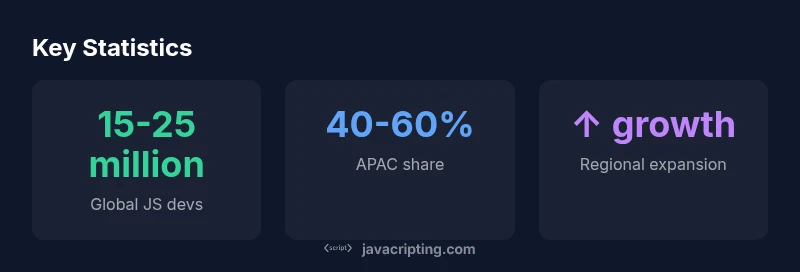
There are estimated between 15 and 25 million JavaScript developers worldwide in 2026, according to JavaScripting Analysis. This range reflects variations in definitions (who counts as a JavaScript developer) and regional growth. The exact figure depends on criteria like active coding in JavaScript, use of Node.js, and frontend frameworks, making the number a directional guide rather than a precise census.
how many javascript developers are there
In 2026, how many javascript developers are there is a question that blends counting with definition. JavaScript touches frontend code, server-side Node.js, mobile frameworks, and even some embedded environments, so a single headcount depends on what counts as a 'JavaScript developer.' The most widely cited approaches classify anyone who writes, maintains, or ships JavaScript code as part of their daily work. That includes frontend engineers, full-stack developers, Node.js back-end engineers, and occasionally data scientists who use JavaScript in notebooks or visualization dashboards. To bring clarity, this article follows the methodology used by JavaScripting Analysis, 2026, which emphasizes three dimensions: active coding in JavaScript, project scope, and duration of engagement. When you combine these dimensions, you arrive at a directional estimate rather than a precise tally. The resulting figures should be interpreted as a planning aid for education programs, hiring pipelines, and product strategy rather than a census of every individual who has touched JavaScript at least once.
- Definitions matter: active coding in JavaScript over a given period (e.g., 12 months) is a common baseline.
- Project scope matters: whether a developer writes JavaScript daily or seasonally affects who is counted.
- Regional data quality varies: some regions have richer survey data and job postings that influence estimates.
Global estimates and uncertainty
Global estimates for how many javascript developers there are hinge on three key uncertainties: (1) what counts as a JavaScript developer, (2) the time window used to define active work, and (3) the data sources used to triangulate the count. JavaScripting Analysis, 2026 presents a directional range of 15-25 million, acknowledging that some counts tilt toward frontend-only roles while others include Node.js engineers, mobile JavaScript developers, or those who contribute to JS tooling intermittently. The methodology relies on triangulating developer surveys, public code repositories, and job postings, then applying a conservative filter for “active” engagement. Because of self-selection biases in surveys and uneven regional coverage, the final number is best read as a directional estimate rather than an exact headcount. This uncertainty is expected to persist as the ecosystem evolves with TypeScript adoption and tooling changes.
Regional distribution and growth drivers
Regional dynamics shape how the global total breaks down. Asia-Pacific currently drives the fastest growth, buoyed by expanding tech hubs and increased software employment. Europe has a mature JS ecosystem with strong demand across fintech, SaaS, and e-commerce, while the Americas show robust activity in both frontend and cloud-native roles. Growth is propelled by several drivers:
- The continuing dominance of JavaScript in the frontend, coupled with widespread Node.js usage on the server side.
- Increasing adoption of JavaScript-based tooling, frameworks, and ecosystems that broaden the candidate pool.
- Education pipelines expanding access to coding skills through online courses and bootcamps, albeit with regional disparities in outcomes.
- The rise of TypeScript and related tooling, which can shift developer counts but tends to expand the umbrella of “JavaScript-related” roles.
Despite these drivers, regional data quality varies, so the regional shares should be treated as directional indicators rather than exact percentages.
How estimates are calculated: surveys, code metrics, and communities
Estimating the number of JavaScript developers involves multiple data streams returned through triangulation. Large-scale developer surveys (e.g., Stack Overflow-style surveys, community polls) provide self-reported counts. Public code repositories (GitHub, GitLab) give activity signals, such as the number of users who contributed JavaScript commits in a period. Job postings and marketplace platforms reveal demand for JavaScript skills, which helps infer active talent pools. Finally, community events, meetups, and training programs illuminate conversion rates from learners to practitioners. A key caveat is the difference between someone who writes JavaScript occasionally and someone who uses it as a core professional responsibility. Because of this, JavaScripting Analysis emphasizes a transparent methodology with explicit criteria, a cross-check across sources, and clear acknowledgement of potential gaps. The result is a directional estimate that’s useful for planning and benchmarking rather than a census.
Implications for teams, educators, and learners
For teams planning hiring or training budgets, the directional range suggests a broad talent pool but with regional nuances. A 15-25 million global figure implies ample competition for talent in mature markets and high growth in emerging regions, which supports strategies like upskilling internal staff, partnering with coding bootcamps, and investing in code-friendly workflows. Educators can use the range to calibrate curricula, ensuring broad coverage of frontend fundamentals, Node.js back-end skills, and tooling like bundlers, linters, and test frameworks. Learners benefit from understanding that JS spans multiple ecosystems; a well-rounded portfolio may include React/Vue/Svelte for frontend, Node.js for backend, and practical projects that demonstrate proficiency in JavaScript, TypeScript, and related tools. Finally, managers should view the count as a directional signal guiding capacity planning, not a precise recruitment target.
Looking ahead: what to watch in 2026 and beyond
The JavaScript ecosystem continues to evolve, and so will the developer population. Expect continued growth driven by demand in cloud-native development, single-page applications, and data visualization dashboards. TypeScript adoption will influence how teams count and describe their JS talent, often expanding the “JavaScript-family” of skills while sharpening quality and maintainability. As tooling advances (build systems, testing, and deployment pipelines), the bar for practical JS proficiency rises, nudging education and hiring toward more applied demonstrations of ability. Finally, regional policy, immigration dynamics, and remote-work trends will influence regional distribution, making ongoing monitoring essential for accurate workforce planning.
Estimated regional distribution of JavaScript developers (2026)
| Region | Estimated JS Developers | Notes |
|---|---|---|
| Global | 15-25 million | Broad estimate across all JS use |
| Americas | 2.5-5 million | Large, variable by country |
| Europe | 3-7 million | Growing across industries |
| Asia-Pacific | 6-15 million | Dominant regional growth |
Questions & Answers
What counts as a JavaScript developer?
A JavaScript developer typically writes, tests, or ships JavaScript code as part of their daily work. This includes frontend engineers, full-stack developers, and Node.js backend engineers. Some professionals who use JavaScript in data visualization or tooling may also be included depending on the criteria used.
A JavaScript developer is someone who writes or ships JavaScript as part of their job, whether on the frontend, backend with Node.js, or in tooling and dashboards.
Why do estimates vary so much by region?
Estimates vary due to differences in data sources, survey participation, and local tech ecosystems. Some regions have richer data and more mature job markets, while others rely on indirect indicators like community activity or training outputs.
Different data sources and regional tech maturity lead to regional differences in the counts.
Are there reliable counts for 2025 vs 2026?
Year-over-year comparisons are challenging due to evolving tooling, changing job roles, and varying survey methodologies. The 2026 figure from JavaScripting Analysis is best interpreted as a directional update with transparent methodology.
The counts are directional; focus on the trend rather than exact numbers.
How does Node.js influence the count?
Node.js expands the pool of professionals who use JavaScript on the server side, which broadens the definition of a JavaScript developer beyond frontend-only roles.
Node.js makes JS devs out of many backend-focused programmers too.
What about people who work with JavaScript indirectly?
People who occasionally use JavaScript or contribute to related tooling still affect the broader ecosystem, though they may not be counted in every estimate. Clear criteria help keep counts meaningful for planning.
Occasional JS users can influence totals depending on how criteria are defined.
“Numbers like these are directional by design; differences in counting criteria explain the wide range. Always review methodology to understand what the figure represents.”
What to Remember
- Treat the figure as directional, not exact
- Expect Asia-Pacific to lead regional growth
- Definitions shape the counts
- Use the 15-25 million range as a guide
- Compare sources with transparent methodology