javascript vs python speed: A Practical Performance Comparison
Explore javascript vs python speed with practical benchmarks, real-world workloads, and guidance to choose the best language for performance-critical tasks.


javascript vs python speed is highly workload-dependent. JavaScript generally delivers faster responsiveness on web-focused tasks and in environments with JIT-compiled runtimes like V8, while Python shines when using optimized libraries or native extensions for CPU-heavy workloads. The best choice depends on data, concurrency needs, and deployment context. Benchmarks vary by task, language version, and platform, so a fair comparison requires representative workloads and consistent measurement.
javascript vs python speed: Context and definitions
Speed in this comparison means how quickly typical workloads complete under realistic conditions, not just raw microbenchmarks. According to JavaScripting, it matters not only how fast a loop runs but how the language, runtime, and libraries cooperate to complete end-to-end tasks. The keyword javascript vs python speed captures a spectrum of performance considerations across client-side code, server environments, data processing, and automation tasks. Realistic measurements require representative workloads, warm-up runs, and careful isolation of environmental factors. This section sets the stage by clarifying what speed means in practice and how to interpret benchmark results across ecosystems.
- End-to-end latency vs. raw compute speed
- I/O-bound vs. CPU-bound workloads
- Impact of libraries, frameworks, and runtimes
How JavaScript speed is shaped by the runtime
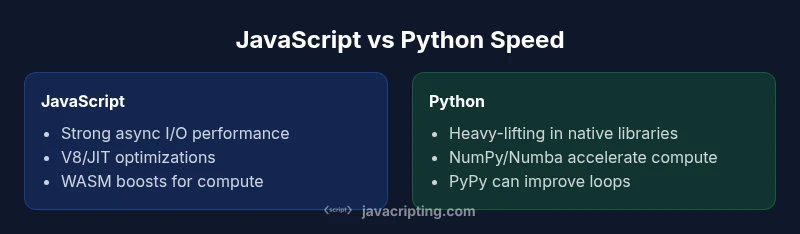
JavaScript speed is heavily influenced by the runtime engine (for example, V8 in Chrome and Node.js). Modern JS engines use Just-In-Time (JIT) compilation, aggressive inlining, and specialized optimizations for frequent patterns. Event-driven models and asynchronous APIs excel at throughput for web servers and real-time apps but can complicate CPU-bound optimizations. Memory management, garbage collection strategies, and the efficiency of asynchronous primitives (async/await, promises) also shape overall latency. In practice, JS speed benefits from hot paths rewritten to efficient idioms, and from WebAssembly for compute-heavy tasks that need near-native performance.
How Python speed is shaped by the runtime
Python speed hinges on the interpreter and the ecosystem around it. CPython, the standard implementation, has a Global Interpreter Lock (GIL) that can limit multi-threaded CPU-bound parallelism, making single-threaded performance a frequent bottleneck. Alternatives like PyPy offer a faster JIT for many workloads, while libraries written in C (NumPy, SciPy, pandas) push compute-heavy operations into optimized native code. For numeric and scientific computing, vectorized operations and native extensions are often the deciding factor in usable performance. The takeaway: Python can be incredibly fast where optimized libraries do the heavy lifting, but raw Python bytecode is typically slower for tight loops.
Benchmarks: micro-benchmarks vs real workloads
Benchmarks come in many flavors. Micro-benchmarks measure tiny, isolated operations and can mislead if extrapolated to real tasks. Real workloads combine I/O, networking, serialization, and data processing, where library quality and platform choices matter as much as language syntax. When comparing javascript vs python speed, ensure benchmarks reflect your actual workflow, including the number of concurrent requests, data sizes, and library versions. Profile-guided optimizations often yield bigger gains than language swaps alone.
Web workloads and I/O-bound scenarios
In web-facing contexts, JavaScript typically achieves strong throughput due to non-blocking I/O and efficient event loops. Node.js and browser runtimes are optimized for asynchronous patterns, fast event dispatch, and streaming data. Python can compete in web services when using asynchronous frameworks (like asyncio-enabled stacks) and when the bottleneck is library-bound I/O rather than pure CPU. For API servers serving many concurrent clients, JavaScript often wins on latency budgets; for data-heavy endpoints with CPU-bound preprocessing, Python’s ecosystem can offset slower language speed with optimized libraries.
CPU-bound tasks and numeric computing
CPU-bound workloads reveal more stark differences. In CPython, pure Python loops are typically slower, while Python’s numeric libraries run in optimized C, enabling substantial performance gains for array operations or matrix math. JavaScript, especially with modern engines and WASM-backed modules, can approach native speeds for certain tight loops. The practical result is task-dependent: use Python for data pipelines and ML workflows with heavy library acceleration; use JavaScript for server-side logic that benefits from a fast event loop and fast I/O paths.
Memory usage and garbage collection
Memory behavior influences speed in subtle ways. JavaScript runtimes emphasize aggressive, concurrent collection to minimize pause times, which can help latency but sometimes add CPU overhead. Python’s CPython uses reference counting and a separate GC for cycles; NumPy and other libraries minimize Python-level loops by pushing work into C. Well-designed memory strategies and careful data shaping often yield speed improvements that are not obvious from language choice alone.
Concurrency models: event loop vs GIL
JavaScript relies on a single-threaded event loop with worker threads for some parallelism, plus non-blocking I/O that keeps latency low under load. Python’s GIL restricts true multi-threaded parallelism in CPython, making multiprocessing or C extensions common routes to speed improvements. PyPy’s JIT and alternative runtimes can alter this dynamic, but the fundamental difference remains: JS favors asynchronous concurrency; Python emphasizes library-driven parallelism and native code speedups.
Tools to optimize speed: JIT, PyPy, WebAssembly
Several optimization avenues exist beyond choosing Python or JavaScript. For Python, PyPy’s JIT can improve loop-heavy code, while NumPy/Numba offloads computation to compiled code. For JavaScript, V8 optimizations, WebAssembly modules for critical sections, and efficient bundling reduce runtime overhead. A practical approach is to identify performance hotspots with profilers, then route those paths to the most efficient implementation, whether in Python’s native extensions or JS WASM modules.
Practical decision framework: when to choose which language
If your priority is rapid development, rich data science libraries, and a mature ecosystem for numerical tasks, Python often delivers better overall speed-to-solution despite slower low-level execution. If you prioritize low-latency I/O, real-time web services, and a robust asynchronous model, JavaScript tends to offer better end-to-end speed for many workloads. Consider hybrid architectures where CPU-heavy components run in Python libraries, while orchestration and data gathering occur in JavaScript; such patterns can yield excellent performance without sacrificing developer velocity.
Authority sources and further reading
For deeper dives into language performance, consult reputable sources and benchmarking discussions. See primary documentation and peer-reviewed analyses for context and reproducible results. Useful references include major publications and industry benchmarks that discuss engine optimizations, interpreter implementations, and its impact on real-world workloads.
mainTopicQueryValueAllowedInSchema annon?":null,
Comparison
| Feature | JavaScript (Node.js/Browser) | Python (CPython/PyPy) |
|---|---|---|
| Typical execution model | Single-threaded event loop with JIT optimizations | CPython interpreter with the GIL; PyPy offers a JIT |
| Best for | Web apps, real-time UIs, I/O-bound services | Numeric computing, data science, ML workloads with optimized libraries |
| Raw CPU compute speed (micro-benchmarks) | Generally strong in optimized runtimes and WASM bridges | Typically slower for pure Python loops unless using C extensions |
| Concurrency/parallelism | Asynchronous patterns, worker threads for heavy tasks | Multiprocessing and C extensions to bypass GIL; PyPy improves some cases |
| Optimization paths | V8/JIT, WASM for hot paths | C extensions, NumPy/SciPy, PyPy, Numba |
| Memory/GC behavior | Aggressive GC with low pause times; memory safety features | Reference counting with a separate GC cycle; numpy arrays reduce Python overhead |
| Ecosystem impact on speed | Strong optimization in server environments; WASM can unlock near-native speeds | Extensive native extensions speed up CPU-bound code |
Benefits
- Strong ecosystem and libraries enable rapid development
- JavaScript engines optimize long-running workloads well
- Python libraries (NumPy, pandas) optimize CPU-bound code
- Asynchronous patterns in JS improve throughput for I/O-bound tasks
- Cross-platform availability and tooling support
The Bad
- GIL in CPython limits true multi-threaded CPU parallelism
- JS single-threaded model requires careful async design for CPU work
- Micro-benchmarks can mislead about real-world performance
- Overheads from transpilation, tooling, and WASM integration can complicate optimization
- Performance depends heavily on chosen runtimes and libraries
JavaScript is typically faster for web-oriented, I/O-bound workloads, while Python excels in CPU-heavy tasks when optimized libraries are used
Choose JavaScript for latency-sensitive, asynchronous workloads and web services. Opt for Python when CPU-bound tasks are accelerated by native libraries and your workflow benefits from rapid development.
Questions & Answers
Which language is faster for CPU-bound tasks in practice?
In practice, Python often closes the gap for CPU-heavy tasks when optimized libraries (NumPy, SciPy) and C extensions are used. JavaScript may perform better in micro-benchmarks, but real-world workloads frequently rely on libraries that run native code, which can level the field.
For CPU-heavy tasks, Python can be very fast if you use optimized libraries and native extensions; JS shines in micro-benchmarks but often relies on libraries that run in native code to reach peak performance.
Is Python inherently slower than JavaScript?
Python’s default CPython interpreter can be slower for tight Python-only loops due to the GIL. However, optimized libraries and implementations like PyPy can dramatically reduce that gap for many workloads. The practical decision depends on your specific task and available optimizations.
Python can be slower for pure Python loops, but optimized runtimes and libraries often make it very fast in the right context.
Can WebAssembly make JavaScript faster for heavy tasks?
Yes, WebAssembly can accelerate compute-heavy sections of code that are offloaded from JavaScript, bringing near-native speeds for certain workloads. WASM is particularly useful for numeric computations that would otherwise run in JS, while keeping the developer-friendly JS ecosystem for orchestration.
WebAssembly lets you speed up heavy tasks by running them in near-native code, while you keep JavaScript for the rest of the app.
How should I benchmark speed fairly between JavaScript and Python?
Benchmark with representative workloads, including realistic data sizes, frequency of calls, and concurrency patterns. Separate CPU-bound hot paths from I/O-bound paths, and use consistent environments and tooling across languages to avoid skewed results.
Make sure your tests reflect real use cases and keep environments and data sizes consistent.
Should I switch languages for performance reasons?
Only switch if speed is the primary bottleneck and the new language provides better ecosystems for your task. Often a hybrid approach—keeping Python for heavy math libraries and using JavaScript for orchestration—delivers the best overall performance and developer productivity.
Switching languages just for speed isn’t always the best move; consider mixing languages to play to each one's strengths.
What role do libraries play in perceived speed differences?
Libraries often determine performance more than language syntax alone. Native extensions (C, C++, Fortran) in Python or WebAssembly modules in JavaScript can dramatically accelerate compute-heavy tasks, shifting the speed picture in meaningful ways.
Libraries can make or break performance—native code often wins the race.
What to Remember
- Benchmark with representative workloads
- Leverage native libraries for CPU-heavy tasks
- Use WASM or PyPy to close gaps where appropriate
- Prefer JavaScript for I/O-bound, event-driven apps
- Consider a hybrid approach to maximize speed and developer productivity