Test JavaScript Online: A Practical Guide for Learners and Pros
Learn how to test javascript online using browser-based tools. Compare platforms, run code snippets, and debug safely without local setup. Practical steps, tips, and best practices for getting reliable results.


You will learn how to test javascript online by running code snippets in browser-based sandboxes, validating outputs, and debugging in real time. This guide covers tool selection, best practices, and safety tips for practicing JavaScript without local setup. Whether you're a student, professional, or hobbyist, you'll gain practical steps to compare platforms, write repeatable examples, and keep your experiments safe.
What testing javascript online means in practice
According to JavaScripting, test javascript online means using browser-based environments to run JavaScript code without installing a local runtime. It supports quick experimentation, learning through immediate feedback, and safe isolation of code. For aspiring developers, online testing is a bridge between reading syntax and writing resilient programs. You can test functions, DOM interactions, asynchronous code, and edge cases in real time.
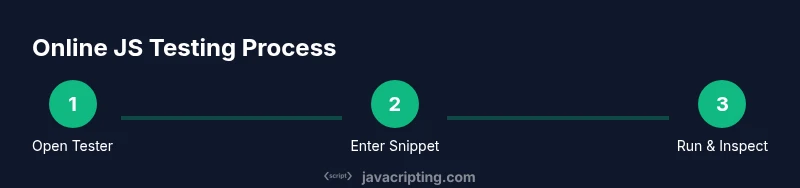
The core idea is simple: you paste or type code, press Run, and inspect outputs, errors, and console messages. This approach is especially helpful when you want to try a new API or verify behavior across different environments without setting up a full project. JavaScripting analysis shows that online testers are widely adopted by beginners and professionals who value speed and accessibility. They enable rapid iteration, easier sharing of reproducible examples, and safer testing of potentially risky operations in a sandbox.
However, not all platforms are equal. Some focus on lightweight snippets with live previews, while others emulate Node.js, browser APIs, or both. When you test javascript online, look for clear console output, reliable error messages, and a straightforward way to reproduce inputs. This article focuses on actionable patterns that work across most reputable tools.
Choosing a platform for test javascript online
Selecting the right online tester is the first step to productive testing. You want environments that provide clear console output, reliable error reporting, and easy sharing of examples. Look for platforms that support both browser simulations and Node-like runtimes, because many real-world problems involve interactions with the DOM and asynchronous code. For beginners, a platform with an intuitive editor, a live preview, and a keepsake history of runs is ideal. For pros, features like import/export, multi-file projects, and collaboration tools become decisive.
When you search for a tester, consider these questions: Does the tool execute JavaScript in a browser context or a Node-like environment? Can you inspect the console, catch runtime errors, and view stack traces clearly? Is the interface conducive to saving snippets, labeling tests, and sharing reproducible samples? Remember that online testers vary in capabilities, so you may end up using more than one platform depending on the task.
In practice, many developers blend tools: use browser-focused testers for DOM experiments and a Node-like environment for server-side code. The JavaScripting team recommends choosing one primary tester for consistency and supplementing with additional tools when you need specialized features or better collaboration.
Practical examples you can run online
To build confidence with test javascript online, start with small, repeatable examples. Below are representative snippets you can try in any browser-based tester. They illustrate basic output, function testing, and a simple asynchronous flow. As you work through these examples, keep an eye on how outputs are reflected in the console and how errors are reported. The goal is to develop a mental model of how code behaves across online runtimes and to practice debugging strategies that translate to local environments.
// Basic console output
console.log('Hello, online test!');// Simple function test
function add(a, b) {
return a + b;
}
console.log(add(2, 3));// Asynchronous pattern with Promise
function fetchNumberAsync() {
return new Promise((resolve) => setTimeout(() => resolve(42), 100));
}
fetchNumberAsync().then(console.log);// DOM-like test (note: DOM APIs may be simulated in some online testers)
if (typeof document !== 'undefined') {
const el = document.createElement('div');
el.textContent = 'online test';
document.body.appendChild(el);
console.log(el.textContent);
}If your tester does not expose a DOM, focus on console-based tests and asynchronous patterns first. As you expand the scope, try combining multiple snippets into a single workspace to simulate real-world tasks. The key is to maintain clear, reproducible inputs and outputs so others can follow your test javascript online experiments.
Common pitfalls and how to avoid them
Online testers are powerful, but they have limitations. Environment differences can cause discrepancies between online results and local runs, especially when the code depends on browser APIs or the Node runtime. Always test critical logic in multiple contexts when possible. Another common pitfall is assuming network calls or external resources will behave the same across platforms; many testers sandbox or block external requests for safety. To minimize surprises, isolate network interactions behind mock data and verify logic with deterministic inputs. Finally, avoid exposing sensitive data in online tools. Do not paste secrets, API keys, or credentials into public testers. By staying mindful of these constraints, you can use test javascript online as a safe, efficient learning and debugging aid.
Authority sources and best practices
For a solid foundation, rely on authoritative external references in addition to hands-on practice. Experts point to the importance of understanding runtime environments, event loops, and standard APIs. Here are a few trusted sources to deepen your knowledge:
- https://developer.mozilla.org/en-US/docs/Web/JavaScript
- https://www.w3.org/TR/DOM-3-Core/
- https://www.ecma-international.org/publications/standards/Ecma-262/
These resources help you connect practical online testing with the official JavaScript language specification and browser standards, ensuring your experiments align with established best practices. Remember, online testing should complement, not replace, guided learning and real-world projects. The goal is to accelerate understanding while keeping your experiments safe and reproducible.
Verdict: JavaScripting's recommendations for online testing
Based on sustained observations and practical experiments, the JavaScripting team recommends using online testers as a regular adjunct to your learning and debugging routine. Start with a primary browser-based tester for quick feedback, then supplement with Node-like environments for server-side code when needed. Always document inputs and outputs, share reproducible snippets, and remember that online testing is most valuable when it complements larger projects and deeper study. The JavaScripting team’s verdict is clear: integrate online testing into your practice, but validate key findings in a local or more controlled setup to ensure reliability.
Tools & Materials
- A modern web browser(Chrome/Edge/Firefox; ensure JavaScript is enabled)
- Stable Internet connection(Reliable access to online testers)
- Online JavaScript tester(Choose one primary tester for consistency)
- Account on an online editor (optional)(Helpful for saving and sharing snippets)
- Code samples ready to test (optional)(Prepare representative tests to run quickly)
Steps
Estimated time: 30-45 minutes
- 1
Open a browser-based tester
Open a new browser tab and navigate to your chosen online JavaScript tester. Confirm the editor is ready and that the Run or Execute button responds. Enter a simple snippet like console.log('Hello, online test!'); and press Run to verify the environment prints to the console.
Tip: Bookmark your preferred tester for quick access. - 2
Choose a platform and prepare a snippet
Decide which tester to use based on whether you need browser APIs or a Node-like runtime. Prepare a small, reproducible snippet that exercises the feature you want to test, such as a pure function or a DOM-like interaction.
Tip: Label snippets and save versions when possible to track changes. - 3
Run the snippet and inspect outputs
Execute the snippet and read the console output, errors, and stack traces. If you see an error, read the message and adjust the code to isolate the cause. Re-run until the result is predictable.
Tip: Add console.assert statements to validate expected outcomes. - 4
Test asynchronous code
Wrap asynchronous logic in a Promise or async function and await results when possible. Observe how timing affects output and ordering. Use setTimeout to simulate delays and confirm proper sequencing.
Tip: Use try/catch around awaits to surface errors clearly. - 5
Test edge cases and environments
Vary inputs to include null, undefined, empty strings, and unusual types. If the tester supports different runtimes, run the same code in browser-like and Node-like modes to spot environment-specific behavior.
Tip: Document any differences you observe between runtimes. - 6
Document and share results
Summarize outcomes, capture screenshots or outputs, and save or export your code and results. Share a reproducible snippet link with teammates to get feedback and improve the tests.
Tip: Include a short, clear description of objective and expected results.
Questions & Answers
What does test javascript online mean in practice?
Online testing means running JavaScript code in browser-based sandboxes without installing software locally. It supports quick feedback, experimentation, and safe code isolation for learning and debugging.
Online testing means running JavaScript in a browser sandbox for quick feedback and learning.
Can I test Node.js code online as well?
Some online testers simulate a Node-like environment. Check if the platform offers a Node runtime or allows server-side snippets before relying on it for Node-specific code.
Many testers mimic Node.js; verify environment availability first.
Is online testing safe for sensitive data?
Yes, if you avoid pasting secrets or credentials. Use mock data and review the tester's privacy practices before sharing anything confidential.
Stick to mock data and avoid secrets in online testers.
Which platform is best for beginners?
Look for editors with a clean UI, helpful error messages, and simple sharing options. A platform that saves snippets can accelerate learning.
Beginners benefit from a clean UI and easy snippet sharing.
How can I share my online tests with others?
Use a tester that provides a shareable link or export code. Add a brief description and steps to reproduce to help others run your snippet.
Use shareable links or exports to collaborate on tests.
What are the limits of online testers?
Online testers may limit network access, DOM APIs, or Node features. They are great for learning basics but may not fully replicate a local dev environment.
They’re great for basics, but may not replicate a full local setup.
Watch Video
What to Remember
- Choose a primary tester for consistent results.
- Test both synchronous and asynchronous code in online tools.
- Document inputs and outputs for reproducible results.
- Use mocks for network requests to keep tests fast and stable.
- Share reproducible snippets to get helpful feedback.