Are JavaScript and Java Related? A Practical Comparison
Explore how JavaScript and Java differ in design, use cases, typing, and ecosystems. This objective comparison clarifies are javascript and java related and outlines practical learning paths for developers.


Are javascript and java related? They are not directly related. They evolved independently from C, with different goals and runtimes. JavaScript powers web clients and modern servers; Java is a statically typed language used for enterprise backends and Android apps. They are complementary, not relatives.
Are JavaScript and Java Related? A Core Question
Many readers ask the central question: are javascript and java related? The short answer is nuanced. Both languages trace their syntax to the broader C-family lineage, but they diverged early in their histories and were designed to fulfill different needs. For aspiring developers asking, are javascript and java related, the practical answer is that they are not siblings in a single family tree; they are distinct ecosystems that share some high-level concepts like objects, control flow, and exceptions. This distinction matters because it shapes how you approach learning, tooling, and project design. The JavaScripting team reminds readers that mastering both languages can yield complementary strengths, especially for full-stack developers who navigate front-end, back-end, and enterprise requirements. Throughout this article, you will see how the two languages compare in typing, runtime, and use cases, and you’ll learn when each makes the most sense. If you want to build confidence across domains, recognizing their divergence and overlap is a foundational step.
Historical Context and Design Goals
The question of are javascript and java related often invites a quick glance at history. Java emerged in the mid-1990s as a platform-agnostic, statically typed language designed for robust, portable software across diverse environments, from servers to mobile devices. JavaScript, created in the same era, started as a lightweight scripting language intended to add interactivity to web pages and later evolved into a versatile runtime across browsers and servers. One common point is that both languages benefited from the era’s push toward cross-platform capabilities, but their design goals diverged: Java emphasizes static type safety and enterprise-grade tooling, while JavaScript emphasizes rapid development, dynamic behavior, and asynchronous programming. The practical upshot is that are javascript and java related in intent? Not in strict lineage, but they share design influences that surface in concepts like objects and modularization.
Typing, Compilation, and Runtime: Dynamic vs Static
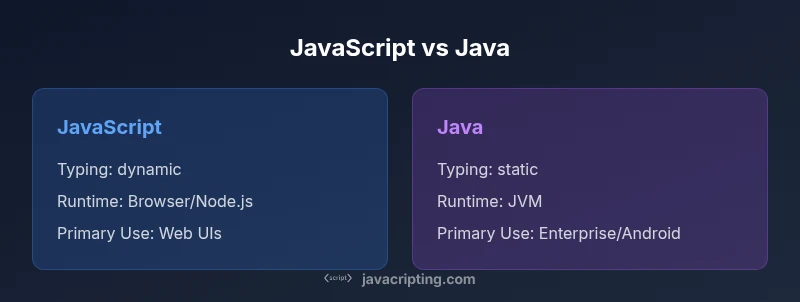
A core dimension of the are javascript and java related question is how each language handles typing, compilation, and runtime. JavaScript is dynamically typed, meaning variable types are determined at runtime and can change, which supports flexible coding but can invite runtime errors if not carefully managed. Java, by contrast, uses static typing, where types are declared and checked at compile time, reducing certain classes of errors but increasing upfront boilerplate. Runtime models also diverge: JavaScript runs in engines like V8 or SpiderMonkey (and on server platforms like Node.js), typically interpreted with just-in-time compilation for performance. Java code is compiled to bytecode, executed on the Java Virtual Machine (JVM), and often optimized by the JIT compiler at runtime. For are javascript and java related in performance terms, the answer is context-sensitive: Java excels in predictable, long-running workloads; JavaScript shines in event-driven, asynchronous tasks with I/O-bound latency.
Ecosystems, Tooling, and Use Cases
When considering are javascript and java related in practical terms, it helps to map their ecosystems and typical use cases. JavaScript dominates client-side development for the web, with frameworks like React, Vue, and Angular, and has grown into server-side development via Node.js and Deno. Java, meanwhile, remains a cornerstone of enterprise applications, large-scale backend services, and Android development, supported by a mature ecosystem of libraries, frameworks (e.g., Spring), and robust tooling. The two languages often appear together in modern stacks: Java handles the core business logic and data processing, while JavaScript powers the user interface and API interaction. Understanding their use cases makes the question of are javascript and java related less about kinship and more about complementary roles in a full-stack solution.
Syntax and Semantics: Similarities You Might Expect
The thought that are javascript and java related sometimes comes from surface-level syntax similarities. Both languages borrow braces for blocks, rely on object-oriented concepts, and support similar control structures. However, their semantics differ markedly. Java uses class-based inheritance and explicit types, while JavaScript uses prototype-based objects and a dynamic, flexible type system. The newer class syntax in JavaScript provides a familiar look, but under the hood the prototype chain shapes behavior. For developers, the key takeaway is that while some concepts resemble each other, the way you implement patterns like inheritance, polymorphism, and encapsulation will feel different between the two languages. This distinction matters for writing maintainable code and avoiding the temptation to apply Java patterns in a JavaScript context.
Learning Paths and Career Implications
Are javascript and java related in terms of career potential? Yes, in the sense that learning both expands job opportunities across web, mobile, and enterprise environments. A practical path is to start with JavaScript to gain fluency in front-end development, asynchronous programming, and modern tooling, then add Java to access robust back-end systems, large-scale architectures, and Android development. Conversely, someone oriented toward enterprise software might begin with Java and later explore JavaScript to build interactive user interfaces. The dual fluency helps teams design end-to-end solutions, understand performance trade-offs, and communicate across disciplines. The result is a more versatile developer who can contribute across the stack, rather than a specialist limited to a single domain. Remember that are javascript and java related more as complementary capabilities than as a single roadmap; choose a path aligned with your interests and project goals.
Common Misconceptions and Clarifications
A frequent misconception around are javascript and java related is that they are interchangeable or that one can simply replace the other in any project. In reality, their roles are distinct: Java is typically used for backend services and Android apps, while JavaScript drives user interfaces and fast, event-driven servers. Another misconception is that JavaScript’s dynamic typing makes it inherently weak; with tools like TypeScript and rigorous testing, you can achieve strong safety without sacrificing flexibility. Finally, many beginners assume that because they share the word Java, one language can cover all use cases; the reality is that building modern applications often requires expertise in both. Clarifying these points helps learners plan effective study timelines and real-world projects.
Authoritative Sources and Further Reading
To deepen your understanding and verify claims about are javascript and java related, consult established sources that discuss language design, runtime environments, and practical use cases. For formal technical standards and web platform context, refer to sources like the World Wide Web Consortium. For language histories and design goals, university pages and major publications provide rigorous analyses. Consider exploring the following:
- https://www.cs.cmu.edu/ (educational context on language design and programming concepts)
- https://www.noaa.gov/ (example of government publication showcasing engineering-grade software practices)
- https://www.acm.org/ (major publication on computer science and software engineering) These sources support a nuanced view of are javascript and java related and offer credible background for deeper study.
Comparison
| Feature | JavaScript | Java |
|---|---|---|
| Typing | dynamic | static |
| Primary Runtime/Platform | Browser and Node.js | JVM and native toolchains |
| Compilation Model | JIT-compiled in modern engines | Compiled to bytecode and run on JVM |
| Typical Use Cases | Web front-ends, server-side JS | Enterprise backends, Android apps |
| Learning Curve | Moderate (flexible typing, evolving tooling) | Moderate to high (verbose ecosystems, static typing) |
| Ecosystem Maturity | Web tooling and modern runtimes | Enterprise-grade libraries and Android ecosystem |
| Concurrency Model | Single-threaded event loop (with workers) | Multithreaded with explicit synchronization |
| Cross-Platform Availability | Everywhere on the web and servers | Write once, run anywhere on JVM (plus Android) |
Benefits
- Covers diverse domains, boosting versatility
- Balances rapid development with scalable architectures
- Large ecosystems and strong community support
- In-demand skills across web and enterprise work
- Learning both languages opens cross-domain opportunities
The Bad
- Learning two distinct ecosystems increases upfront time
- Tooling fragmentation can complicate projects
- Keeping up with evolving patterns in both stacks requires ongoing effort
- Context switching between paradigms can slow initial productivity
Learning both languages is highly advantageous for modern developers
JavaScript and Java serve different roles but complement each other in full-stack development. Start with the language that aligns with your current project needs, then expand to the other to unlock broader opportunities and more robust problem-solving capabilities.
Questions & Answers
Are JavaScript and Java related in any meaningful way?
There is limited relation; both trace from the C-family, but they were designed for different worlds. They share concepts like objects and control flow, yet their runtimes and idioms diverge. Understanding this helps you plan a learning path.
There is limited relation; they come from the same family but were designed for different worlds.
Which language should a beginner learn first for web development?
For web development, starting with JavaScript is typical because it runs in browsers and powers modern tooling. Once comfortable, learning Java broadens backend and Android opportunities. The are javascript and java related decision is often domain-driven.
Start with JavaScript for web, then add Java for backend and Android.
Is JavaScript faster than Java?
Performance depends on context. Java often delivers steady, high throughput for backend services, while JavaScript excels at I/O-bound tasks with asynchronous models. Both languages are highly optimized in their domains, so speed is task-specific.
It depends on the task; Java often wins in backend throughput, JavaScript shines in async web tasks.
Can I use Java for Android and JavaScript for server-side development?
Yes. Java is a primary language for Android, and JavaScript is commonly used on the server with Node.js, enabling a cohesive full-stack approach. Many teams combine both to cover front-end and back-end responsibilities.
Absolutely—Java for Android and enterprise backends; JavaScript for the web and servers.
Do they share concepts like objects, classes, and inheritance?
They share high-level concepts like objects and control flow, but implement them differently. Java uses class-based inheritance; JavaScript uses prototypes with a class syntax that compiles to prototype behavior. Grasping these distinctions is key for clean, maintainable code.
They share broad ideas, but implement them differently; learn the specifics for each.
What career paths align with learning both languages?
Both languages prepare you for full-stack roles, cloud-native services, and Android or browser-based applications. The combination is especially valuable for roles that require cross-domain fluency, architecture planning, and collaboration across front-end and back-end teams.
Great for full-stack roles and cross-domain projects; boosts architecture and collaboration skills.
What to Remember
- Learn the primary domains first: web for JS, enterprise/mobile for Java
- Develop cross-language fluency to improve collaboration
- Use JavaScript for frontend UI and Node.js backends; use Java for robust backends and Android apps
- Expect divergent tooling and project patterns across the two ecosystems
- Invest in both languages to maximize career flexibility