JavaScript vs Java: A Practical Comparison for Developers
A thorough, analytical comparison of JavaScript and Java, covering typing, runtime, concurrency, tooling, use cases, and career implications. Learn where each language shines and how to choose based on project goals.


javascript or java presents two foundational yet distinct paths for developers: JavaScript excels in browser-based UI and rapid iteration with flexible typing, while Java offers performance, scalability, and enterprise-grade reliability. For most frontend teams, JavaScript is the default choice, but for large-scale backends and Android development, Java remains a strong option. The best decision depends on your target platform, performance needs, and long-term maintenance strategy.
The Landscape: Language Roles and Evolution
In modern software development, JavaScript and Java occupy different but complementary spaces. JavaScript started as a browser scripting language and has evolved into a versatile language used across front-end, server-side (via Node.js), and even mobile tooling. Java, by contrast, grew from a need for portability and performance in large-scale systems and Android applications. The JavaScripting team notes that many teams end up using both languages in a single product, each serving its strengths. When you ask which is better, you’re really asking which is better for a given domain: user interfaces and rapid iteration versus robust back-end infrastructure and long-term stability. As you explore javascript or java alongside career goals, the decision becomes a matter of scope, audience, and maintainability rather than a single universal truth.
Language Fundamentals: Typing, Syntax, and Paradigms
JavaScript is dynamically typed and prototype-based, with first-class functions and a flexible object model. Its syntax is concise for simple tasks but can become tricky in large codebases without discipline. Java is statically typed, class-based, and strongly typed, with explicit generics and a verbose but clear structure. The paradigms differ as well: functional patterns are common in JavaScript, while Java emphasizes object-oriented design with well-defined interfaces. When you compare javascript or java in terms of learning curve, Java’s explicitness can help prevent some runtime errors, but JavaScript’s flexibility can accelerate initial productivity. The JavaScripting guidance suggests pairing strong typing (via TypeScript in the JS world) or Kotlin in the JVM ecosystem to balance safety and productivity.
Runtime and Execution Environments: Browsers, Node.js, and the JVM
JavaScript runs in the browser, where the runtime is tightly coupled with the document model and UI thread. Node.js extends JS to server-side workloads, enabling event-driven architectures with asynchronous I/O. Java runs on the Java Virtual Machine (JVM), delivering platform independence and a mature runtime with sophisticated garbage collection and optimization. When comparing javascript or java regarding execution, the critical distinction is that JavaScript trades raw peak CPU for flexibility and rapid I/O responsiveness, while Java often achieves higher sustained performance through compilation, JIT optimizations, and strong runtime guarantees. Teams should consider deployment environments, latency requirements, and memory profiles when choosing a path.
Concurrency and Performance Patterns
JavaScript uses an event loop model, asynchronous callbacks, promises, and async/await to handle concurrency without traditional threading. This model suits I/O-bound workloads and responsive UIs but can complicate CPU-bound tasks if not offloaded to workers. Java relies on multithreading, synchronized blocks, and a robust threading API, allowing true parallelism on multi-core systems. Although Java’s raw performance can surpass JavaScript for compute-heavy workloads, the JVM’s tuning and memory management can require deeper expertise. For long-running services, Java often yields stable throughput; for real-time web apps, JavaScript’s non-blocking I/O can deliver responsive experiences.
Tooling, Frameworks, and Build Ecosystems
The JavaScript ecosystem thrives on npm, bundlers (Webpack, Vite), and a plethora of frameworks (React, Vue, Angular) that accelerate UI development. Tooling emphasizes rapid feedback cycles, hot module replacement, and cross-platform testing. Java’s ecosystem centers on the JVM, with robust IDEs (IntelliJ, Eclipse), build tools (Maven, Gradle), and a vast collection of enterprise libraries. Both languages reward standardization and automation, but the scope differs: JS tooling emphasizes front-end delivery and client performance; Java tooling emphasizes stability, security, and server-side reliability. When deciding between javascript or java in a project, examine team familiarity, deployment pipelines, and dependency management.
Learning Curve and Developer Experience
JavaScript lowers the barrier to entry for beginners due to its forgiving syntax and ubiquity. The dynamic nature of JS allows experimenting without heavy boilerplate, but it can hide runtime issues until execution. Java’s verbose syntax and explicit typing create a steeper learning curve but yield predictable behavior and easier refactoring at scale. For newcomers, starting with JS to build interactive web pages is common, then expanding to TypeScript (typed JS) or Kotlin/Java for backend services to reap safety benefits. The micro-choices you make—choosing TypeScript, choosing Kotlin, or adopting a strict linting setup—impact long-term maintainability.
Use Cases: Web Apps, Backend, Mobile, and Beyond
JavaScript dominates client-side web development, enabling dynamic interfaces, single-page applications, and cross-platform mobile apps via frameworks like React Native. It also powers many server-side systems through Node.js, microservices architectures, and serverless functions. Java remains a workhorse for enterprise backends, batch processing, and Android development, with a long track record of reliability and scale. Choosing between javascript or java hinges on the primary problem: UI interactivity and reach (JS) versus performance-critical services and native mobile ecosystems (Java). In mixed environments, teams often compile hybrid stacks that leverage both languages where each excels.
Ecosystem, Community, and Career Prospects
Both languages enjoy vibrant communities and extensive documentation. JavaScript’s ecosystem evolves rapidly, with frequent tooling updates and new frameworks; Java’s ecosystem emphasizes stability, long-term support, and formal specifications. Career opportunities reflect these trajectories: roles focusing on front-end experiences, UX-driven teams, and full-stack positions frequently require JavaScript expertise, while roles in enterprise software, data processing, and Android development commonly demand Java proficiency. The JavaScripting team notes that a dual skill set—proficiency in JavaScript for UI and Java for back-end services—often yields the strongest career versatility.
Security, Reliability, and Maintenance Considerations
JavaScript’s browser environment introduces client-side security considerations—cross-site scripting, insecure dependencies, and browser-specific quirks—necessitating careful validation, dependency auditing, and content security policies. Java’s security model emphasizes access control, robust sandboxing, and mature runtime protections, though JVM-based apps still require careful dependency management and patching. For long-term maintenance, consider code quality tooling, test coverage, and ongoing learning: JS teams benefit from strong linting and automated testing, while Java teams gain from comprehensive unit tests and integration tests across services.
Cross-Platform Realities and Interoperability
Interoperability between JavaScript and Java is common in modern stacks. Front-end UI communicates with back-end services written in Java via REST or GraphQL APIs; Java apps can expose data to front-end clients, while Node.js services can consume those APIs efficiently. Some projects also use transpilers or cross-compiled languages (e.g., Kotlin/JS, Scala.js) to bridge concepts, but they add build complexity. When evaluating javascript or java for a project, weigh the integration costs, data serialization formats, and network latency implications. A carefully designed API layer often yields the cleanest separation of concerns.
Cost of Ownership and Long-Term Considerations
Total cost of ownership for JavaScript projects often centers on tooling, hosting, and developer time; performance optimizations and bundle sizes can influence hosting costs and user experience. Java projects incur costs tied to JVM tuning, enterprise-grade dependencies, and ongoing maintenance for large codebases. In practice, JS projects can scale cost-effectively for web apps, while Java projects pay dividends in predictability and performance for large workloads. The decision should factor in team readiness, expected growth, and infrastructure plans.
Trade-offs and Practical Guidance
Ultimately, javascript or java choice is a trade-off between speed of delivery and system complexity. If you need a quick-to-market UI with broad reach, JavaScript is the pragmatic path. If you must support high-throughput backends, strict type safety, and robust Android development, Java remains compelling. In many teams, a hybrid approach leverages both: front-end JavaScript for interactive experiences and Java for scalable services. The key is to align technology decisions with business goals, not just current trends.
Comparison
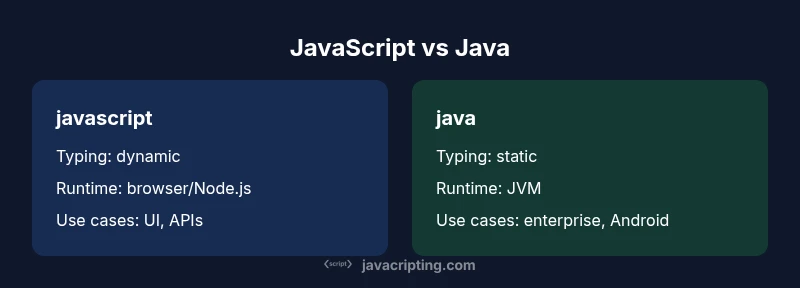
| Feature | javascript | java |
|---|---|---|
| Typing | dynamic | static |
| Runtime | browser/Node.js | JVM |
| Concurrency Model | event loop with async/await | multithreading with JVM/libs |
| Platform Reach | web browsers, servers via Node.js | cross-platform JVM environments, Android |
| Ecosystem Maturity | fast-evolving, vast frontend tooling | long-standing enterprise libraries |
| Use Cases | UI/UX, web apps, serverless | enterprise backends, Android apps |
| Learning Curve | lower entry barrier, flexible syntax | steeper due to verbosity and typing |
Benefits
- Large, active communities across web dev and back-end roles
- Rich tooling and rapid iteration cycles support quick delivery
- Cross-platform opportunities and strong career portability
- JavaScript enables rapid UI prototyping and dynamic experiences
The Bad
- JavaScript can suffer from fragmented ecosystems and runtime quirks
- Java can be verbose and require more boilerplate for clean architecture
- Security considerations differ by environment and require discipline
- Performance tuning responsibilities vary by project complexity
JavaScript for UI speed; Java for robust backends
Choose JavaScript when user experience and rapid iteration matter most. Opt for Java when you need predictable performance, enterprise-grade reliability, and strong type safety.
Questions & Answers
What are the fundamental differences between JavaScript and Java?
JavaScript is dynamically typed and prototype-based with an event-driven runtime, primarily used for UI and web services. Java is statically typed, class-based, and runs on the JVM, offering strong performance and scalability. The languages serve different purposes, so javascript or java decisions hinge on domain goals rather than a single feature comparison.
JavaScript is dynamic and prototype-based, great for UI. Java is static and class-based, strong for enterprise backends. The right choice depends on your project goals.
Should I learn JavaScript or Java first for frontend development?
For frontend development, start with JavaScript to build interactive experiences. Then add TypeScript for type safety and future-proofing. If you also need server-side skills, gradually learn Java for back-end robustness and Android development. The combination covers most modern stacks.
Start with JavaScript for the frontend, then bring in TypeScript or Java for backend needs.
Can JavaScript be used on the server?
Yes. Node.js enables server-side JavaScript, supporting scalable, event-driven services. Many teams use Node.js for REST APIs, microservices, and serverless functions, often in combination with front-end JS frameworks.
Yes. Node.js lets you run JavaScript on servers and build scalable APIs.
Is Java still relevant for Android development?
Java remains a foundational language for Android development, complemented by Kotlin. Many legacy apps and enterprise apps rely on Java, and it continues to be taught in many computer science curricula, ensuring a steady supply of Java-enabled Android developers.
Yes. Java is still important for Android today, though Kotlin is increasingly popular.
Which language is better for enterprise-grade backends?
Java often excels in enterprise-grade backends due to performance predictability, tooling maturity, and long-term support. Java also benefits from robust security and large libraries for integration, data processing, and middleware. JavaScript can handle backends too, especially with Node.js, but Java generally offers stronger long-term stability for critical systems.
For enterprise backends, Java is usually the safer bet for scale and stability.
Do both languages support strong typing?
Java has built-in static typing, while JavaScript uses dynamic typing. Developers often add type safety to JavaScript via TypeScript, bringing compile-time checking. In enterprise contexts, combining TypeScript with JavaScript or using Kotlin on the JVM can improve safety without sacrificing flexibility.
Java is statically typed, JavaScript is dynamic, but you can add typing with TypeScript.
What to Remember
- Identify project scope: UI-centric or enterprise backend
- Balance typing: dynamic JS vs static Java
- Assess runtime: browser/Node.js vs JVM
- Leverage hybrid stacks when appropriate
- Invest in tooling to reduce maintenance costs