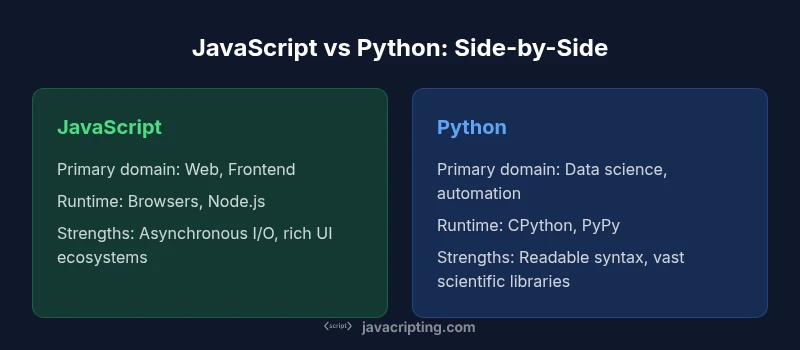
Is JavaScript the Same as Python? A Practical Comparison
Explore a rigorous, practical comparison of is javascript the same as python, covering syntax, typing, ecosystems, and use cases to help you decide which language fits your goals. Analytical, clear, and domain-focused.


JavaScript and Python are not the same language; they serve different domains. JavaScript powers the web and frontend development, while Python dominates data science and scripting. When you ask 'is javascript the same as python', the answer is clearly no—each language is optimized for its ecosystem, with distinct syntax, tooling, and learning paths.
Core Philosophies: Dynamic Languages in Practice
Two languages, one family, power modern development. According to JavaScripting, two popular dynamic languages drive very different domains: is javascript the same as python? Not at all; they share foundational concepts like variables, control flow, and functions, but their design goals diverge. JavaScript emphasizes event-driven programming, asynchronous patterns, and a runtime tightly coupled to the browser and, increasingly, the server side with Node.js. Python emphasizes readability, maintainability, and expressive syntax for a broad spectrum of domains from data science to automation. For beginners, the underlying idea is to recognize that dynamic typing and flexible syntax open doors to rapid prototyping, but you must respect the ecosystem’s conventions to avoid feel-broken tooling. If your project involves building interactive web interfaces, you’ll encounter JavaScript first; if it involves rapid data exploration or scripting tasks, Python is often your starting point. This framing helps answer the overarching question: is javascript the same as python? The pragmatic answer is no—the languages are optimized for different problem spaces, and your choice should align with project goals and team workflows.
Syntax and Language Habits: Readability, Whitespace, and Semicolon Trade-offs
A key initial distinction is how developers express logic. Python uses indentation to define blocks, which enforces a readable, uniform style and reduces boilerplate. JavaScript uses curly braces to delineate blocks, with semicolons often optional due to automatic semicolon insertion. These syntactic choices influence how you read and write code, especially on larger teams. The topic of whether is javascript the same as python often hinges on ergonomics and familiarity: Python’s syntax tends to be friendlier for beginners, while JavaScript rewards engineers who enjoy explicit structure in complex web apps. Another layer is typing discipline: both are dynamically typed, but Python tends to be perceived as more explicit about data structures, whereas JavaScript’s type coercion can surprise newcomers. To reduce surprises, rely on linting, type hints (where available), and consistent naming conventions. The bottom line: is javascript the same as python in day-to-day syntax? They are not identical—each language sneaks in unique patterns that support their core use cases.
Runtime and Execution Model: Interpreters, JITs, and Environments
Understanding how code runs clarifies why these languages feel different. Python executes via interpreters like CPython or PyPy, with an emphasis on simplicity and explicitness. JavaScript runs through engines like V8, with JIT compilation and aggressive optimization for event-driven workloads. Environment matters: Python shines in server-side scripting, data pipelines, and scientific computing, while JavaScript thrives in browsers and modern server stacks through Node.js. Async behavior is central to both, but expressed differently. JavaScript’s event loop and promises/async-await are core to responsive frontends and scalable backends. Python offers asyncio for concurrency, but many developers rely on multi-threading or multiprocessing patterns for CPU-bound tasks. This divergence in runtime models contributes to the intuitive answer to is javascript the same as python: they perform similar tasks in broad strokes, but their underlying runtimes shape how you write and optimize code.
Ecosystems and Libraries: A World of Packages
Both languages boast rich ecosystems, but the geography differs. JavaScript’s npm and Yarn ecosystem dominates front-end tooling, framework ecosystems (React, Vue, Angular), and cross-platform mobile development via frameworks like React Native. Python’s PyPI provides extensive libraries for data science (NumPy, pandas), machine learning (scikit-learn), web frameworks (Django, Flask), and automation tools. The breadth of resources in each ecosystem accelerates development in its favored domains. When you ask is javascript the same as python, the ecosystem answer is: no—both offer massive, thriving communities, yet they orbit different problem spaces. This matters for hiring, libraries, and long-term maintenance: you’ll likely reach for JS libraries for client-side work and Python libraries for scientific computing or data workflows. The upshot: choose based on ecosystem alignment with project goals.
Typical Use Cases: Web vs Data Science vs Scripting
The practical split centers on where you’re applying the language. JavaScript dominates client-side web development and is increasingly used on the server with Node.js, enabling full-stack JavaScript in many teams. Python shines in data science, scientific computing, automation, and rapid prototyping, with a mature ecosystem of analysis and visualization tools. If your work involves building interactive websites, dashboards, or browser-based experiences, is javascript the same as python becomes a moot point—JavaScript is the natural choice. If your focus is data analysis, automation scripts, or research-oriented tasks, Python becomes your default option. There are also hybrid domains, where teams use both languages in different layers of the stack. The key takeaway is to map the problem domain to the language’s strengths, rather than seeking a universal one-size-fits-all solution.
Learning Curve for Developers Switching Languages
If you already know one language, picking up the other comes with a predictable set of challenges and opportunities. Python’s clean, readable syntax often lowers the barrier for learners transitioning from other languages, making it a popular first choice. JavaScript introduces a steeper onboarding curve in some aspects: the ecosystem’s breadth, the complexity of asynchronous patterns, and quirks around type coercion require deliberate study and practice. For someone asking is javascript the same as python, the practical answer is no—the learning path converges when you focus on fundamentals such as data structures, control flow, and function scope, but the specific idioms differ. A pragmatic approach is to learn core programming concepts in one language first, then leverage those concepts while acquiring the syntax and ecosystem knowledge for the second language.
Performance Considerations: When to Prioritize One Language
Performance discussions hinge on task type rather than language alone. JavaScript engines optimize heavily for I/O-bound and event-driven workloads common in web apps and real-time services, often giving JS an edge in those areas. Python, with optimized libraries in data processing and numeric computations, can compete effectively for certain workloads when the heavy lifting is done in native extensions. The question of is javascript the same as python becomes less about raw speed and more about how you structure work and leverage domain-specific libraries. For CPU-bound tasks, consider using Python with native extensions or delegating to compiled modules, while for scalable web services, JavaScript’s asynchronous model and non-blocking I/O can be advantageous.
Practical Guide: How to Start Learning the Other Language
If you know JavaScript and want to explore Python, start with the basics: syntax, data types, and control structures, then move to common standard libraries and simple scripting tasks. Practice with small projects like data parsing or automation scripts to internalize Pythonic idioms. Conversely, if you know Python and want to explore JavaScript, focus on browser basics, the Document Object Model (DOM), and asynchronous programming patterns with promises and async/await. Build a small web page or a backend service in Node.js to encounter the core differences firsthand. A disciplined approach—paired with hands-on projects and ongoing reference to official docs—will accelerate your transition. Remember that practice and real-world projects reinforce understanding far more than reading alone.
Real-World Scenarios and Decision Framework
In real projects, decisions are driven by domain, team expertise, and long-term maintenance needs. If your goal is rapid prototyping for data exploration, Python’s ecosystem and readability can accelerate results. If your objective is a web application with a rich interactive frontend, JavaScript is the natural foundation. For teams adopting a polyglot stack, both languages often co-exist, with Python handling data pipelines and ML, and JavaScript powering the UI and API layers. When evaluating whether to adopt one language over the other, ask questions like: Which language aligns with core competencies on the team? Which language has libraries and tooling that reduce development time for the target domain? Which runtime and deployment considerations are in play? Is javascript the same as python? The answer remains domain-driven: use the language whose strengths map directly to the problem you’re solving, and don’t shy away from integrating both when appropriate.
Common Pitfalls and How to Avoid Them
New learners often fall into a few recurring traps. In JavaScript, don’t rely on implicit type coercion; use strict mode and explicit checks to prevent bugs. In Python, avoid overusing global state in larger scripts; modularize code early and pay attention to packaging and dependency management. Mistakes often arise from assuming the two languages behave identically in concurrency, IO, and ecosystem tooling. To minimize risk, practice writing small, focused modules, read official documentation, and maintain consistent testing strategies across languages. Finally, remember that learning multiple languages takes time; pace your study with meaningful projects and seek feedback from the broader community to accelerate mastery.
Comparison
| Feature | JavaScript | Python |
|---|---|---|
| Typing | dynamic, loosely typed | dynamic, strongly typed |
| Syntax/Readability | Brace-delimited blocks, semicolons optional | Indentation-based blocks, emphasis on readability |
| Typical Use Cases | Web frontend, Node.js backend, mobile via frameworks | Data science, scripting, automation, backend |
| Ecosystem/Package Manager | npm/yarn; web-centric ecosystem | PyPI; rich scientific and automation libraries |
| Async/Concurrency | Native async/await, event-driven model | asyncio and async/await patterns; diverse concurrency approaches |
| Performance Profile | Engine-based JIT optimization; strong for I/O/web tasks | Optimized libraries can boost CPU-bound tasks; CPython interpreter |
| Learning Curve | Quirks and ecosystem breadth; practical for web dev | Often easier for beginners; strong emphasis on readability |
Benefits
- Huge web-centric ecosystem and tooling for JavaScript
- Readable syntax and strong libraries for data science in Python
- Rapid iteration and broad community support for both languages
- Cross-domain applicability encourages polyglot stacks
The Bad
- JavaScript quirks like implicit type coercion can be surprising
- Python can be slower for CPU-bound tasks unless optimized libraries are used
- Cross-language context switching adds cognitive load in mixed stacks
- Learning curves vary by domain and ecosystem maturity
Choose language by domain: JavaScript for web-focused work, Python for data science and scripting.
JavaScript dominates front-end development and modern full-stack stacks, while Python excels in data analytics, automation, and rapid prototyping. If you need both worlds, plan a polyglot approach and allocate time to learn the other language to complement your stack.
Questions & Answers
Is JavaScript the same as Python in syntax and usage?
No. They share core programming concepts but differ in syntax, runtime environments, and typical use cases. JavaScript is Web/Frontend-focused; Python is data science and scripting-oriented. Understanding domain-driven differences helps you choose wisely.
No—JS and Python have different syntax styles and typical use cases. Each shines in its own domain.
Can I use Python for frontend development?
Python is not used for client-side browser code. You’ll typically run Python on the server or in data processes. For browser-based code, JavaScript remains the standard.
Python isn’t used in the browser; use JavaScript for frontend work.
Which language is easier for beginners?
Python is commonly easier for beginners due to its readable syntax. If your goal is web development, starting with JavaScript can be advantageous because it covers both frontend and many backend tasks.
Python is usually easier to start with, but your goal matters a lot.
Do both languages support asynchronous programming?
Yes. JavaScript has native async/await and an event-driven model. Python offers asyncio and related patterns, though integration patterns differ between the two ecosystems.
Both support async, but the patterns differ.
Which has a larger data science ecosystem?
Python leads in data science with libraries like NumPy and pandas, plus strong visualization tools. JavaScript has growing data tasks libraries and visualization, but not as mature overall for analytics.
Python dominates data science libraries, with JS trailing in that space.
Is JavaScript faster than Python in practice?
Performance is task-dependent. JavaScript engines optimize web workloads well, while Python relies on optimized libraries for numerical tasks. If you need raw speed in CPU-heavy work, consider the task and use case rather than language alone.
Speed depends on the task and libraries, not just the language.
What to Remember
- Map your project domain to language strengths
- JavaScript powers the web; Python powers data and automation
- Learn fundamentals first, then adapt to idioms of each language
- Use the right tool for the job, not the languages in isolation
- Plan for polyglot stacks when teams require both ecosystems