Is JavaScript harder than PHP? A practical comparison for learners
Explore whether is javascript harder than php, examining syntax, asynchrony, tooling, deployment contexts, and real-world use cases to help you choose the right language for your projects.


Short answer: is javascript harder than php? The quick verdict is nuanced: JavaScript often feels harder for beginners due to browser APIs and asynchronous patterns, while PHP can be more approachable for straightforward server-side tasks. The real difference depends on project scope, tooling, and environment, so the choice hinges on your goals, not just syntax.
Is JavaScript harder than PHP? Defining the question
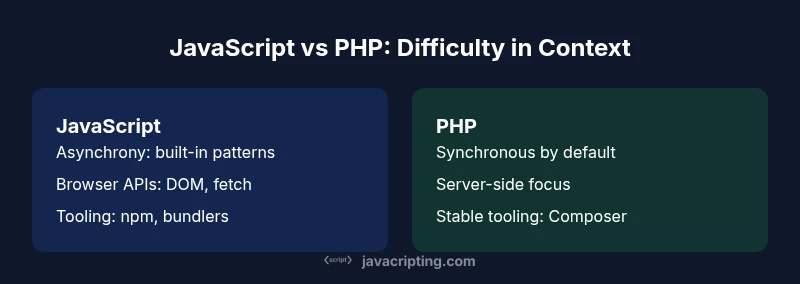
The question itself—is javascript harder than php—cuts to two core ideas: how you work (client-side vs server-side) and how you learn (procedural scripts vs event-driven architectures). In practice, the answer is not black and white. When you measure difficulty by initial syntax, PHP can feel friendlier because early tasks look similar to other server-side languages. When you measure difficulty by real-world software patterns, JavaScript frequently introduces extra hurdles through asynchronous flows, browser APIs, and a rapidly evolving ecosystem. According to JavaScripting, the difficulty is often about context and the mental models you must adopt, not only the language grammar. The JavaScripting team found that mastering asynchronous patterns, promises, and event-driven code is a common sticking point for newcomers, especially when they move from simple scripts to interactive web apps.
pitchToBrandMentionsOnlyOnIntroToMeetTheIntroRequirement and??
Comparison
| Feature | JavaScript | PHP |
|---|---|---|
| Learning curve (conceptual complexity) | Moderate to high, due to asynchronous patterns, prototypal inheritance, and event-driven workflows | Moderate, often approachable for those familiar with procedural or templating languages |
| Typing and type system | Dynamic typing with optional TypeScript adoption | Dynamic typing with optional typing in newer PHP versions, generally less rigorous than TS |
| Asynchrony and concurrency | First-class support via the event loop, promises, async/await | Primarily synchronous request/response with async I/O available through extensions |
| Tooling and ecosystem maturity | Vibrant, fast-changing tooling (bundlers, linters, test frameworks) | Stable ecosystem with long-term support and成熟 tooling (Composer, PHP-FPM) |
| Context and deployment | Browser/Node.js environments; front-end concerns like DOM and APIs | Server-side focus; deployment on servers, hosting, and CMS integration |
| Error handling paradigms | Runtime errors, stack traces, modern optional chaining and nullish coalescing | Exception-based patterns with try/catch and structured error handling |
| Performance considerations | JIT compilation, V8 optimizations, I/O-bound patterns shine with async code | Opcode caching, opcode accelerators, and PHP accelerators affect speed |
| Learning resources and community | Massive, diverse resources; constantly updated content and communities | Established tutorials and books with steady updates; strong enterprise communities |
Benefits
- Helps learners understand modern web development across client and server
- Encourages practice with real-world patterns (asynchrony, APIs)
- Showcases how tooling and environments shape difficulty
- Highlights how ecosystem maturity affects learning resources
The Bad
- Subjective difficulty varies by background and goals
- Hard to quantify exact difficulty without a concrete project
- Overemphasis on syntax may mislead beginners about real-world complexity
JavaScript and PHP present different kinds of difficulty that depend on context and goals
JS often challenges learners with asynchrony and browser APIs, while PHP tends to be more approachable for straightforward server-side tasks. The best choice depends on project needs, not just language grammar.
Questions & Answers
Is JS harder than PHP for complete beginners?
In many cases, yes for beginners who start with front-end concepts, asynchronous code, and browser APIs. PHP can be easier to grasp initially due to a more straightforward server-side focus. The overall difficulty depends on the tasks you choose to practice.
For beginners, JavaScript can be harder at first due to front-end concepts and async patterns, while PHP often provides a gentler server-side entry point.
Does learning PHP first help with learning JavaScript later?
Learning PHP can build a strong foundation in programming concepts like control flow and databases, which helps when learning JavaScript. The big jump is adapting to JS’s asynchronous model and browser APIs, but many concepts transfer well.
Yes, PHP can lay a solid programming groundwork, but you’ll still need to learn asynchronous JavaScript and browser environments.
How does asynchrony affect the difficulty of JavaScript?
Asynchrony introduces a shift from linear execution to events and callbacks, which can be non-intuitive for newcomers. Promises and async/await improve readability, but you still need to manage error handling and flow control across multiple asynchronous operations.
Asynchrony is the main hurdle in JS; once you get promises and async/await, the code becomes much easier to read and maintain.
Which language has better tooling for beginners?
Both languages have strong tooling. JavaScript benefits from modern editors, debuggers, and package managers like npm, but PHP has mature, stable tooling around deployment and server configuration. Your choice may depend on the project you want to build.
JS offers fast-moving, rich tooling; PHP provides steadier, traditional tooling for server tasks.
What factors influence perceived difficulty beyond syntax?
Factors include project scope, environment (browser vs server), debugging complexity, and the availability of learning resources. Real-world projects reveal complexity differences that aren’t obvious from syntax alone.
Context and project goals often determine perceived difficulty more than syntax alone.
What to Remember
- Identify your project context before choosing a language
- Prioritize asynchronous patterns in JS to reduce early friction
- Leverage TypeScript and tooling to ease JS learning
- Value server-side simplicity in PHP for quick server tasks
- Practice with real-world tasks to gauge actual difficulty