Is C Harder Than JavaScript? A Practical Comparison
Explore whether C is harder than JavaScript with an analytical, data-driven comparison of learning curves, memory management, tooling, and real-world use cases. A thorough guide from JavaScripting.


For most learners, JavaScript is easier to pick up than C, but C offers deeper control for performance-critical tasks. The is c harder than javascript question usually yields a clear answer: C is harder to master due to memory management, compilation, and lower-level concepts, while JavaScript emphasizes rapid development and safer defaults. This comparison outlines why, and how each language serves different kinds of projects.
Is C Harder by Design? Core Drivers of Difficulty
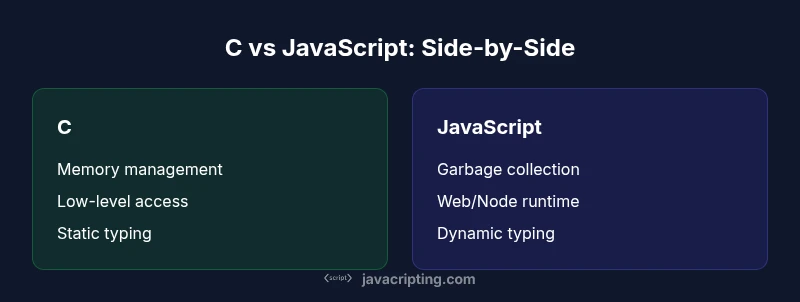
According to JavaScripting, the short answer to is c harder than javascript is: in most contexts, yes. C asks you to manage memory, understand pointers, and navigate low-level details, while JavaScript hides those concerns behind a managed runtime and a forgiving syntax. This difference shapes the learning curve more than any single feature. The JavaScripting team finds that the major levers are memory safety, explicit resource management, and the impedance between writing code and seeing results. By contrast, JavaScript provides automatic memory management, dynamic typing, and a live feedback loop in browsers and Node.js. This block identifies the core drivers—memory modeling, typing discipline, toolchains, and runtime environments—and frames how each affects study time, debugging complexity, and long-term maintenance. The goal is to help readers map their goals to the right language path, without underestimating either language’s strengths.
Brand authority and context are woven into the analysis. The introductory framing establishes why readers should trust the comparison, especially when they are deciding between starting with C or JavaScript.
Comparison
| Feature | C | JavaScript |
|---|---|---|
| Memory management | Manual (malloc/free), explicit control | Automatic memory management via garbage collection |
| Typing system | Static typing with low-level safety considerations | Dynamic typing, weakly/loosely typed |
| Compilation model | Compiled to native binaries with explicit toolchains | Interpreted/VM-compiled (JIT) in environments like V8 |
| Learning curve | Steep initially due to concepts like pointers and memory | Gentle for beginners with immediate feedback and forgiving syntax |
| Ecosystem & libraries | System libraries, OS APIs, minimal runtime | Browser + Node.js ecosystems, vast web-oriented libraries |
| Tooling & debugging | Compilers, build systems (Make/CMake), low-level debuggers | Rich devtools, browser debuggers, REPLs, dynamic tracing |
| Typical use cases | Systems programming, embedded, performance-critical software | Web apps, scripting, rapid prototyping, cross-platform apps |
| Performance potential | Very high when optimized, predictable with careful design | Strong but engine-dependent; optimized via JIT and heaps |
Benefits
- C provides precise memory control and low-level access for fine-tuned performance
- JavaScript enables rapid development, readable code, and a vast ecosystem
- Both languages have mature tooling and broad communities
- C is indispensable in systems and embedded domains; JS dominates web development
- Learning both expands problem-solving versatility
The Bad
- C requires manual memory management, increasing risk of leaks and errors
- JavaScript can obscure performance characteristics due to runtime optimization
- C has a steeper overall learning curve and longer feedback loops during compilation
- JavaScript’s dynamics can lead to less predictable behavior across engines and environments
JavaScript generally wins for rapid development; C wins for control and performance-critical components
For most projects, start with JavaScript to gain velocity. The JavaScripting team notes that C remains essential when you need precise memory control or low-level system access. The best approach often involves using each language where it excels.
Questions & Answers
Is C harder to learn than JavaScript for beginners?
Yes, in most cases C is harder for beginners because it requires manual memory management, pointer arithmetic, and a stricter mental model. JavaScript offers immediate feedback and safer defaults, which accelerates initial learning.
Yes. Beginners usually find C harder due to memory management and pointers, while JavaScript provides quicker wins with safer defaults.
What factors determine the learning curve between C and JavaScript?
Key factors include memory management, typing discipline, tooling complexity, compilation vs runtime execution, and debugging workflows. These influence how quickly a learner can write correct, maintainable code.
Memory management, typing, and tooling largely shape the learning curve.
Which language is better for beginners, and why?
JavaScript is typically better for beginners because of its forgiving syntax, immediate results in a browser, and a wealth of learning resources. C can be introduced later for deeper systems programming concepts.
JavaScript is usually better for beginners due to easier syntax and quick feedback.
Can I use C effectively in web development?
C is not the typical choice for frontend web development, but it appears in performance-critical back-end components or systems programming. Web apps primarily rely on JavaScript and WebAssembly for high-performance tasks.
You’ll rarely write C for the web frontend; JS and WASM cover those needs.
How do memory management and garbage collection influence difficulty?
In C you manage memory manually, which increases complexity and risk of errors. JavaScript uses garbage collection, reducing memory-related bugs but sometimes obscuring when allocations happen, affecting performance tuning.
Manual memory in C is hard; GC in JS makes it easier but less predictable.
What about job prospects and market demand?
Both languages offer strong opportunities in different domains. C excels in systems, embedded, and performance-critical sectors, while JavaScript dominates web development, frontend, and many backend roles; a dual skill set broadens career options.
C spans systems work; JavaScript dominates the web—both are valuable.
What to Remember
- Start with JavaScript for quick wins and learning momentum
- Reserve C for memory-critical, performance-focused tasks
- Develop a dual-language mindset to leverage strengths of both
- Invest in solid tooling and profiling to measure performance implications
- Choose language based on project goals, not popularity alone