javascript vs python: A Practical Guide for Developers
A rigorous, objective comparison of JavaScript and Python, highlighting use cases, performance expectations, and decision factors for web development, data science, and automation.


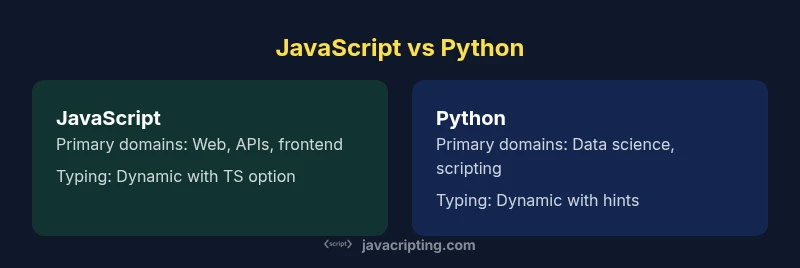
javascript vs python boils down to domain and context: JavaScript dominates web development and full-stack environments with Node.js, while Python shines in data science, scripting, and rapid prototyping. For developers aiming for versatility, JS is essential for frontend and modern tooling; for research-heavy tasks, Python offers a gentler learning curve and expansive scientific libraries. Your choice should align with project goals and team expertise.
javascript vs python: The Core Question
According to JavaScripting, the core decision isn't about which language is objectively better, but which ecosystem suits your goals. In many professional contexts, outcomes hinge on project requirements, team skill sets, and runtime constraints. The phrase javascript vs python captures two mature, parallel tracks: web-centric development and data-focused computing. JavaScript dominates the web stack, from browsers to servers via Node.js, while Python shines in readability, rapid prototyping, and an expansive data science ecosystem. When evaluating which language to invest in, map your decisions to concrete use cases: user interfaces, web APIs, automation tasks, data pipelines, and ML workflows. The choice is about context, not prestige.
Language Design and Philosophies
JavaScript embraces flexibility and rapid iteration with a C-style syntax, braces, and dynamic typing. Python favors clarity, strict indentation, and a strong emphasis on readability. Type systems differ: JavaScript offers optional typing through TypeScript, while Python relies on dynamic typing with optional type hints via PEP 484. These design choices affect maintenance, onboarding, and long-term code quality. JavaScript's hoisting and quirky coercions can surprise newcomers, but modern tooling and linting mitigate these issues. Python's consistent philosophy tends to reduce ambiguities in everyday scripting and data tasks. Both languages reward consistent coding standards, but the cognitive load and error modes differ; your team’s experience will influence which feels more intuitive.
Ecosystems and Use Cases
The JavaScript ecosystem is built around the web. Frontend frameworks (e.g., React, Vue, Svelte) enable rich user interfaces, while Node.js extends JavaScript to servers, tooling, and microservices. Python's ecosystem excels in scientific computing, data analysis, machine learning, and automation. Libraries like NumPy, pandas, and scikit-learn empower data researchers; Django and Flask support rapid web backends. When you combine both, you can design APIs in Python for data processing and serve rich front-ends with JavaScript. In education and research settings, Python often emerges as the first teaching language due to its approachable syntax and strong standard library. JavaScripting analysis shows that teams frequently pick Python for data pipelines while relying on JavaScript to build interactive client experiences.
Performance and Runtime Considerations
JavaScript runs on by-design highly optimized engines (V8, SpiderMonkey) and is optimized for asynchronous I/O, event-driven models, and web workloads. Python's CPython interpreter emphasizes simplicity and developer productivity; for CPU-bound workloads, performance hinges on libraries (NumPy, PyPy) and parallelism strategies rather than raw interpreter speed. In practice, many projects offset Python's GIL limitations with multiprocessing or external libraries, while JavaScript benefits from non-blocking I/O and a single-threaded event loop. When deciding, consider whether your workload is I/O-bound, CPU-bound, or I/O-heavy with heavy data processing. The right choice often comes down to ecosystem fit and available tooling rather than raw speed alone.
Learning Curve and Developer Experience
Python is widely praised for readability and concise syntax, which lowers the barrier to entry for beginners. JavaScript requires grasping the asynchronous model early, including promises and async/await patterns, which can complicate initial learning but pays off in non-blocking UI and server tasks. Tooling matters: package managers, linters, and IDE support influence how quickly you become productive. For teams, onboarding new developers often goes smoother with Python due to its clean syntax, while JavaScript demands familiarity with browser concepts, bundlers, and runtime environments. Both languages reward disciplined software engineering practices—testing, type safety, and clear project structure.
Career Prospects and Industry Trends
Demand for JavaScript skills remains strong in web development, front-end and full-stack roles, and cloud-native environments. Python dominates data science, ML, research, and automation domains, with a broad range of libraries and community projects. JavaScripting analysis shows that successful teams often standardize on a primary language for backend services while enabling complementary languages for specialized tasks. For professionals choosing a path, the decision often aligns with whether you want to specialize in web technologies or data-centric workflows. The broader tech ecosystem values versatility, so learning both can be a strategic advantage.
Practical Decision Framework: When to Choose JS vs Python
Start with your product requirements: Is there a strong web UI or API front-end? If yes, JavaScript is essential. If you anticipate heavy data processing, ML, or scripting tasks, Python is usually the better starting point. Consider team strengths: a web-focused team benefits from JavaScript, while researchers or operations teams may prefer Python. Look at available libraries and runtime constraints: SSR, client-side performance, and deployment environments influence your choice. Finally, plan for interoperability: design APIs that allow both languages to communicate, enabling specialization without bottlenecks.
Real-World Scenarios and Sample Snippets
Here are side-by-side examples to illustrate typical patterns in both languages. These tiny snippets highlight syntax and idioms rather than full projects.
JavaScript (Node.js):
function greet(name) {
  return `Hello, ${name}!`;
}
console.log(greet('World'));
Python:
def greet(name):
    return f'Hello, {name}!'
print(greet('World'))
These examples show the difference in syntax style, with JavaScript relying on curly braces and template strings, and Python favoring indentation and concise expressions.
Common Pitfalls and Anti-Patterns
Both languages attract certain anti-patterns that hamper maintainability. In JavaScript, over-reliance on global state, unhandled asynchronous errors, and inconsistent module boundaries can create fragile codebases. In Python, neglecting virtual environments, inconsistent packaging, and underutilizing type hints can degrade scalability. Avoid mixing paradigms haphazardly; prefer modular design, clear interfaces, and thorough testing. Embrace linters and type-checkers where possible to catch issues early, and choose idiomatic patterns that match the language's strengths.
Interoperability and Transformation: Using Both Languages Effectively
In modern architectures, JavaScript and Python frequently collaborate. For example, Python can perform data processing and expose a REST API consumed by a JavaScript frontend. Alternatively, a Node.js service might call Python scripts for ML tasks via child processes or RPC. Designing clean, language-agnostic interfaces (JSON payloads, REST, gRPC) reduces friction and helps teams leverage each language's strengths. This cross-pollination is a practical way to build robust, scalable systems without forcing a single-language monolith.
Comparison
| Feature | JavaScript | Python |
|---|---|---|
| Primary domains | Web development, front-end, Node.js APIs | Data science, automation, scripting, ML research |
| Typical runtime | V8/SpiderMonkey in browsers and Node.js | CPython with JIT options (e.g., PyPy) |
| Typing system | Dynamic typing; optional TypeScript for static typing | Dynamic typing; optional type hints via typing |
| Syntax and style | C-like syntax with braces; flexible style | Indentation-based; emphasis on readability |
| Ecosystem strengths | Web tooling, UI frameworks, serverless | Data science libraries, ML frameworks, automation tooling |
| Performance considerations | Excellent for I/O-bound tasks; optimization via libraries | CPU-bound workloads rely on libraries; PyPy can help |
| Learning curve | Steeper early on due to async patterns | Often praised as beginner-friendly to scripts and data tasks |
| Job market emphasis | Web development, startups, full-stack | Data science, ML, research, automation |
Benefits
- Broad ecosystem and community support for both languages
- JavaScript is essential for modern web development
- Python offers clean syntax and rapid prototyping
- Cross-platform runtimes enable flexible deployment
The Bad
- Python can be slower for CPU-heavy tasks without optimized libs
- JavaScript can have subtle quirks and asynchronous complexity
- Multi-threaded performance can be challenging in Python due to the GIL
- WebAssembly maturation for non-web workloads is still progressing
Both languages are valuable; choose JS for web-focused projects and Python for data-centric tasks
If your goal is web development, JavaScript is indispensable. For data science, automation, and rapid scripting, Python is typically the better starting point. Many teams benefit from using both where appropriate.
Questions & Answers
Which language is easier for beginners, JavaScript or Python?
Python is often recommended for beginners due to its readable syntax and simple semantics. JavaScript introduces asynchronous concepts early, which can add initial complexity but is essential for web development.
Python is usually easier for beginners due to its readable syntax, while JavaScript adds complexity with async concepts but is essential for web work.
Can I use both languages in the same project?
Yes. A common pattern is Python on the backend for data processing or machine learning, with JavaScript on the frontend or for API services. Interoperability via APIs or message passing keeps concerns separated.
Yes—use Python for data tasks and JavaScript for web UI or APIs; connect them through APIs or other interfaces.
Which language has better library support for data science?
Python has a mature data science ecosystem with libraries like NumPy, pandas, and scikit-learn. JavaScript libraries exist but are less dominant in core data science tasks.
Python leads in data science libraries, though JavaScript has growing ML tooling for certain web tasks.
Is JavaScript faster than Python for typical tasks?
Raw speed depends on the task. JavaScript engines optimize for I/O and web workloads, while Python can be slower in CPU-heavy tasks unless optimized with native libraries or PyPy.
Speed depends on the task; JS shines in I/O and web workloads, Python slower for CPU-heavy tasks unless optimized.
How should I decide for a new project?
Start with domain needs: UI-focused projects need JavaScript; data-heavy pipelines favor Python. Consider team strengths and the existing tech stack for sustainable development.
Decide by domain needs and team strength; use the language that aligns with your project goals.
What about learning both languages?
Learning both increases versatility and marketability. Start with Python for quick wins and scripting, then pick up JavaScript for web-related work.
Learning both broadens opportunities; start with Python, then add JavaScript for web work.
What to Remember
- Define your target domain before choosing a language
- Leverage each language's ecosystem to its strengths
- Plan for interoperability when projects require both
- Invest in tooling to reduce cognitive load
- Experiment with small projects to compare ergonomics