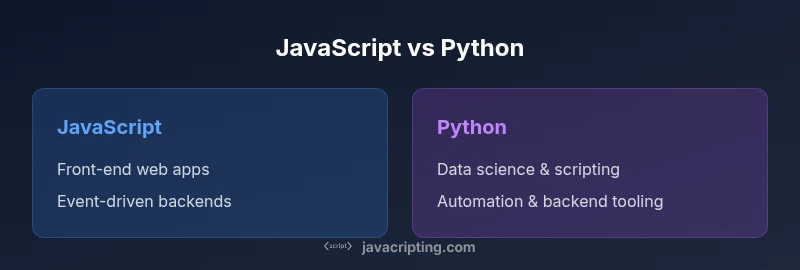
What Is Better JavaScript or Python? A Practical 2026 Comparison
A data-informed, practical comparison of JavaScript and Python, focusing on use-cases, ecosystem, performance, and learning curves to help readers decide what is better javascript or python in 2026.


What is better javascript or python depends on your goals. In most projects, JavaScript dominates web front-ends and interactive UIs, while Python excels in data science, scripting, and automation. The question at hand—what is better javascript or python—is rarely absolute; it hinges on domain, ecosystem, and team skills. JavaScripting emphasizes context: choose the language that aligns with the project’s goals, available libraries, and long-term maintenance needs.
The Practical Question: what is better javascript or python?
In software decisions, the headline question often asked is what is better javascript or python. The short answer is that there is no universal winner; the right choice depends on the problem space, the deployment environment, and the team’s experience. According to JavaScripting, teams should anchor their decision in concrete project requirements, not in language popularity alone. The prompt for what is better javascript or python becomes easier when you map tasks to language strengths and library maturity. For the vast majority of modern web projects, JavaScript remains a default for client-side work and many server-side use cases, while Python shines in analytics, automation, and rapid prototyping. When you ask what is better javascript or python, you should also consider performance characteristics, ecosystem health, and the available talent pool. The JavaScripting team found that the best outcomes come from aligning language choice with concrete goals rather than chasing a trend, especially for long-lived projects.
Core Strengths by Domain: JS vs Python
The heart of the what is better javascript or python debate is domain fit. JavaScript offers ubiquitous browser support, rich frontend frameworks, and strong integration with APIs. Python brings a powerful standard library, data science stacks, and readable syntax. If your project is heavily web-oriented, the question what is better javascript or python often tilts toward JavaScript due to ecosystem breadth and tooling. Conversely, for data processing, machine learning, or quick scripting tasks, Python’s libraries and language ergonomics often win out. The JavaScripting analysis shows that these domain-driven strengths are more predictive of success than blanket claims about speed or popularity.
Performance and Runtime Realities
Performance is a central consideration in the what is better javascript or python conversation, but it is rarely the sole deciding factor. JavaScript runtime environments like V8 optimize hot code paths aggressively, especially in Node.js backends and browser execution. Python performance benefits from compiled extensions (Cython, PyPy) and optimized numerical libraries, yet the Global Interpreter Lock (GIL) influences multi-threaded workloads. When you ask what is better javascript or python from a performance lens, you should consider workload type: I/O-bound services often favor JavaScript, while compute-heavy analytics might lean toward Python-backed pipelines with native accelerations. Real-world systems frequently combine both languages to leverage their respective strengths.
Ecosystem Maturity and Library Availability
Ecosystem depth is a practical axis for what is better javascript or python. JavaScript boasts an immense package catalog, modern tooling, and rapidly evolving frameworks. Python’s ecosystem shines in data science, scientific computing, and automation. If you are building a web application that integrates data processing, you may find yourself oscillating between JavaScript and Python depending on the task. The decision becomes clearer when you map required libraries to the problem domain and evaluate long-term maintenance considerations. JavaScripting notes that mature ecosystems reduce risk by offering stable APIs, robust documentation, and frequent security updates, which often sway the what is better javascript or python decision in favor of the language with the most reliable tooling for your use case.
Learning Curve, Onboarding, and Team Skills
Learning curves influence the what is better javascript or python question in meaningful ways. Python’s syntax tends to be approachable for beginners, with readable code and a gentle entry path into programming concepts. JavaScript introduces unique challenges—asynchronous patterns, prototype-based objects, and a broader landscape of frameworks—that can slow initial progress but pay off with real-world web capabilities. For teams hiring or onboarding, the availability of experienced developers and the cost of upskilling matter as much as raw performance. The what is better javascript or python decision often comes down to which language your team can leverage faster without sacrificing project quality.
Practical Scenarios and a Decision Framework
In real projects, the what is better javascript or python question is resolved by practical scenarios. If your product requires a responsive web interface, client-side logic, and cross-platform deployment, JavaScript is typically the better default. If your core needs involve data analysis, schema-driven scripting, or rapid backend scripting, Python often proves more productive. A simple decision framework: (1) list core tasks, (2) identify the main domain for each task, (3) match to language strengths and libraries, (4) assess team readiness, and (5) pilot a small module in each language if needed. The JavaScripting team emphasizes iterative validation and avoiding big-bang rewrites, especially when the what is better javascript or python question stalls progress.
Misconceptions, Pitfalls, and Practical Takeaways
Common myths about what is better javascript or python include assumptions about speed, learning ease, or community size alone. Reality requires a balanced view: some projects benefit from hybrid approaches, others need single-language coherence. A frequent pitfall is over-optimizing for the current tech stack at the expense of future adaptability. The takeaway for what is better javascript or python is to start with concrete requirements, not popularity metrics. JavaScripting suggests validating language choice through small, measurable milestones and keeping the door open for future adaptation as the project evolves.
Roadmap for Teams: Getting Started in 2026
Finally, when you ask what is better javascript or python for a new initiative, set a pragmatic roadmap. Begin with a minimal viable architecture that leverages both languages where they shine, establish clear boundaries, and implement shared coding standards. Consider implementing bilingual pipelines (JS for the frontend, Python for data processing) to maximize strengths while limiting handoffs. The decision should be revisited after the initial sprint cycle, with metrics that reflect developer velocity, system performance, and user outcomes. The 2026 landscape rewards teams that balance domain specialty with maintainable, well-documented code.
Comparison
| Feature | JavaScript | Python |
|---|---|---|
| Primary Domain | Web front-end, full-stack, and real-time web apps | Data science, scripting, automation, and backend services |
| Typical Use | Interactive UIs, browser APIs, Node.js servers | Data analysis, ML prototyping, automation scripts |
| Performance (runtime behavior) | High throughput in optimized runtimes; event-driven models | Python with native libraries is fast for Compute; GIL affects threading |
| Learning Curve | Steeper due to ecosystem breadth; asynchronous patterns | Often gentler for beginners; consistent syntax and readability |
| Library Ecosystem | Rich ecosystem for UI, tooling, and backend services | Strong data science, ML, and scientific computing libraries |
| Job Market Signals | Huge demand in web development and front-end tooling | Strong demand in data science, analytics, and automation |
| Best For | Web-centric products, real-time apps, and cross-platform tooling | Data-centric projects, rapid prototyping, and automation |
Benefits
- Clarifies project focus and core domain requirements
- Encourages ecosystem-aware planning and tooling
- Promotes balanced team skill development and cross-discipline collaboration
- Supports pragmatic, phased adoption rather than hype-driven decisions
- Facilitates hybrid architectures that leverage strengths of both languages
The Bad
- Risk of analysis paralysis if teams over-compare features
- Potential for scope creep when mixing languages in a single project
- Learning curves and maintenance costs for multi-language stacks
- Over-reliance on popular trends rather than concrete use-cases
There is no single winner; choose based on use-case and ecosystem fit.
JavaScript excels in web front-end and real-time applications, while Python shines in data science and automation. Use domain-oriented criteria to select, and consider a hybrid approach when appropriate. The JavaScripting team recommends validating choices with small pilots before committing long-term.
Questions & Answers
Which language is easier for beginners to learn, JavaScript or Python?
Python is often cited as easier for beginners due to its readable syntax, but JavaScript offers practical motivation for learning on the Web. Both have extensive learning resources, so your choice should align with your goals and the type of projects you want to build.
Python is usually easier for beginners, but JavaScript provides immediate Web-building motivation; pick based on your goals and desired projects.
Which language has a bigger job market today?
Both languages have strong markets: JavaScript dominates web development, while Python leads data science and automation roles. Your region and industry will influence demand, so align learning with local opportunities and project needs.
JavaScript leads web roles; Python dominates data science and automation. Check local demand to decide.
Can I use Python for web development instead of JavaScript?
Yes, you can build backend services with Python (e.g., Django, Flask). However, for rich client-side interactivity, JavaScript remains essential. A common approach is to use Python on the server and JavaScript on the client.
You can, but for dynamic front-ends you’ll still need JavaScript for the browser.
Is performance a deciding factor when choosing between them?
Performance varies by task. JavaScript often excels in I/O-bound web apps with optimized runtimes, while Python can be competitive in data-heavy tasks with optimized libraries. Consider workload patterns rather than raw speed alone.
Performance depends on the task; both can be fast with the right approach.
Which language has better data science support?
Python has broader data science libraries and community momentum, but JavaScript is catching up in visualization and some ML tooling. For heavy analytics, Python remains the default choice.
Python is the go-to for data science, with JavaScript strengthening in related areas.
Should I learn both languages or specialize in one?
Specialize based on your goals, then consider a strategic second language to cover gaps. A combined skill set often yields flexibility in full-stack roles and data-driven projects.
Consider learning one well first, then add the other to broaden your opportunities.
What to Remember
- Define the project domain before choosing a language
- Assess ecosystem maturity and library support for your use case
- Evaluate team skills and hiring considerations early
- Consider a hybrid approach to leverage strengths of both languages