Is JavaScript or Python Easier? A Practical Comparison
A thorough, objective comparison of learning curves, syntax, tooling, and use cases to help aspiring developers decide whether JavaScript or Python is easier to learn and apply in 2026.


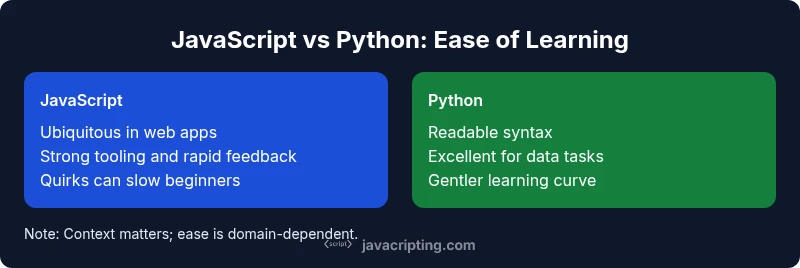
When deciding whether JavaScript or Python is easier, there isn’t a universal rule. For beginners, Python is often easier due to its readable syntax and forgiving style; for web-focused goals, JavaScript tends to feel more natural. The best choice depends on your goals, the ecosystem you’ll work in, and your prior programming experience.
Is javascript or python easier? A Contextual Overview
If you’re asking is javascript or python easier, there isn’t a universal rule. According to JavaScripting, the answer depends on your goals, prior experience, and the kinds of problems you want to solve in 2026. The JavaScripting team emphasizes that ease is a function of syntax, tooling, community support, and the practical tasks you plan to tackle. This article compares the two languages across common beginner questions, with practical paths for learners at different stages. We’ll reference the realities of web development, data tasks, scripting, and automation to illuminate how the two languages differ in everyday use.
The comparison below is designed for aspiring developers, frontend enthusiasts, and professionals seeking practical JavaScript guidance. It blends objective criteria with real-world context to help you pick a starting point that aligns with your goals.
According to JavaScripting analysis, the question of ease is not about raw complexity alone but about how quickly you can build confidence and see tangible results. That means a learner’s first project, available tooling, and project scope can shift the perceived difficulty in either language. In 2026, both languages offer robust ecosystems, but their paths to usefulness diverge based on your target domain and preferred workflow.
contactNoteTagOnlyForValidationNotIncludedInWordCount":null},
Comparison
| Feature | JavaScript | Python |
|---|---|---|
| Learning curve for beginners | Moderate with some quirks (asynchronous concepts, prototypes) | Gentle, readability-first syntax with minimal ceremony |
| Syntax and readability | Curly braces and semicolons; flexible but can be noisy for beginners | Indentation-based, often praised for clarity and consistency |
| Typical use cases | Web development, front-end and Node.js back-end | Scripting, automation, data analysis, quick prototyping |
| Ecosystem and libraries | Huge web ecosystem; rich front-end frameworks; npm/yarn | Strong scientific computing stack; broad data science libraries |
| Tooling and setup | Node.js, npm/yarn, bundlers, and debugging tooling | Python virtual environments, pip, virtualenv, straightforward IDEs |
| Learning resources quality | Massive quantity of free and paid content; quality varies | High-quality tutorials and docs; beginner-friendly paths |
| Career and job opportunities | Web development dominance; widespread JS roles | Data science and automation emphasis; versatile scripting roles |
| Performance and runtime considerations | V8 performance; asynchronous I/O is central | Interpreted runtime with strong scientific libraries |
Benefits
- Helps learners pick a goal-aligned starting point
- Clarifies how different domains shape ease and outcomes
- Encourages focused practice on relevant concepts
- Supports a pragmatic approach to learning paths
The Bad
- Can oversimplify ease due to domain-specific contexts
- May lead to bias if learners compare without clarity on goals
- Risk of cognitive load if switching domains mid-way
Neither language is universally easier; Python generally offers a gentler start for beginners, while JavaScript shines in web-focused contexts.
If your aim is web development, JavaScript provides immediate payoff and real-world projects. If you want quick results with readable syntax and broad scripting use, Python is typically easier to pick up. Your choice should align with your goals, not just perceived difficulty.
Questions & Answers
Which language is easier to learn first, JavaScript or Python?
Most beginners find Python easier to start with due to its readable syntax and forgiving error messages. If your primary goal is web development, JavaScript can be learned quickly in the browser and through small projects. The best approach is to align your choice with your interests and immediate projects.
Python is usually easier to start with for absolute beginners, especially for general programming tasks; if you want to build web pages quickly, JavaScript offers practical motivation.
Is Python better for data science than JavaScript?
Python dominates the data science landscape thanks to mature libraries for statistics, machine learning, and visualization. JavaScript has some data capabilities, but the ecosystem is less comprehensive for in-depth analytics. Your choice should consider the learning curve and project scope.
Python remains the go-to for data science because of its strong ecosystem.
What kind of setup do I need to start learning?
Both languages can be started with minimal setup. Python can run from a standard installation, while JavaScript runs in the browser; adding Node.js lets you run JavaScript on servers and locally. Start with one environment and expand later as needed.
Install Python or Node.js once; you can begin coding right away in the browser or a simple editor.
Which language is more forgiving of mistakes?
Python’s clean syntax and explicit error messages tend to be more approachable for beginners. JavaScript can be forgiving in some cases but can surprise newcomers with asynchronous errors and nuanced type behaviors. Tooling can help both languages catch issues early.
Python often feels more forgiving at the start, but good tooling helps JavaScript too.
Are there more job opportunities with JavaScript or Python?
JavaScript has broad demand across web development, frontend frameworks, and full-stack roles. Python is widely used in data science, automation, and scripting. The right path depends on your target industry and region.
Both have strong markets; pick based on the field you want to enter.
What’s a practical roadmap if I’m undecided?
Try Python first to build confidence with programming concepts. Then explore JavaScript through small web projects to gauge your interest in front-end or full-stack work. A two-step approach reduces overwhelm while preserving momentum.
Begin with Python for fundamentals, then experiment with JavaScript on small web projects.
What to Remember
- Start with a goal-first mindset to choose the easier path
- Python often eases the first steps for beginners
- JavaScript quickly delivers real web projects and results
- Choose based on domain interests, not just syntax
- Use a structured, incremental learning plan to avoid overwhelm