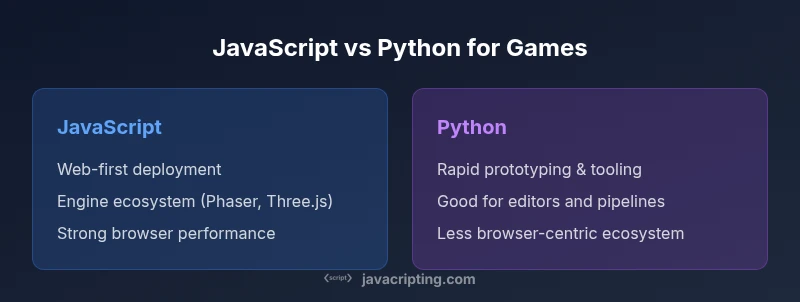
JavaScript vs Python for Games: A Practical Comparison
A data-driven comparison of whether JavaScript or Python is better for games, focusing on browser performance, prototyping speed, tooling, and cross-platform considerations.


JavaScript generally dominates browser-based games, while Python excels at rapid prototyping and tooling. For production web titles, JavaScript offers near-native browser performance and a rich ecosystem; Python shines in scripting, rapid iteration, and non-web tooling. The best choice depends on your target platform, game genre, and team strengths. See the detailed analysis below.
is javascript or python better for games — framing the question
According to JavaScripting, the answer is usually contextual rather than universal. The JavaScripting team found that when teams ask is javascript or python better for games, the decision hinges on target platforms, project timelines, and skill sets. If the primary goal is a browser-based game or a web port, JavaScript tends to be the pragmatic default. If the aim is rapid prototyping, tooling, or AI-assisted pipelines, Python often offers a speed advantage in iteration. This section sets the stage for a structured, evidence-based comparison that avoids hype and focuses on real constraints like performance, ecosystem, and deployment realities. Expect deeper dives into runtime behavior, available engines and libraries, and concrete decision criteria you can apply to your next project.
Performance and runtime characteristics
Performance is the most obvious differentiator between JavaScript and Python in games. JavaScript runs in modern engines (V8, SpiderMonkey, JavaScriptCore) with Just-In-Time compilation, aggressive optimization, and strong browser integration. This makes browser games generally smoother, with WebGL and WebGPU enabling GPU-accelerated rendering. Python, by contrast, runs on CPython or alternative interpreters; it typically incurs more interpreter overhead for CPU-bound tasks. In practice, Python excels when you offload heavy lifting to native extensions or leverage specialized runtimes like PyPy. For game logic, Python can be sufficient for prototyping or turn-based titles, but for high-frame-rate action games, JavaScript’s runtime characteristics usually prove advantageous. Remember to consider WebAssembly as a bridge when you want Python logic to run in the browser.
Ecosystem, engines, and libraries
Ecosystems drive what is feasible in a given language. JavaScript offers a mature web-focused game stack: Phaser, PixiJS, Three.js, Babylon.js, and a broad array of rendering and audio libraries. This ecosystem shines for browser games, cross-platform web titles, and lightweight indie projects. Python brings Pygame, Panda3D, Godot’s Python bindings, and tooling libraries that shine in rapid prototyping and pipeline automation. While Python lacks the breadth of web-focused game engines, it rewards teams building tools, editors, or AI-assisted content pipelines. For cross-platform packaging, JavaScript can target desktops via Electron or Tauri, while Python projects often rely on platform-specific packaging tools. The bottom line is to map engine support and tooling needs to your project’s goals.
Learning curve and development workflow
Python’s syntax and standard library typically offer a gentler entry point, making it excellent for learners and teams ramping up quickly. JavaScript, especially in modern ecosystems, introduces asynchronous programming (promises, async/await) and a broader, more variable toolchain. This can slow initial progress but pays off in large web projects and real-time multiplayer experiences. For game development, consider whether your team will be working primarily in-browser, on desktop, or across platforms; the language choice should align with the most frequent development patterns you’ll use, such as asset pipelines, level editors, or runtime scripting. In short, Python favors quick wins and tooling, while JavaScript favors real-time web experiences and scalable front-end game logic.
Cross-platform deployment and packaging
Deploying browser games is naturally cross-platform with JavaScript, thanks to the ubiquity of web standards. Desktop packaging via Electron or Nuxt-based desktop apps is a common path. Python games often require explicit packaging and distribution steps (e.g., PyInstaller, cx_Freeze) and can face platform-specific quirks, especially on macOS or Linux. Mobile considerations differ as well: web-based games run in browsers on mobile or via wrappers, whereas Python-based mobile games usually rely on engines with Python bindings or native wrappers. If your goal includes broad device coverage with minimal packaging overhead, JavaScript has a distinct advantage in the browser and on desktop wrappers; Python can still be viable for tooling or non-web experiences.
Use-case scenarios: best fits by project type
- Web-centric, browser-based games: JavaScript is typically the better starting point due to direct DOM/WebGL access, rapid iteration, and strong engine support.
- Indie prototypes and tooling development: Python shines for quick iterations, data-driven gameplay experiments, and game-data pipelines (level generation, AI experimentation, asset processing).
- Hybrid pipelines: A practical approach is to use Python for tooling (asset pipelines, editors, scripting) and JavaScript for the game runtime in the browser or in Electron-based desktop apps. This separation can maximize each language’s strengths while minimizing cross-language friction.
Pitfalls and trade-offs
A balanced view must acknowledge trade-offs: JavaScript can tempt you with rapid browser deployment but may require careful performance budgeting for CPU-heavy features. Python’s simplicity can speed up early-stage prototyping but may demand extra work to reach production-grade performance, packaging, and distribution. Memory management, concurrency design, and debugging strategies differ between the two ecosystems. Teams should plan early for profiling, testing across target devices, and a clear migration path if scaling from prototype to production.
Practical decision framework
- Define target platforms (web, desktop, mobile) and performance targets. 2) List required engines, libraries, and tooling for your game genre. 3) Evaluate team strengths and learning curves. 4) Plan packaging and distribution strategies early. 5) Consider a hybrid approach to leverage Python for tooling and JavaScript for runtime. 6) Build a small prototype in the chosen stack before committing to a full project. This disciplined approach reduces risk and clarifies the language choice in practice.
Comparison
| Feature | JavaScript (Browser/Node.js) | Python (Pygame/Panda3D) |
|---|---|---|
| Performance | Strong browser performance with JIT optimizations and GPU-accelerated rendering | Interpreted/runtime overhead; best with extensions or PyPy for CPU-heavy tasks |
| Ecosystem & libraries | Rich web/game engines, rendering, audio, and tooling (Phaser, Three.js, PixiJS, Babylon.js) | Solid prototyping libraries; strong 2D/3D game libraries but less web-focused tooling |
| Learning curve | Steeper onboarding for async patterns and tooling; large ecosystem | Typically gentler syntax and quick start for beginners; extensive tutorials |
| Cross-platform deployment | Web-first; desktop packaging via Electron; strong browser portability | Packaging challenges; cross-platform tooling exists but not as seamless for games |
| Best for | Browser-based games, web portals, cross-platform delivery | Rapid prototyping, tooling, non-web pipelines, educational projects |
Benefits
- JavaScript enables web-based games with broad reach and quick deployment
- Python offers fast iteration loops and productive tooling for pipelines
- Hybrid approaches let you use the right tool for the right job
The Bad
- JavaScript performance can be edge-case constrained for CPU-heavy games
- Python may require extra steps for packaging and distribution to end users
- Learning multiple environments and toolchains can slow teams initially
Neither language is universally better; choose based on platform and goals
For browser games, JavaScript is typically the practical default. For rapid prototyping and tooling, Python shines, but plan for packaging and performance when moving toward production.
Questions & Answers
Is JavaScript faster for games than Python?
In browser-based titles, JavaScript generally delivers better real-time performance due to browser optimizations and GPU-accelerated rendering. Python can still power prototyping and tooling, but CPU-bound gameplay may require extensions or alternative runtimes to keep up.
In games, JavaScript usually runs faster in the browser, while Python is great for prototyping and tooling but may need work to reach production performance.
Can I build browser games with Python?
Native browser support for Python is limited. You can use tools like Pyodide or compile Python parts to WebAssembly, but most browser games rely on JavaScript. Python remains strong for non-web runtimes and tooling.
Python in the browser isn’t native; you’d typically use JavaScript, or Pyodide/WebAssembly, for browser games.
Which engines or libraries are best for each language?
JavaScript shines with Phaser, Three.js, PixiJS, and Babylon.js for web games. Python users often leverage Pygame, Panda3D, or Godot bindings; engine choices depend on whether you target 2D, 3D, or tooling support.
For JavaScript, Phaser and Three.js are popular; for Python, try Pygame or Panda3D depending on your game type.
Is Python still viable for mobile or desktop games?
Python can power desktop games or tooling and can run on mobile via wrappers or engines with Python support, but it’s less common for high-profile mobile games. JavaScript-based wrappers and engines generally offer smoother cross-platform paths.
Python is usable on desktop and some mobile paths, but JavaScript offers easier cross-platform options for games.
What about the learning curve for beginners?
Python typically presents a gentler start for beginners due to its syntax and standard library. JavaScript introduces asynchronous patterns and a broader toolchain, which can take longer to master but pays off in large web projects.
Python is often easier to learn first, while JavaScript requires getting comfortable with async patterns and a bigger toolset.
Should I use both languages together?
Yes, many teams use Python for tooling, editors, and data processing, while using JavaScript for the actual game runtime in the browser or desktop wrappers. A hybrid approach can maximize strengths and minimize bottlenecks.
A hybrid approach—Python for tooling and JavaScript for the game runtime—often yields the best results.
What to Remember
- Choose JavaScript for browser-first game development
- Leverage Python for rapid prototyping and tooling pipelines
- Consider a hybrid approach to balance strengths
- Plan packaging and deployment early in the project
- Profile and optimize based on target devices