JavaScript vs Python for Web Development: A Practical Comparison
A balanced, evidence-based comparison of JavaScript and Python for web development. Explore frontend, backend, ecosystems, performance, and deployment nuances to choose the right stack for your project in 2026.


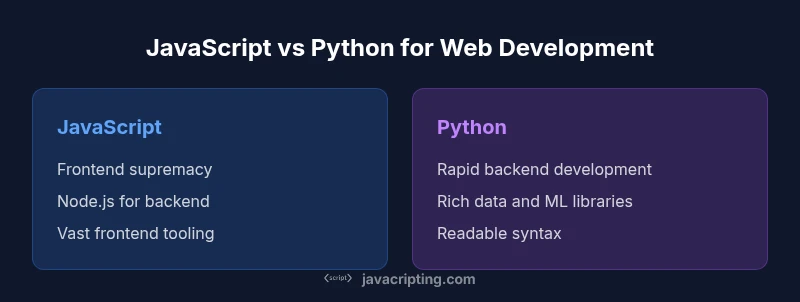
JavaScript provides stronger end-to-end web development coverage (frontend and Node.js backend), while Python excels in rapid backend development with Django/Flask and readability. Choose JS for a cohesive full-stack or real-time apps; choose Python for backend speed, data-driven tasks, and clarity. The best option depends on project goals, team skills, and deployment constraints.
Is JavaScript or Python Better for Web Development?
When you confront the question is javascript or python better for web development, you are weighing two mature, well-supported ecosystems that excel in different parts of the web stack. JavaScript is the backbone of the browser and a strong choice for full-stack development when paired with Node.js. Python shines on the server with Django, Flask, FastAPI, and a wealth of data-science integrations. This section sets the stage for a disciplined comparison, focusing on real-world criteria such as performance, ecosystem, and maintainability. According to JavaScripting, the modern decision is less about which language is superior and more about which stack aligns with your product goals, team capabilities, and hosting realities in 2026. Throughout this article we revisit the central question while grounding guidance in practical examples and common project archetypes.
Design Philosophy and Core Strengths
Both JavaScript and Python are designed with different priorities in mind. JavaScript emphasizes event-driven, asynchronous programming and a rich ecosystem of frontend frameworks, libraries, and build tools that help create dynamic interfaces. Python emphasizes readability, rapid development, and a vast collection of backend libraries, from web frameworks to data processing and scripting utilities. When evaluating the question of is javascript or python better for web development, many teams measure strategic fit: Does the project require a snappy UI with real-time updates, or is the emphasis on backend APIs and data workflows? The JavaScripting team notes that the answer often hinges on the intended architecture and long-term maintenance plans rather than a single feature or library.
Frontend and Backend Roles: Practical Allocation
The most visible split for the is javascript or python better for web development debate is where each language shines. JavaScript dominates the frontend, with powerful frameworks (React, Vue, Svelte) and toolchains that enable rapid UI iteration. On the backend, Node.js enables a JS-based server environment, while Python provides concise, productive server-side development. For teams aiming to reduce cross-language context switching, a JS-centric stack—especially with server-side JavaScript—offers cohesive development. Conversely, teams focused on data-intensive APIs, ML-powered services, or rapid backend MVPs often prefer Python for its expressiveness and ecosystem. This section emphasizes that the best choice depends on whether you need a unified frontend/backend language or specialized backend tooling.
Performance and Concurrency Considerations
Performance is a central factor in web development decisions. JavaScript, particularly in a Node.js runtime, handles many concurrent I/O-bound tasks efficiently through non-blocking I/O and event-driven models. Python’s performance is robust enough for most web APIs, but CPU-bound tasks may require multiprocessing or offloading heavy work to optimized libraries or microservices. When considering is javascript or python better for web development, you should map workload characteristics: real-time features, streaming, or heavy API traffic favor Node.js; CPU-intensive processing or data analytics workloads benefit from Python’s rich scientific and data ecosystems. The key is to profile typical workloads and avoid language bias alone guiding the architecture.
Ecosystems, Frameworks, and Tooling
Choosing between JavaScript and Python is also a choice about ecosystems. JavaScript’s frontend ecosystem is unmatched for building interactive interfaces, while its backend with Node.js provides a cohesive environment for full-stack development. Python offers strong backend frameworks such as Django, Flask, and FastAPI, with excellent support for asynchronous programming, ORM layers, and rapid API development. Tooling ecosystems influence productivity: build systems, testing frameworks, and deployment pipelines differ between stacks. If you are evaluating is javascript or python better for web development, you should consider not just libraries, but also the maturity of the deployment story (server environments, containers, serverless options), and how well the ecosystem aligns with your organization’s existing expertise.
Learning Curve, Hiring, and Maintainability
Learning curves and talent markets differ between the two languages. Python is frequently praised for readability and quick onboarding, which accelerates backend development and reduces cognitive load during maintenance. JavaScript requires learning both the language and the broader ecosystem of frontend frameworks, build tools, and asynchronous patterns, but it pays off with a single-language full-stack option for teams. When weighing is javascript or python better for web development, factor team composition, existing codebases, and long-term maintainability. A bilingual team that can seamlessly bridge frontend and backend can maximize productivity, but it may also raise onboarding complexity. Plan for cross-training and explicit architectural decisions to keep complexity in check.
Security and Best Practices Across Stacks
Security is not solely a function of the language; it is driven by process, dependencies, and configuration. Both JavaScript and Python have well-documented security best practices, but the exact risks differ. JavaScript ecosystems have historically highlighted dependency management, npm audit considerations, and secure browser interactions, while Python ecosystems emphasize dependency pinning, virtual environments, and secure API design. When deciding between is javascript or python better for web development, adopt shared security fundamentals: implement input validation, manage dependencies carefully, monitor for vulnerabilities, and maintain up-to-date runtimes. A strong security posture comes from disciplined development practices rather than language choice alone.
Deployment, Hosting, and Operational Realities
Deployment decisions often tip the balance in the is javascript or python better for web development debate. Node.js deployments are widely supported across major cloud platforms, with options ranging from containers to serverless functions. Python deployments are equally mature, with robust support for WSGI-compatible servers, containers, and serverless environments. Consider your operational model: if you require rapid iteration and consistent dev/prod parity, a unified JS stack can simplify CI/CD; if you need specialized data processing or ML components, Python can shine in a microservices pattern. The hosting reality should guide technology choice as much as, if not more than, theoretical performance.
Real-World Scenarios: Project Archetypes
To translate the abstract comparison into practice, examine typical project archetypes. For a real-time dashboard with interactive UI and frequent UI updates, JavaScript-based frontend with Node.js or Deno for the backend often delivers the most cohesive experience. For a data-driven API with heavy processing, Python-backed services with FastAPI or Django can accelerate feature delivery and maintainability. For teams aiming to reuse code across client and server, a JavaScript stack provides the most straightforward path. Finally, if your product combines a rich frontend with sophisticated data pipelines, a hybrid approach—JavaScript on the frontend and Python on the backend—can balance benefits, but it requires careful API design and governance to reduce complexity.
Decision Framework: A Practical Checklist
When choosing between is javascript or python better for web development, apply this practical checklist:
- Define core workloads: UI interactivity vs data processing
- Assess team skill sets and hiring realities
- Map deployment and hosting constraints
- Evaluate maintenance plans and scalability needs
- Consider security implications and dependency management
- Pilot with a small MVP before committing to a long-term stack This structured decision process helps align technology choices with business goals and reduces the risk of a misfit architecture.
2026 Team Guidance: What to Do Next
In 2026, the optimal approach often combines pragmatic architecture with a clear emphasis on team strengths. If your product demands highly interactive interfaces and rapid iteration, prioritize JavaScript for the full stack and front-end frameworks. If your product centers on backend APIs, data processing, or analytics, Python offers a productive path with strong ecosystem support. Regardless of the choice, invest in solid API design, thoughtful data modeling, and robust deployment practices. The JavaScripting team emphasizes aligning stack decisions with concrete project goals and continuing to monitor evolving tooling to avoid stagnation.
Conclusion: Practical Takeaways for 2026
A robust web development strategy uses the language that best fits the task, not a dogmatic preference. JavaScript remains the most versatile option for end-to-end web apps, while Python remains the fastest path to backend MVPs and data-centric services. Remember to calibrate your stack to your team, your hosting environment, and your product goals. The practical answer to is javascript or python better for web development is that both have merits; the best choice is the one that aligns with your project’s unique constraints.
Comparison
| Feature | JavaScript (Frontend/Full-stack) | Python (Backend) |
|---|---|---|
| Primary Role | Frontend and full-stack development with Node.js and modern JS frameworks | Backend development with Django, Flask, FastAPI |
| Performance & Concurrency | Excellent non-blocking I/O with Node.js for I/O-heavy workloads | Strong general performance; may require multiprocessing or optimization for CPU-intensive tasks |
| Ecosystem & Frameworks | Rich frontend ecosystems (React, Vue, Angular) and server-side JS tooling | Mature backend frameworks (Django, Flask, FastAPI) and data libraries |
| Learning Curve | Broad tutorials; cohesive JS stack reduces context switching | Readable syntax; quick backend MVPs possible |
| Deployment & Hosting | Widespread Node.js hosting and serverless options | Strong hosting options; well-supported in cloud environments |
| Community & Jobs | Huge frontend and full-stack talent market | Robust backend and data-science community; steady growth |
| Best For | Interactive UIs, real-time apps, and unified stacks | Backend-first apps, APIs, data processing, and automation |
Benefits
- Unified, end-to-end stacks reduce context switching for teams
- Rich, battle-tested tooling accelerates development
- Python’s readability speeds backend feature delivery
- Strong deployment options exist for both stacks
The Bad
- JavaScript can be package- and framework-fragmented; governance matters
- Python may be slower for CPU-bound tasks without optimization
- Hybrid stacks require careful API design and coordination
- Browser support limits Python usage on the client side
JavaScript generally provides better end-to-end coverage for web development; Python shines in backend speed and readability.
Choose JavaScript for a cohesive frontend-plus-backend stack or when real-time interactivity is critical. Pick Python for rapid backend MVPs and data-centric services. A hybrid approach is viable with disciplined API design.
Questions & Answers
Can Python be used for frontend development in production?
Not in the browser in mainstream web development. Python is primarily used on the server side, with experiments like Pyodide or transpilation projects. For typical client-facing apps, JavaScript remains the standard.
Not directly in browsers; Python is mostly backend-focused, with some experimental browser options.
Which is easier to learn for web development?
Python is often praised for readability, which helps beginners. JavaScript requires learning the language plus frontend frameworks and asynchronous patterns. Your choice should depend on whether you prioritize backend readability or frontend capabilities.
Python is usually easier to read, but JavaScript is essential for the browser and modern frontends.
Is performance a deciding factor between the two?
Performance depends on workload. Node.js handles many concurrent I/O operations efficiently, while Python excels in clear code and can be optimized; CPU-heavy tasks may benefit from specialized approaches or services.
Performance depends on workload; Node.js is strong for I/O, Python for processing with the right setup.
Can both languages be used in the same project?
Yes. A common pattern is a React frontend with a Node.js backend, or a Python backend with a separate frontend. When you mix stacks, define clear API contracts and data schemas to avoid integration friction.
Yes, you can mix stacks, but keep the interfaces clean.
What about security considerations?
Security is not language-specific. Follow best practices: validate inputs server-side, manage dependencies, keep runtimes updated, and implement proper authentication and authorization across services.
Security comes from good practices, not just the language you choose.
What factors matter most when choosing between them?
Project goals, team strengths, ecosystem needs, performance requirements, and deployment constraints should drive the decision. Start with a clear MVP plan and potential growth paths.
Focus on goals, team skills, and hosting when deciding.
What to Remember
- Choose JavaScript for cohesive frontend and backend where possible
- Prioritize Python when backend speed and readability are paramount
- Assess hosting constraints before finalizing the stack
- Balance performance by using Node.js for I/O-heavy workloads and Python for data pipelines
- Invest in team skill development to minimize migration risks