Difference Between JavaScript and PHP: A Practical Guide
An analytical comparison of JavaScript vs PHP, covering execution environments, typing, ecosystems, performance, and use cases to help developers choose the right language for their project.


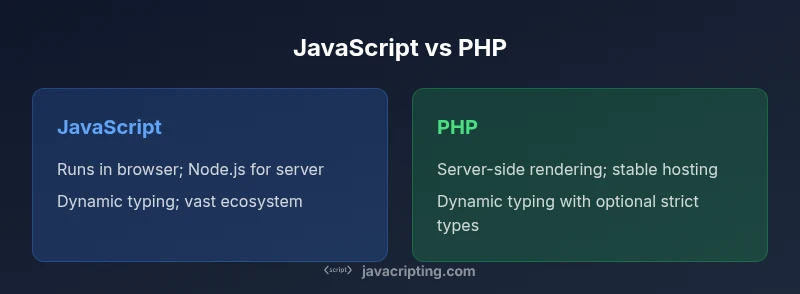
In the difference between javascript and php, JavaScript runs on the client (and now on the server with Node.js) to create interactive UIs, while PHP remains a server-side language that generates dynamic HTML. The core distinctions lie in execution environment, typing, and ecosystems, which shape the best use cases for each language.
What JavaScript vs PHP Look Like in Practice
JavaScript and PHP occupy distinct corners of the web development landscape, yet they share a common goal: delivering dynamic, responsive experiences to users. According to JavaScripting, JavaScript began as a client-side language for enhancing webpages, evolving to power server-side logic with environments like Node.js. PHP, by contrast, emerged as a server-side workhorse for generating HTML and handling back-end processes. Understanding the difference between javascript and php helps teams allocate responsibilities effectively, minimizing surprises in deployment, debugging, and performance tuning. For learners, this contrast highlights why many developers master both languages as part of a full-stack toolkit. JavaScripting’s analysis suggests that the two languages complement rather than compete when used in well-defined roles, with JavaScript shaping the user interface and PHP handling robust server-side rendering and data processing.
wordCount”:0},
Comparison
| Feature | JavaScript | PHP | |
|---|---|---|---|
| Execution environment | Runs primarily in the browser (client-side); can run on the server via Node.js | Runs on the server via a PHP interpreter (mod_php, PHP-FPM, etc.) | |
| Typing and semantics | Dynamic typing; evolving with optional type annotations via TypeScript in practice | Dynamic typing with optional strict types (type declarations introduced in PHP 7+) | |
| Concurrency and asynchrony | Event-driven, non-blocking I/O with the event loop; callbacks/promises/async-await | Per-request, multi-process model; traditionally synchronous | |
| Performance and scaling | Strong for interactive UIs; performance depends on client and V8/npm ecosystem | Efficient server-side rendering with opcode caches (Opcache) and accelerating frameworks | |
| Ecosystem and tooling | NPM, rich frontend frameworks, vast libraries, bundlers | Composer, PHP frameworks (Laravel, Symfony), broad hosting support | |
| Typical use cases | Rich client-side apps, APIs, microservices, SSR with Node.js | Server-rendered sites, CMS-driven apps, traditional backends, RESTful services | |
| Learning curve | Broad frontend ecosystem; JS quirks and browser inconsistencies | Mature server-side parity; PHP syntax and ecosystem patterns | |
| Deployment & hosting | Widely available on static hosts if only serving assets; needs Node or browser context for logic | Common on LAMP/LEMP stacks; strong hosting options for PHP apps | |
| Security considerations | Client-side exposure requires strict input validation and sanitization; XSS risks | Server-side concerns include SQL injection, CSRF, and proper input handling | |
| Best for | Dynamic user interfaces, real-time apps, cross-platform tooling | Robust server-side rendering, CMS-driven sites, stable backends |
Benefits
- JS offers a unified language for front-end and back-end development (with Node.js)
- Vast ecosystem and fast iteration cycles via npm/yarn and modern frameworks
- Strong tooling for UI/UX, testing, and debugging across the stack
- PHP provides mature server-side rendering, stable hosting, and robust CMS ecosystems
The Bad
- Client-side code can be exposed and manipulated in the browser, requiring careful security controls
- PHP can be slower for real-time, asynchronous workloads without appropriate architecture
- Different paradigms across languages can increase cognitive load for teams learning both
Choose JavaScript when you need interactive front-end experiences or cross-platform back-end capabilities; choose PHP for reliable server-side rendering and established CMS ecosystems.
JavaScript shines on the client and in modern serverside contexts like Node.js, enabling dynamic UI and scalable APIs. PHP remains a dependable choice for server-rendered pages and mature hosting environments. A pragmatic approach often uses both: JavaScript on the client, PHP on the server, with clear integration points.
Questions & Answers
What is the main difference between JavaScript and PHP?
The primary difference is where they run: JavaScript runs in the browser (and on the server with Node.js), while PHP runs on the server to generate HTML and handle back-end logic. Each serves different parts of the web stack.
JavaScript runs in the browser or on servers via Node.js, while PHP runs on the server to produce HTML.
Can PHP be used on the client side?
No, PHP is a server-side language. Client-side interactivity is handled by JavaScript or WebAssembly, while PHP processes requests on the server and returns HTML or data.
PHP runs on the server, not in the browser.
Is learning both languages necessary for full-stack development?
Not strictly necessary for every job, but knowing both can significantly expand your capabilities, allowing you to handle server logic with PHP and client interactivity with JavaScript.
Many developers learn both to bridge front-end and back-end work.
Which language is better for real-time applications?
JavaScript, especially with Node.js, is generally better for real-time or I/O-heavy workloads due to its non-blocking I/O model. PHP can support real-time needs with additional infrastructure.
Node.js handles real-time apps well; PHP can do so with the right setup.
How do these languages interact in a modern stack?
Often they interoperate via APIs: JavaScript on the client or server fetches data from PHP-based backends, or PHP renders pages that include JavaScript for interactivity.
They talk to each other through APIs or embedded scripts.
Are there security concerns unique to each language?
Both require careful input handling. JavaScript security focuses on protecting the client and API endpoints, while PHP emphasizes server-side validation and secure data handling to prevent SQLi and CSRF.
Security matters in both stacks; validate and sanitize on the server and client.
What to Remember
- Define project goals before language choice
- JavaScript dominates client-side interactivity and can power serverside apps with Node.js
- PHP excels at server-side rendering, CMS integrations, and traditional hosting
- Choose a hybrid approach for full-stack projects to leverage strengths of both
- Plan security and performance strategies early in your architecture