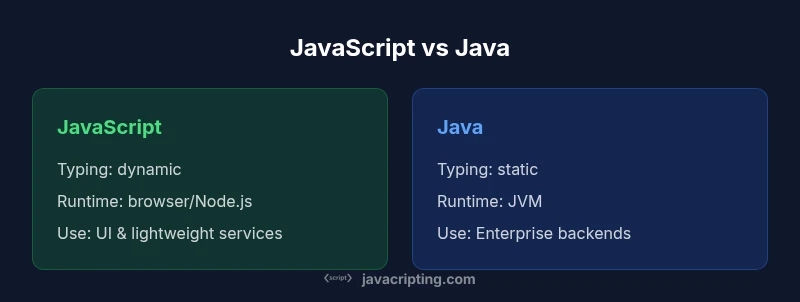
JavaScript vs Java: Core Differences for Developers
A comprehensive, data-driven side-by-side comparison of JavaScript and Java, covering typing, runtime, concurrency, tooling, domain use cases, and learning paths to help you choose the right language for your project in 2026.


JavaScript and Java differ in purpose, typing, and runtimes: JS excels at browser-based UI scripting and lightweight servers, while Java powers large-scale, high-performance backends on the JVM. This javascript and java difference shapes ecosystems, tooling, and career paths, guiding whether you should optimize for web interactivity or enterprise-grade reliability.
Core Intentions Behind JavaScript and Java
According to JavaScripting, understanding the javascript and java difference helps developers navigate modern web and enterprise stacks. JavaScript emerged as a lightweight, dynamic language designed to empower web pages with interactive features, while Java was engineered for stability, portability, and scalability across large systems. In 2026, teams weigh time-to-value against long-term maintainability when choosing between these two families, recognizing that they often coexist within the same product—each playing a distinct role in the software stack. The javascript and java difference becomes especially visible when you compare how teams structure front-end experiences versus back-end services and how rapid iteration contrasts with engineered reliability.
In practice, the two languages rarely replace one another; instead, they complement each other. The javascript and java difference is less about superiority and more about domain suitability, deployment realities, and developer skill sets. As a result, modern projects frequently adopt both languages, with clear boundaries and interoperability patterns that prevent overlap from becoming a liability.
- Design goals: JS for rapid UI while Java targets robust, scalable systems
- Typical runtimes: browsers/Node.js vs the JVM
- Ecosystems: web APIs and npm vs enterprise libraries and JVM tooling
confidenceLevelAlsoUsedForContentContinuity
Comparison
| Feature | JavaScript | Java |
|---|---|---|
| Typing | dynamic, weakly typed | static, strongly typed |
| Runtime | interpreted with JIT in browsers/Node.js | compiled to bytecode and run on the JVM |
| Concurrency Model | event-driven, single-threaded with async APIs (Web APIs) or worker threads | multi-threaded with explicit synchronization |
| Memory Model | garbage-collected with browser/engine-specific strategies | garbage-collected with mature JVM tuning options |
| Compilation | JIT-compiled at runtime via JavaScript engines | AOT and JIT compilation to bytecode executed by the JVM |
| Typical Use Cases | web UIs, lightweight servers, rapid prototyping | enterprise back-ends, Android apps, high-performance services |
| Tooling & Ecosystem | browsers, Node.js, npm, frontend frameworks | vast standard library, Spring/Eiber, and many JVM ecosystems |
| Learning Curve | generally easier to start; dynamic typing can hide errors | steeper but predictable; strong typing aids large codebases |
Benefits
- Fast iteration for UI development and prototyping
- Strong back-end performance potential with Java
- Broad tooling and community support for both languages
- JavaScript enables universal web access; Java powers cross-platform systems
The Bad
- Dynamic typing in JavaScript can lead to runtime errors
- Java's verbosity and compilation steps can slow iteration
- Browser fragmentation can complicate JS behavior across platforms
- Java requires more upfront architectural planning for large projects
JavaScript and Java serve different purposes; neither language is universally better, but each excels in its own domain.
Choose JavaScript for interactive web experiences and lightweight services; select Java for scalable, performance-critical back-end systems and Android development. The javascript and java difference is most pronounced in how you approach architecture, deployment, and team skills.
Questions & Answers
What is the fundamental difference between JavaScript and Java?
The core difference lies in purpose and execution: JavaScript is a dynamic scripting language primarily used for web UI and lightweight backends, while Java is a statically typed, compiled language designed for large-scale, portable enterprise applications on the JVM.
JavaScript is mainly for interactive web behavior and lightweight servers, whereas Java is for large, scalable back-end systems on the JVM.
Is JavaScript interpreted or compiled?
JavaScript is typically interpreted by runtime engines, but modern implementations include Just-In-Time (JIT) compilation to optimize performance. The javascript and java difference here is that JS emphasizes rapid execution in diverse environments.
Most JS engines use JIT compilation for speed, not traditional ahead-of-time compilation.
Can Java code run in a JavaScript environment?
Direct Java execution in a browser isn’t standard. You can run Java on the server or JVM-compatible runtimes, or use transpilation and WebAssembly or bridging technologies to interoperate with JavaScript environments.
You can’t run Java directly in a browser; you’d typically use server-side Java or bridging tools.
Which language should a new developer learn first for web work?
For frontend-focused work, start with JavaScript to build interactive UI. If backend or Android development interests you, learning Java later will open a broad set of enterprise and mobile opportunities.
If you’re aiming for web UI, begin with JavaScript; Java is great to add for backend or Android paths.
Does JavaScript support true multithreading like Java?
JavaScript is primarily single-threaded, with Web Workers for parallel tasks. Java provides true multi-threading with synchronized memory management.
JS is mostly single-threaded; use Web Workers for parallel work, while Java has built-in threads.
Which ecosystem is larger or more mature?
Both ecosystems are large; Java dominates enterprise back-end tooling and JVM-based projects, while JavaScript dominates web front-ends and modern full-stack tooling.
Java has a strong enterprise ecosystem; JavaScript leads in web development tooling.
What to Remember
- Focus on domain when choosing: UI/interactive work favors JS, back-end systems favor Java
- Expect different typing and runtime implications, influencing tooling and test strategies
- Leverage interoperability patterns to combine both languages effectively on modern stacks
- Consider team expertise and ecosystem maturity when planning long-term maintenance
- Use TypeScript or similar typings in JS projects to mitigate dynamic typing risks