JavaScript vs SQL: Key Differences and Uses for Developers
Explore differences between JavaScript and SQL, their distinct roles, and practical guidance on when to use each in modern apps with clear examples and best practices.


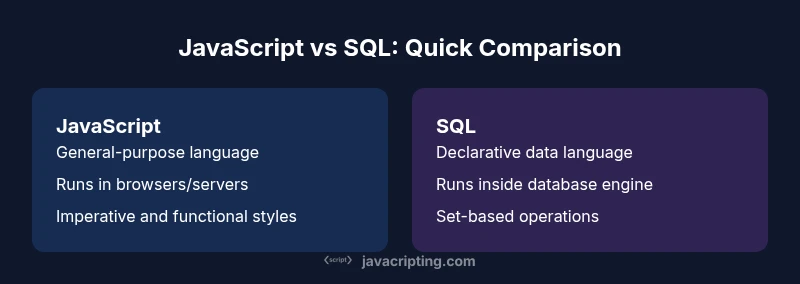
Is javascript the same as sql? Not at all. JavaScript is a general-purpose scripting language used to build interactive behavior in web and server environments. SQL is a domain-specific language designed for querying and mutating data stored in relational databases. They serve different purposes, and you’ll typically use both in a full-stack app, but in very different layers of the technology stack.
Core Distinctions: Language vs Query Language
is javascript the same as sql? The short answer is no, but the nuance matters. In practice, developers often encounter both in the same project, yet they occupy different layers of the stack. JavaScript is a general-purpose language that powers behavior, interfaces, and logic in browsers and on servers; SQL is a declarative language specialized for querying and mutating data stored in relational tables. According to JavaScripting, clarity about these roles helps prevent misapplied expectations when you design an application.
JavaScript code runs by interpreting or compiling into executable instructions that manipulate the DOM, handle events, make network requests, and orchestrate components. SQL, by contrast, expresses what data you want and how to transform it, leaving the exact data retrieval plan to the database engine. While both languages share a common goal—solving problems with code—their syntax, semantics, and execution environments are fundamentally different. This distinction matters for performance, security, and maintainability, especially as teams scale or adopt new architectures like microservices or serverless backends. The key is to map tasks to the language best suited for them, rather than trying to stretch one language beyond its design intent. In short, is javascript the same as sql? Not at all in practice, even though both tools help you build powerful software.
Comparison
| Feature | JavaScript | SQL |
|---|---|---|
| Nature of language | General-purpose programming language for client/server environments | Domain-specific language for querying and mutating relational databases |
| Primary use case | Building interactive web apps, scripting, UI behavior | Querying and updating relational data in databases |
| Execution environment | Runs in browsers or Node.js servers | Executed inside RDBMS or via database drivers |
| Data handling | Mutable, dynamic, supports complex logic | Declarative set-based operations over tables |
| Syntax style | C-like syntax, event-driven patterns | ANSI standard with SELECT/INSERT/UPDATE/DELETE and joins |
| Typing & semantics | Loosely typed, dynamic typing in JS | Typing depends on DB, SQL types per column |
| Performance considerations | Depends on engine and code structure | Depends on database engine, indexes, query plans |
| Learn curve | Relatively broad; many paradigms | Focused on data querying; syntax stable across dialects |
| Interoperability | Can be embedded; uses APIs to talk to databases | Directly interacts with relational data via queries |
| Best for | Interactive apps, front-end logic, serverside logic | Relational data analysis, reporting, data manipulation |
Benefits
- Clarifies domain separation between programming and data querying
- Encourages pairing of frontend/backend skills with data design
- Promotes correct use of each tool for its strengths
- Supports safer data access via parameterized queries and ORMs
The Bad
- Learning curve for developers new to relational data concepts
- Risk of underestimating the need for database design and indexing
- Potential tunnel vision if teams conflate architectural roles
JavaScript and SQL are distinct tools with complementary strengths
They are not interchangeable; treat JavaScript as the engine for behavior and UI, and SQL as the language that governs relational data. This separation guides better architecture, security, and performance in modern apps, especially when integrating frontend, backend, and database layers.
Questions & Answers
Can JavaScript replace SQL for data storage?
No. JavaScript cannot replace SQL for data storage. JavaScript handles behavior and logic, while SQL is designed to model, query, and mutate relational data in a database. In real apps, you use both in their respective layers.
No—JavaScript handles app behavior, not long-term data storage. SQL is the language databases understand for querying and updating data.
Can SQL be executed from JavaScript?
Yes, JavaScript can execute SQL through database drivers, APIs, or ORMs. The code builds parameterized queries that the database engine runs to fetch or modify data, often with an intermediate backend service.
You can run SQL from JavaScript via a backend layer and safe APIs.
What should I learn first, JavaScript or SQL?
Start with JavaScript basics (syntax, scope, asynchronous patterns) and simultaneously learn core SQL concepts (SELECT, WHERE, JOIN). The order depends on your goals, but a practical plan blends both early on to build full-stack fluency.
Learn the basics of both, but mix practice so you can connect data queries with app logic.
Are there databases that use JavaScript as the query language?
Most databases use SQL or SQL-like dialects for querying. There are JavaScript-based query builders and in-memory databases that mimic SQL, but the underlying data store typically still relies on SQL-like semantics or specialized APIs.
Databases don’t generally use JavaScript as their query language, though JS tools help build and run SQL queries.
How do ORMs relate to SQL when using JavaScript?
ORMs abstract SQL into higher-level methods in JavaScript. They translate object operations into parameterized SQL under the hood, which can simplify development but may obscure exact query plans and performance details.
ORMs let you write JS that becomes SQL behind the scenes.
Is GraphQL a replacement for SQL?
No. GraphQL is a flexible query language for APIs that can fetch related data from multiple sources, not a replacement for relational SQL. It complements SQL by shaping what data the client receives.
GraphQL isn’t SQL; it’s another way to fetch data from APIs.
What to Remember
- Know JavaScript handles behavior, SQL handles data queries
- Use each tool in its native layer to maximize performance
- Guard against SQL injection with parameterized queries and safe APIs
- Plan architectures that clearly separate UI, API, and data layers
- Leverage both languages to build robust, scalable apps