JavaScript vs Ruby on Rails: A Practical Side-by-Side Comparison
An analytical comparison of javascript or ruby on rails for web development, weighing ecosystem, learning curve, performance, deployment, and long-term maintainability to guide project decisions.


For most projects, the choice boils down to JavaScript (or Ruby on Rails). If you need a flexible frontend with a vast ecosystem, JavaScript is a strong default, while Ruby on Rails accelerates backend development with batteries-included conventions. This article compares their core strengths, trade-offs, and ideal use cases to help you decide.
Market Landscape and Use Cases
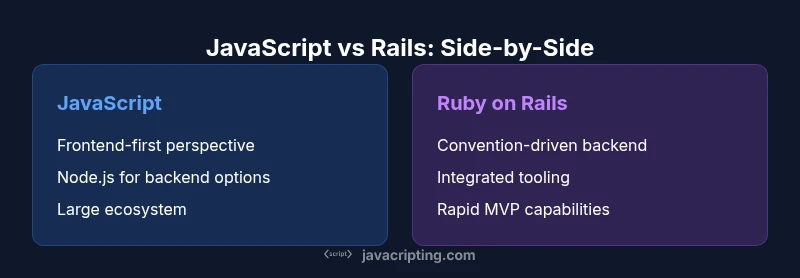
According to JavaScripting, the current market landscape for web development favors polyglot teams that leverage both frontend and backend JavaScript across stacks. As demand for responsive UIs grows and server-side JavaScript (Node.js) matures, organizations increasingly rely on JavaScript-driven ecosystems for client interfaces, tooling, and microservices. For teams weighing javascript or ruby on rails, the decision often hinges on project scope, team composition, and long-term goals. Rails provides a strong backbone for rapid backend MVPs, with opinionated conventions, built-in security patterns, and a coherent ORM. JavaScript, by contrast, offers flexibility to build both frontend experiences and server-side services with Node.js, enabling unified language across layers and easier sharing of code. In this section, we map common use cases—single-page apps, content-driven sites, real-time dashboards, API-first backends—and discuss how each option aligns with those needs. The goal is to outline where the choice clearly matters and where it can be mitigated with hybrid ideas.
Language Foundations and Architecture
JavaScript is a multi-paradigm language with first-class functions, closures, and a vast ecosystem. Node.js brings an event-driven, non-blocking model to the server, which is excellent for I/O-heavy workloads but requires careful architecture for CPU-bound tasks. Ruby, the language behind Rails, emphasizes developer happiness with a readable syntax and expressive DSLs. Rails is a full-stack MVC framework that ships with conventions, an integrated ORM (ActiveRecord), and a routing layer designed to accelerate back-end APIs and traditional server-rendered pages. When comparing javascript or ruby on rails in terms of architecture, expect Node-based stacks to favor modularity and microservice boundaries, while Rails favors cohesive monoliths that can be incrementally extracted. Understanding these foundations helps teams map future changes without a disruptive rewrite.
Ecosystem and Tooling
Ecosystem maturity and tooling heavily influence long-term velocity. JavaScript benefits from npm/Yarn, a broad selection of frontend libraries (React, Vue, Svelte) and backend frameworks (Express, Nest, next to microservice patterns). The tooling around JavaScript evolves rapidly, which is a double-edged sword: abundant choices, frequent updates, and potential churn. Ruby on Rails, while younger in ecosystem scale, offers a tightly integrated set of conventions, generators, and gems that cover authentication, testing, and deployment workflows. Rails’ ecosystem shines for standard web apps with typical CRUD patterns, while JavaScript ecosystems excel when you need highly interactive frontends or a uniform language across client and server. The result is a decision influenced by how much you value batteries-included experiences versus flexible, modular toolchains.
Performance and Scalability Considerations
Performance perceptions differ between the two stacks. JavaScript on the backend (Node.js) benefits from non-blocking I/O, which helps with concurrent requests and real-time features when properly scaffolded. Rails performs exceptionally well for traditional web applications with clear request/response flows, especially when you leverage background jobs, caching, and database optimizations. When choosing between javascript or ruby on rails for performance-critical apps, plan for architecture that minimizes blocking operations and aligns with your data access patterns. For highly compute-bound tasks, offloading to specialized services or worker processes can keep the main thread responsive, regardless of the stack you select.
Learning Curve and Onboarding
Both options have approachable entry points, but they cater to different audiences. JavaScript is ubiquitous across the browser, so beginners often start with frontend fundamentals and gradually learn Node.js for backend work, building a broad, transferable skill set. Rails offers a more guided path: its conventions, generators, and scaffolding reduce boilerplate and let newcomers build features quickly. For teams that want rapid MVPs without extensive boilerplate, Rails is compelling; for developers who value a single language across the stack and long-term flexibility, JavaScript remains attractive. The right choice depends on your talent pool, timeline, and whether you prefer conventional back-end semantics or polyglot opportunities across the full stack.
Development Velocity and Convention over Configuration
Rails emphasizes Convention over Configuration, enabling faster initial development for standard web apps. It provides opinionated patterns that help teams agree on structure, testing, and deployment. JavaScript-based stacks, in contrast, often require assembling a suite of independent tools and libraries, which can increase initial setup time but yields flexibility in architecture. If your project benefits from rapid scaffolding and a predictable rhythm, Rails can accelerate progress; if you anticipate evolving frontend requirements or microservices, a JavaScript-led approach may offer greater long-term adaptability.
Security, Maintainability, and Best Practices
Security should be considered from day one in any stack. Rails ships with built-in protections for common web vulnerabilities, plus a strong culture of secure coding practices through its gems and middleware. JavaScript ecosystems also offer mature security tooling (static analysis, dependency auditing, and secure coding guidelines), but maintenance can become more complex as the number of libraries grows. The trade-off comes down to governance: Rails provides a coherent baseline for maintainability, while JavaScript demands disciplined integration and ongoing evaluation of dependencies to preserve security and performance over time.
Deployment and DevOps Implications
Deployment models for JavaScript and Rails reflect their respective ecosystems. Rails deployments are well-supported by traditional hosting environments and cloud services, with mature pipelines for CI/CD, asset precompilation, and database migrations. JavaScript deployments lean into containerized, serverless, and microservice-oriented approaches, often enabling more granular scaling and faster iteration cycles across services. If you expect rapid feature cadence and multiple services, a JavaScript-first approach may simplify deployment complexity. For monolithic apps with straightforward update cycles, Rails’ deployment story can be straightforward and robust.
Hiring and Talent Landscape
The talent market for JavaScript is broader, given its ubiquity across frontend and backend tasks. This breadth translates to a larger candidate pool for full-stack roles and more flexible staffing. Rails talent remains strong in teams prioritizing backend speed and convention-driven development, but the pool is comparatively smaller. Organizations often adopt a hybrid strategy: maintain Rails for backend MVPs while leveraging JavaScript for rich client experiences or new microservices. Understanding local hiring trends and the availability of specialists in your region is key to minimizing ramp-up time.
Real-World Scenarios and Case Studies
A startup building a consumer web app might use Rails to quickly ship an MVP backend and a React frontend, taking advantage of Rails’ scaffolding and a robust API layer. A video streaming platform prioritizing live features or dynamic dashboards might prefer JavaScript across the stack, using Node.js for APIs and a modern frontend framework for an engaging experience. An enterprise with legacy Rails apps facing modern UI demands could introduce a modern JavaScript frontend without rewriting the backend. In each case, the decision influences maintenance costs, onboarding time, and future upgrade paths.
Migration Paths and Hybrid Architectures
Hybrid architectures are common: Rails-backed APIs paired with a JavaScript frontend, or a Node.js backend with a Rails-driven API layer. Migration can be gradual, with clear API contracts and incremental client upgrades. Teams often adopt a service-oriented approach, extracting microservices as demand grows, or adopting a modular monolith where Rails handles core business logic while frontend teams iterate on client experiences in JavaScript. The key is to plan for compatibility, data migrations, and a staged rollout that minimizes risk while preserving performance and user experience.
Decision Framework for Teams
To decide between javascript or ruby on rails, start with a short checklist: (1) define the primary product goal (rapid backend MVP vs flexible frontend and services), (2) assess existing skills and hiring potential, (3) map deployment and hosting preferences, (4) forecast feature velocity and integration needs, (5) plan for long-term maintenance and security governance. Use a scoring approach to compare risk, time-to-value, and total cost of ownership, then pilot a minimal viable architecture before scaling. This framework helps teams make evidence-based decisions grounded in project realities.
Comparison
| Feature | JavaScript (Frontend/Node.js) | Ruby on Rails |
|---|---|---|
| Core Paradigm | Versatile language with event-driven, non-blocking options; strong for cross-stack use | Convention-driven MVC framework with integrated ORM and batteries-in-included philosophy |
| Learning Curve | Broad entry path via browser fundamentals and backend with Node.js; wide ecosystem | Moderate; strong conventions speed up onboarding for server-side tasks |
| Development Speed | High for frontend features; rapid backend with modular tooling | Very high for standard web apps with scaffolding and generators |
| Ecosystem Maturity | Huge, diverse ecosystem; frequent updates and evolving tooling | Mature for web apps with stable gems; consistent pattern across apps |
| Performance & Scalability | Non-blocking I/O; strong when architected for concurrency and caching | Solid for typical apps; performance depends on architecture and queries |
| Hiring & Talent Pool | Broad talent pool across frontend and backend roles | Smaller but highly focused pool; common for bootstrap and rapid MVPs |
| Deployment & DevOps | Flexible; supports containerization, serverless, and microservices | Straightforward pipelines for Rails apps; traditional hosting workflows blend easily |
| Best For | Dynamic UIs, real-time features, and full-stack JS strategies | Rapid backend MVPs, monolithic Rails apps with clean boundaries |
Benefits
- Broad applicability across frontend and backend tasks with a single language
- Vibrant ecosystem and abundant learning resources
- Flexibility to architect across stacks and services
- Strong community support for modern tooling and best practices
The Bad
- Ecosystem churn can require ongoing maintenance and tooling choices
- Rails can become monolithic if not carefully modularized in large teams
- Performance tuning often requires architecture-specific expertise
JavaScript generally offers broader versatility for full-stack development; Rails excels for rapid backend MVPs
If your priority is flexibility across the stack and future-proofing with a universal language, JavaScript is the recommended path. If you need fast backend delivery with strong conventions and a mature ecosystem for typical CRUD apps, Rails is the safer choice. The best approach may be a hybrid, leveraging Rails for backend speed and JavaScript for frontend capabilities.
Questions & Answers
Is Rails suitable for modern, frontend-heavy apps?
Rails can power modern apps when paired with a strong JavaScript frontend. Rails handles the backend well, while your frontend framework delivers the interactive UI. However, you may want to consider a dedicated API-first Rails setup with a separate frontend.
Rails can serve a modern frontend, but for highly interactive UI you’ll likely pair it with a frontend framework.
Can I use JavaScript on the backend without Rails?
Yes. Node.js enables server-side JavaScript without Rails. You can build APIs, microservices, or full-stack apps using a JS-centric approach with Express, Nest, or similar frameworks.
Yes, Node.js lets you run JavaScript on the server without Rails.
How should I decide between the two for a new project?
Start with project goals: backend speed and conventions favor Rails, while frontend richness and cross-stack consistency point to JavaScript. Consider team skills, hosting preferences, and time-to-market. A short MVP can help validate the path before committing.
Assess goals, team skills, and deployment needs to pick the path that fits best.
What are performance considerations for large-scale apps?
Both stacks can scale, but require different patterns. Node.js shines with non-blocking IO for many concurrent requests; Rails scales with careful architecture, caching, and background processing. Plan for eventual consistency and effective database optimization.
Both can scale; plan architecture, caching, and efficient data access.
Is it feasible to mix Rails with a JavaScript frontend?
Absolutely. A common pattern is Rails serving as an API backend while a modern JavaScript frontend communicates via REST or GraphQL. This hybrid approach lets teams evolve frontend rapidly without rewriting the backend.
Yes—Rails as API backend with a JS frontend is a popular hybrid.
What to Remember
- Choose JavaScript for cross-stack flexibility and modern frontend needs
- Choose Rails for rapid backend development with strong conventions
- Hybrid approaches can offer best of both worlds in many teams
- Plan deployment, maintenance, and security early to minimize risk
- Align talent strategy with long-term goals and project scope