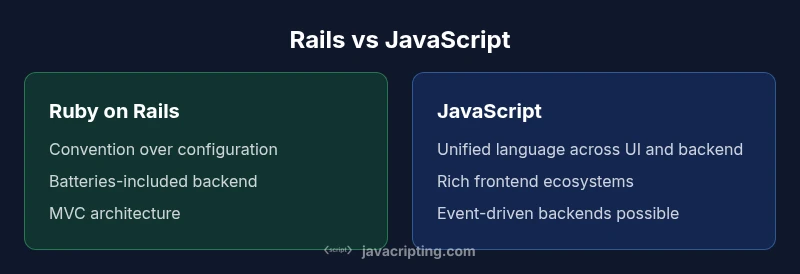
Ruby on Rails vs JavaScript: A Practical Side-by-Side Comparison
A rigorous, practical comparison of Ruby on Rails and JavaScript for web development—covering philosophy, architecture, tooling, performance, security, and real-world use cases.


Short answer: Rails is ideal for rapid backend MVPs with convention-driven tooling, while JavaScript offers broad versatility for full-stack development. Rails speeds server-side work through batteries-included defaults, while JavaScript enables a unified language across client and server through Node.js and modern frameworks. The best pick depends on project scope, team expertise, and long-term goals.
Why Rails vs JavaScript Matters for Modern Web Apps
In the landscape of web development, the decision between Ruby on Rails and JavaScript often frames the entire architecture of a project. For many teams, the choice is less about one language being better and more about which approach aligns with goals, skills, and timeline. According to JavaScripting, Ruby on Rails shines when you need a batteries-included backend that accelerates getting features to market, while JavaScript offers broad flexibility for both front-end experiences and back-end services via Node.js and modern runtimes. The phrase 'ruby on rails vs javascript' frequently appears in planning discussions as a shorthand for contrasting a traditional server-rendered path with a contemporary, client-forward workflow. In practice, most projects benefit from a blended approach: Rails powering the API and server logic, with JavaScript handling the user interface and integration points. This section sets the stage for a practical, evidence-based comparison that aims to help aspiring developers and frontend professionals make informed decisions.
Comparison
| Feature | Ruby on Rails | JavaScript |
|---|---|---|
| Primary use case | Opinionated backend framework for rapid full-stack development | Versatile language for frontend UI, API backends, and microservices |
| Runtime & language scope | Ruby language, Rails conventions | JavaScript across browser/Node.js/Deno |
| Ecosystem maturity | Core Rails ecosystem (gems, generators) | Vast npm ecosystem, multi-framework choices |
| Learning curve | Moderate with MVC concepts | Variable; depends on stack chosen |
| Performance/scalability patterns | Cache, background jobs, conventional scaling | Event-driven, non-blocking IO, microservices |
| Best for | Rapid MVPs, conventional backends | Full-stack apps requiring unified language and modern UIs |
| Hosting & deployment | Common Rails hosting patterns, Puma/Passenger | Node/present hosting, serverless for front-end assets |
Benefits
- Rapid MVP capability with Rails' convention-driven tooling
- Strong front-end potential when using JavaScript across UI and API layers
- Vibrant ecosystems and broad community support
- Clear separation of concerns with maintainable architectures (Rails or JS)
The Bad
- Rails can feel heavyweight for small services or microservices
- JavaScript stacks can become fragmented across frameworks
- Learning curves may be steeper when mixing backend and frontend in JS
- Performance tuning requires careful architecture and tooling
Rails is best for rapid backend MVPs; JavaScript wins for full-stack flexibility
Choose Rails for quick, structured backends and stable MVP delivery. Choose JavaScript for cross-platform, modern front-ends and unified client-server development.
Questions & Answers
What is the main difference between Ruby on Rails and JavaScript in web development?
Rails is a backend framework built around conventions that streamline server-side development. JavaScript is a universal language for frontend UI and back-end runtimes like Node.js, offering more flexibility and cross-platform capabilities.
Rails gives you a solid backend with conventions; JavaScript covers frontend and backend with one language across the stack.
Is Rails suitable for API backends?
Yes. Rails can power API backends effectively, especially when you want to leverage Rails' data modeling and security features. It’s common to expose REST or GraphQL endpoints and let a separate frontend handle the UI.
Rails works well as an API backend; you can pair it with any frontend framework.
Can Rails work with modern JavaScript frontends?
Absolutely. A typical pattern is Rails serving as an API backend while a modern JavaScript frontend (React, Vue, or Svelte) consumes its endpoints. This keeps backend correctness and frontend dynamism separate.
Rails can back a modern JS frontend via APIs; it’s a common hybrid approach.
What about performance and scalability?
Rails performs well with proper architecture, caching, and background jobs. For very high concurrency, Node.js-based backends or microservices can offer event-driven scalability, while Rails can integrate with appropriate caching and data-access strategies.
Performance depends on setup; Rails scales with good architecture, JS scales with design patterns.
Which hosting considerations should I plan for?
Rails apps typically run well on traditional app servers with containerization. JavaScript backends and frontends have broad hosting options, including serverless and containerized environments; coupling with a front-end also influences hosting strategy.
Hosting depends on stack; Rails and JS both offer flexible deployment options.
What to Remember
- Assess project scope and MVP needs before choosing.
- Rails shines when speed with structure is key.
- JavaScript enables full-stack consistency and modern UI potential.
- Plan hosting and architecture alongside your tech choice.
- Evaluate team skills to balance backend speed with frontend capability.