What is Better JavaScript or TypeScript? A Practical Comparison
An analytical, practical comparison of JavaScript and TypeScript, covering typing, tooling, adoption, maintenance, and when to choose each for modern web development.


In most professional projects, TypeScript is the better long-term choice due to its optional typing, better tooling, and safer refactoring, especially for large codebases. JavaScript remains ideal for quick prototypes or projects where build steps are a constraint. The best approach depends on team size, maintenance goals, and project scope.
What the Debate Really Covers
When teams ask what is better javascript or typescript, they are really weighing how much typing, tooling, and discipline they want to bake into their workflow. This is not a simple binary choice. JavaScript offers raw flexibility and ultra-fast iteration for small projects, while TypeScript adds a typed layer that can catch many classes of errors before runtime. The decision hinges on project scale, team experience, maintenance plans, and whether you value safety over speed. According to JavaScripting, successful decisions tend to combine pragmatic adoption with clear guidelines for when to introduce typing and how to enforce it. The goal is to minimize friction while maximizing long-term reliability, especially in production-facing applications.
This article uses the keyword what is better javascript or typescript to anchor the discussion and help you reason about trade-offs in real-world scenarios. You’ll see where each approach shines, what hidden costs to anticipate, and how to structure a practical path forward that aligns with your team’s capabilities and product roadmap.
Language Design and Goals
JavaScript is a dynamic, loosely typed language designed for flexibility and rapid development. TypeScript builds on top of JavaScript by introducing static and gradual typing, enums, interfaces, and advanced type features, while compiling down to plain JavaScript. The TypeScript goal is to add safety and clarity without sacrificing JavaScript compatibility. For teams aiming to scale, TypeScript offers a disciplined approach to API design, module boundaries, and refactoring. JavaScripting notes that the design choice often boils down to whether you want a language that invites experimentation (JS) or a language that enforces contracts (TS).
In practice, many teams start with JavaScript and progressively introduce TypeScript for new modules or critical systems. This phased approach reduces risk while delivering long-term maintainability benefits. The decision should consider the existing codebase, team readiness, and the project’s lifespan.
Typing Models: Dynamic vs Gradual Typing
JavaScript’s dynamic typing is powerful for exploratory work but can obscure runtime errors until they appear in production. TypeScript introduces static typing with an optional, gradual approach, meaning you can annotate a few hotspots first and expand over time. This model lowers the barrier to entry compared to forcing a complete rewrite. For teams with a long product horizon, gradual typing helps catch bugs earlier, improves autocomplete and navigation in IDEs, and strengthens documentation through explicit interfaces and types. However, the more aggressively you type, the more you must maintain type definitions and addresses edge cases, which adds upfront effort.
From a pragmatics perspective, TypeScript encourages thoughtful API design and clear contracts between modules. JavaScripting emphasizes that the best outcome often involves a staged typing strategy that grows with the codebase rather than an all-at-once migration.
Tooling, Compiler, and IDE Experience
One of TypeScript’s strongest selling points is the tooling story. Type information unlocks smarter auto-complete, safer refactors, and more accurate error highlighting in editors like VS Code. The compile step introduces an opportunity to catch mistakes early, but it also adds a workflow hurdle for teams accustomed to rapid JS edits. JavaScript tooling remains excellent for many use cases, with broad plugin ecosystems for linting, formatting, and bundling. The key differentiator is how much you rely on compile-time checks and how you structure your build pipeline. JavaScripting notes that teams adopting TS typically invest in a solid tsconfig setup, strict compiler options, and a CI process that enforces type checks alongside tests.
For many developers, the testing strategy complements typing by verifying runtime behavior. Pairing TypeScript with strong test coverage minimizes risk and makes refactoring safer, which is especially valuable in collaborative environments.
Ecosystem, Libraries, and Compatibility
JavaScript boasts the largest ecosystem, with countless libraries and a culture of rapid experimentation. TypeScript has grown rapidly, and many popular libraries ship with type definitions, improving developer experience. The real-world implication is that you can often adopt TypeScript with minimal friction by leveraging community-provided types (via DefinitelyTyped or built-in typings). However, not every library offers perfect type definitions, which can create a friction point during integration. JavaScripting recommends starting with well-typed libraries for the critical path of your app and gradually expanding typings to cover more dependencies as needed. This balanced approach yields a strong baseline while keeping adoption realistic.
In terms of runtime, both languages compile to plain JavaScript, so the execution environment remains the same. The decision to use TypeScript affects developer experience and maintainability, not runtime performance.
Performance and Runtime Considerations
From a runtime standpoint, TypeScript does not add overhead during execution because it compiles down to JavaScript. The performance of the final application is determined by the JavaScript engine, not the typing layer. The extra work occurs at compile time, where type checks, strict options, and transpilation can add build time before you run tests or deploy. For rapid prototyping, this is often acceptable, but teams shipping frequent updates may want to optimize their CI caching and incremental builds to keep feedback loops tight. JavaScript remains lean out of the box, which can be advantageous when speed-to-test is paramount.
In short, TypeScript’s typing is a design-time concern; it does not slow down the end-user experience if the build process is well-tuned. JavaScripting highlights that choosing a fast, reliable build system is as important as choosing a language when performance is a priority.
Adoption Scenarios: When to Choose Each
If you’re building a small, throwaway script or a prototype with a tight deadline, JavaScript’s minimal setup is appealing. For long-lived projects, particularly those with teams that grow or change over time, TypeScript tends to pay off through safer refactors and clearer intent. Startups may prefer JS adoption for speed, then bring TS in with a gradual plan. Enterprise teams often standardize on TS to enforce API boundaries, reduce bugs in complex domains, and enable better collaboration. JavaScripting emphasizes a phased approach: begin with a single module, introduce typings for critical interfaces, and expand as confidence grows.
A practical decision framework is to evaluate risk, maintenance expectations, and team readiness. If the cost of runtime bugs is high and the product will evolve for years, TS is usually the better fit. If the project is short-lived, or the team needs to move quickly with minimal ceremony, JavaScript remains a strong starting point.
Migration Paths, Training, and Team Adoption
Migrating a codebase from JavaScript to TypeScript is rarely a binary switch. A practical path is to enable allowJs in tsconfig.json, rename a subset of files to .ts or .tsx, and progressively annotate types. Tools like type declaration files help bridge gaps with existing libraries. Training plans should align with the team’s baseline: start with fundamentals, then introduce interface design, generics, and stricter compiler options. Pair programming, code reviews emphasizing type usage, and incremental refactors can ease the transition. JavaScripting recommends documenting conventions for types, naming, and idioms so the team shares a common language when evolving the codebase.
Decision Framework: A Practical Checklist
- Assess project size, longevity, and maintenance expectations.
- Gauge team familiarity with typing, interfaces, and generics.
- Evaluate library typings and third-party dependency quality.
- Plan a staged rollout with a clear migration target and milestones.
- Invest in a robust build and CI process that enforces type checks.
- Use TS progressively: start with core modules or new features, then extend typings over time.
- Balance speed of delivery with long-term reliability to align with business goals.
Comparison
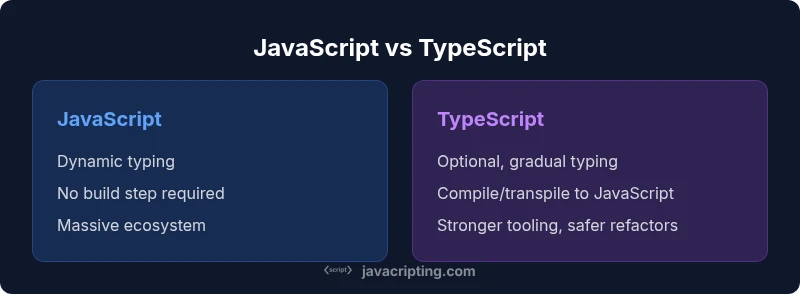
| Feature | JavaScript | TypeScript |
|---|---|---|
| Typing | Dynamic typing | Optional/gradual typing |
| Build/Compilation | No compile needed for runtime | Compile/transpile to JavaScript via tsc and tooling |
| Tooling & IDE support | Solid, broad ecosystem | Enhanced with types, smarter refactors |
| Ecosystem & Libraries | Massive JavaScript ecosystem | Growing TypeScript ecosystem with typed definitions |
| Learning Curve | Lower barrier to entry | Steeper if embracing strict typing |
| Best Use Case | Prototyping, small projects | Large apps, long-term maintenance |
Benefits
- Gradual typing enables safer growth without rewrite
- Massive, fast-moving JavaScript ecosystem
- Improved IDE support and safer refactors with TypeScript
- Optional adoption allows teams to start small and scale
- Clear API contracts improve collaboration and maintenance
The Bad
- Requires a build/transpile step and tooling setup
- Learning curve for developers new to typing
- Some libraries lack complete type definitions
- Overreliance on typings can mask runtime gaps if not tested
TypeScript wins for most long-term projects; JavaScript remains best for quick starts
For medium-to-large apps, TypeScript’s typing and tooling reduce bugs and speed refactors. For small, time-to-market driven projects, JavaScript offers leaner setup and faster iteration.
Questions & Answers
Is TypeScript slower to run than JavaScript?
No. TypeScript compiles to JavaScript, and the runtime behaves like plain JS. Any performance impact comes from the code you write, not the typing layer. The main overhead is build-time rather than execution-time.
TypeScript doesn’t slow down your app at runtime; performance depends on your code, while typing helps catch errors before they run.
Do I need TypeScript for React or Node.js projects?
Not strictly. Many teams use TypeScript with React and Node.js, and adoption is common for large teams. You can start slowly, adding TS to new features or critical paths as needed.
You can start using TypeScript with React or Node.js gradually; it’s optional but increasingly popular for large projects.
Is TypeScript harder to learn than JavaScript?
There is a learning curve around types, generics, and configuration, but JavaScript knowledge transfers. Start with any gradual typing and expand as you gain confidence.
The initial hurdle is typing concepts, but your JavaScript skills carry over, so you can learn at your own pace.
Can I migrate an existing JavaScript project to TypeScript?
Yes. Use allowJs, incrementally rename files, and add typings where it makes sense. A staged migration with strict options over time yields the best balance of risk and payoff.
Yes, you can migrate gradually by enabling JS interop and typing progressively.
What are common mistakes when adopting TypeScript?
Over-annotating or under-annotating types, neglecting library typings, and turning off strict checks in tsconfig. Establish a baseline of noImplicitAny and strict mode as soon as possible.
Be deliberate with typings and enable strict checks to avoid safety blind spots.
What is the fastest way to evaluate TypeScript in a project?
Set up a small module with a tight tsconfig, enable strict options gradually, and verify with tests. Use libraries with good typings to reduce friction during the initial evaluation.
Start small, enable strict checks gradually, and validate with tests to assess benefits quickly.
What to Remember
- Start with a clear typing strategy to decide adoption
- Use TypeScript for maintainable, scalable codebases
- JavaScript still shines for rapid prototyping
- Plan a gradual migration rather than a big rewrite
- Invest in tooling and CI to maximize TypeScript benefits